
 By admin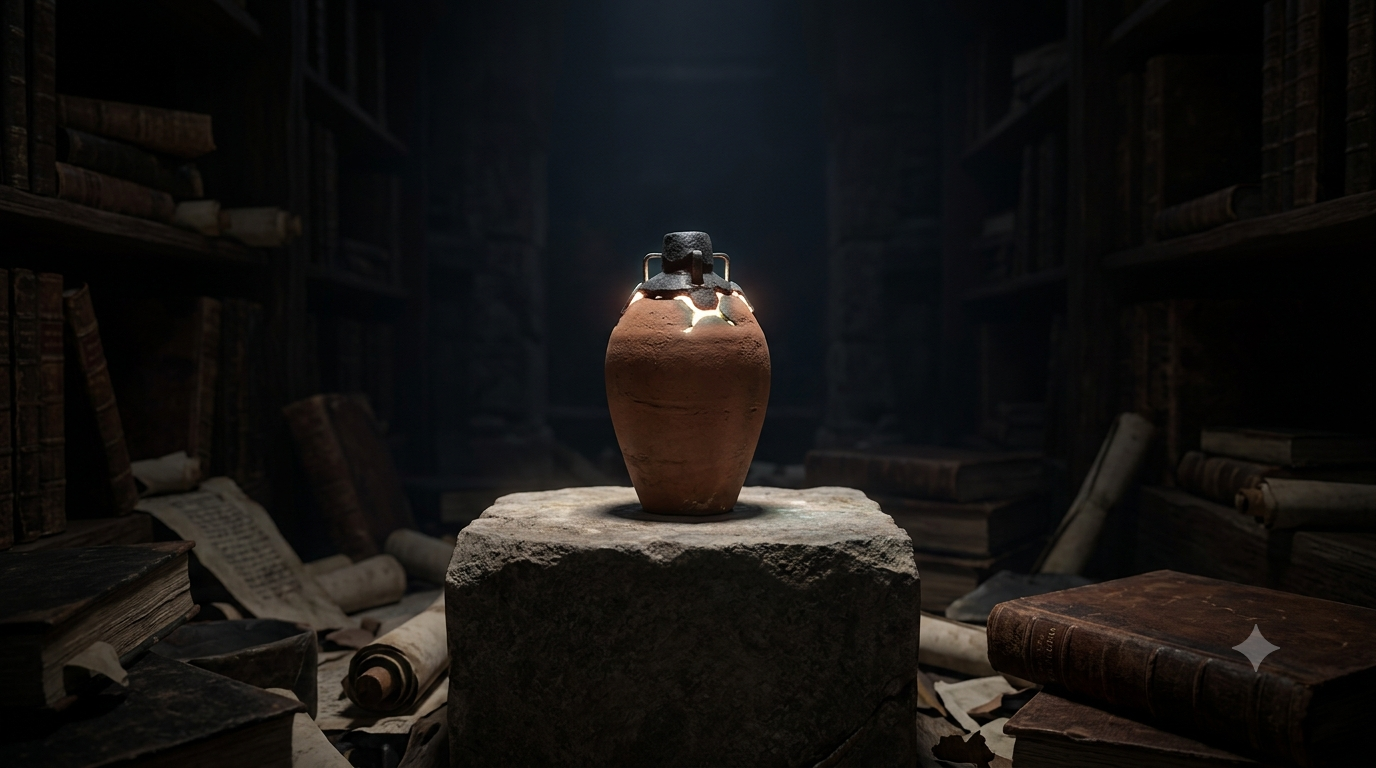
Introduct
Imagine discovering the Baghdad Battery while exploring an ancient ruin near Baghdad.
Not a sword. Not a coin. A battery.
Sounds impossible, right? Because electricity is supposed to be new. We thank Benjamin Franklin, Alessandro Volta, and Thomas Edison for it.
But what if people 2,000 years ago already knew how to make electricity?
That’s the question behind the ancient artifact.
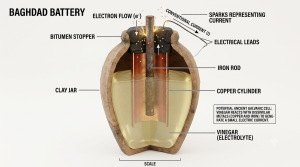
In the 1930s, archaeologists digging near Baghdad, Iraq found a strange clay jar. Inside the clay jar was a copper cylinder and an iron rod.
When scientists tested the ancient jar with vinegar, it produced electricity.
Suddenly the discovery became one of history’s biggest mysteries.
Was this ancient discover proof that ancient people understood electricity?
Or it just an ordinary jar we misunderstood?
90 years later, no one agrees. And that’s what makes this ancient artifact so fascinating.
Let’s uncover the truth behind the ancient artifact.
The Discovery of the Baghdad Battery
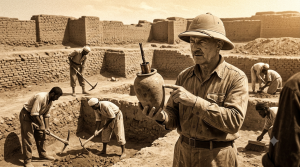
The story of the Baghdad Battery starts in 1936. Not in a lab, but in the dirt.
Austrian archaeologist Wilhelm König was excavating near Khujut Rabu, outside Baghdad. This area was once part of the Parthian Empire, from 247 BCE to 224 CE.
Among old pots and tools, König found the mysterious jar.
The artifact was small. Only 14 cm tall. A plain clay jar.
But inside the jar was something unusual: a copper cylinder with an iron rod in the center. The top was sealed with bitumen.
König looked at the artifact and wondered: why build it like this?
It didn’t look like a normal storage jar. The design of the looked intentional.
For years the artifact just sat in a museum.
Then researchers had an idea. What if you filled the jar with an acidic liquid?
They tried vinegar inside it. Grape juice. Lemon juice.
The experiment produced a small electric current. About 0.5 to 1 volt.
That’s when people started calling it the Baghdad Battery.
Because it looked just like a simple galvanic cell.
If the device ,was really designed for this purpose, it meant people 2,000 years ago invented electricity before Volta.
The discovery made international news.
Some historians got excited about the discovery. Others stayed skeptical.
Because we have no manual for the artifact. No instructions.
That missing evidence is why the mysterious jar is still debated today.
2. Could the Baghdad Battery Really Produce Electricity?
This is where the mystery gets really interesting.
On the surface, the artifact is just clay, copper, and iron.
But science says those 3 parts can make electricity.
When you put two metals in acid, electrons move. That’s how a battery works.
And this ancient device has exactly that setup.
Researchers built replicas of the Baghdad Battery using the same materials.
They filled the replicas with vinegar.
The result? Every replica test produced electricity.
The replica produced about 1 volt. Not enough for a light bulb.
But enough to prove the device could generate power.
This made people rethink the artifact.
If it was really worked, then ancient people discovered electricity 1800 years early.
Some experts think people connected several Baghdad Battery jars together for more power.
But that raises another question about the artifact: why?
There were no computers. No lights.
So what was it used for?
The most popular idea is electroplating.
Maybe it was used to coat jewelry with gold or silver.
A weak current from the device is enough for that.
But we have no proof that it was used for electroplating.
So while we know the Baghdad Battery can make electricity, we don’t know if ancient people used it that way.
3. What Was the Baghdad Battery Actually Used For?
This is the biggest fight about the Baghdad Battery.
Just because the artifact can make electricity doesn’t mean it was a battery.
We have zero instructions for the artifact.
So experts made 4 main theories about the mysterious jar:
Theory 1: The Baghdad Battery Was an Actual Battery
This is the famous one. The device with vinegar to make power.
If true, it is the oldest battery ever.
But no wires were found with the device.
Theory 2: The Baghdad Battery Was For Electroplating
Maybe craftsmen used the ancient device to make cheap jewelry look expensive.
The ancient device could provide enough current for that.
But again, no evidence connects the Baghdad Battery to real electroplated objects.
Theory 3: The Baghdad Battery Was Religious
Some say the artifact had nothing to do with science.
It might have been used in rituals.
Ancient people often gave symbolic meaning to objects like the Baghdad Battery.
Theory 4: The Baghdad Battery Was a Storage Jar
The simplest idea. It was just a container.
Maybe the Baghdad Battery held scrolls or sacred items.
Many archaeologists think this is the real purpose of the Baghdad Battery.
So what was the Baghdad Battery really?
Nobody knows. Every theory about the Baghdad Battery has problems.
That’s why the ancient artifact still divides experts.
4. Why Do Many Historians Reject the Baghdad Battery Theory?
The idea of the artifact is exciting. Maybe too exciting.
Because archaeology needs proof. And the evidence doesn’t have much to support it.
Problem 1: No wires.
If the device made electricity, where are the devices?
We’ve never found anything that used power from the artifact.
Problem 2: No writing.
Ancient people wrote about everything. But no one wrote about the mysterious jar.
Not one text mentions the artifact or electricity.
Problem 3: No proof of electroplating.
Objects from the time of the Baghdad Battery look handmade.
No signs it was used for metalwork.
Some researchers think we named it wrong.
Calling it the Baghdad Battery makes us assume it’s a battery.
But it might just be a storage container.
That’s why the debate about the Baghdad Battery continues.
Half think the it proves ancient tech.
Half think the object is a misunderstanding.
Until we find more evidence, the mystery keeps its secret.
5. Lessons From the Baghdad Battery
Whether the artifact was real or not, it taught us a lot.
Lesson 1: History is full of surprises.
One small clay jar caused 90 years of debate.
The Baghdad Battery proves we still don’t know everything.
Lesson 2: Not every mystery has an answer.
Was it a battery? A ritual item? A jar?
We may never know the truth about the artifact.
Lesson 3: Ancient people were clever.
Even if the device wasn’t electrical, making the artifact took skill.
Its design shows real craftsmanship.
Lesson 4: New discoveries change history.
Tomorrow we might find another similar artifact with instructions.
It’s story isn’t over.
More than 2,000 years later, the mystery still makes people curious.
That alone makes the artifact important.
Conclusion
The artifact looks simple. Just a clay jar.
But it contains copper and iron.
And when you fill the jar with acid, it makes electricity.
Tests prove the device works.
But tests don’t prove why the it was built.
Was it the world’s first battery?
Was it used for gold plating?
Was it was for religion?
Or was it just a storage jar?
We don’t know. And the mystery might never tell us.
But the discovery reminds us that history isn’t finished.
It what we think we know.
Whether the Baghdad Battery was technology or a mistake,
the artifact will keep inspiring debate for years to come.
Because sometimes the smallest artifact, like this ancient artifact.
asks the biggest questions about who we are.
[…] admin Aug 4, 2026 […]