
 By admin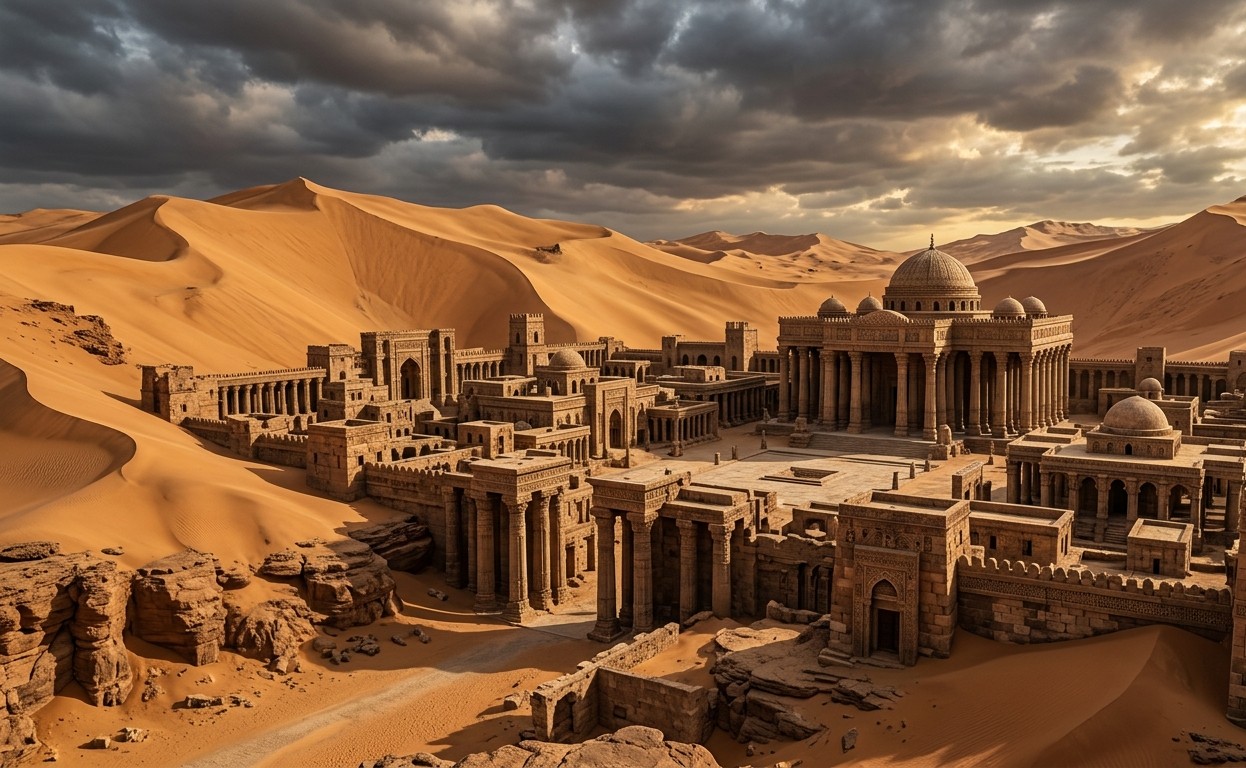
Introduction
The Lost City of Iram has fascinated explorers, historians, and archaeologists for centuries. Hidden deep within the vast Arabian Desert, this mysterious city is believed by many to be one of history’s greatest lost civilizations.
According to the Qur’an, Iram was a magnificent city built by the powerful people of ‘Ad. They were known for their strength, wealth, and impressive buildings unlike anything seen in their time. But despite their power, they ignored the message of Prophet Hud (peace be upon him) and became arrogant.
Then, everything changed.
The city and its people disappeared after a devastating punishment from Allah, leaving behind only stories and unanswered questions. For centuries, many believed that The Lost City of Iram was nothing more than a legend.
However, in the twentieth century, researchers and archaeologists discovered ancient ruins buried beneath the desert sands. This unexpected discovery raised an exciting question.
Could the legendary Lost City of Iram have really existed?
Was it a real city destroyed by a natural disaster, or is its exact location still one of history’s greatest mysteries?
Let’s explore the fascinating story behind The Lost City of Iram, often called “The Atlantis of the Desert.T
The Story of the People of ‘Ad
To understand The Lost City of Iram, we first need to know about the people who lived there.
According to the Qur’an, the city of Iram was home to the powerful tribe of ‘Ad. They lived in the southern part of the Arabian Peninsula and were blessed with fertile land, great wealth, and impressive architecture. The Qur’an describes Iram as a city with “lofty pillars,” showing that it was famous for its magnificent buildings and advanced construction.
The people of ‘Ad were known for their physical strength and prosperity. They built large homes, enjoyed a comfortable life, and believed that no one could defeat them. Their success made them proud, and over time, they became arrogant.
Allah sent Prophet Hud (peace be upon him) to guide them. He called on them to worship Allah alone, abandon idol worship, and live with humility and righteousness. Prophet Hud warned them that if they continued to reject Allah’s message, they would face a severe punishment.
However, most of the people refused to listen.
Instead of accepting the truth, they mocked Prophet Hud and believed their power and wealth would protect them forever. They thought their great city could never fall.
Sadly, that confidence would soon lead to their destruction, turning The Lost City of Iram into one of the greatest mysteries in history.
The Punishment That Destroyed Iram
After years of rejecting the message of Prophet Hud (peace be upon him), the people of ‘Ad continued their arrogance. They believed that their strength, wealth, and magnificent city made them untouchable. Even when Prophet Hud warned them about Allah’s punishment, they refused to change their ways.
Then the weather suddenly changed.
For a long time, no rain fell. The land became dry, crops stopped growing, and people began to suffer. Instead of asking Allah for forgiveness, they remained stubborn and continued to reject His message.
Finally, Allah’s punishment arrived.
The Qur’an tells us that Allah sent a powerful, freezing wind that blew continuously for seven nights and eight days. The storm was so fierce that it destroyed everything in its path. The mighty people of ‘Ad, who once believed no one could defeat them, were helpless against the power of Allah.
The wind swept through their homes, destroyed their buildings, and left the once-great city in ruins. The Qur’an describes the people as if they had become fallen trunks of hollow palm trees, showing how completely they were destroyed.
Only Prophet Hud (peace be upon him) and the small group of believers who accepted Allah’s message were saved.
After the storm ended, the great city of Iram disappeared beneath the desert sands. For centuries, people wondered whether the city had really existed or if it had become nothing more than a forgotten legend. That mystery would remain unsolved for thousands of years.
Was the Lost City of Iram Ever Found?
For centuries, many people believed that The Lost City of Iram was only a legend mentioned in the Qur’an. Since no one knew its exact location, historians and explorers searched the Arabian Desert for generations without finding clear evidence.
Everything changed in the early 1990s.
Using satellite images taken by NASA, researchers noticed ancient trade routes hidden beneath the desert sands. These routes all seemed to lead to one location in Oman called Shisr. Archaeologists later began excavating the site and discovered the remains of an ancient settlement, including the ruins of a large fortress and several collapsed stone towers.
The discovery quickly attracted worldwide attention.
Some researchers suggested that Shisr could be the legendary Lost City of Iram mentioned in the Qur’an. They believed it had once been an important trading center on the famous frankincense trade route before being buried by the desert.
However, not everyone agreed.
Many historians believe that Shisr was an important ancient city, but they are not certain it was the Iram described in the Qur’an. Others argue that Iram may have referred to an entire region or the civilization of the people of ‘Ad, rather than a single city.
Because of this, the debate continues today.
Although the discovery in Oman provided exciting clues, there is still no final proof that the ruins belong to the legendary Lost City of Iram. This uncertainty is one of the main reasons why the mystery continues to fascinate historians, archaeologists, and readers around the world.
What Do Historians and Islamic Scholars Say Today?
Today, The Lost City of Iram is viewed from both a historical and an Islamic perspective. While archaeologists continue to study the ancient ruins found in Oman, Islamic scholars remind us that the most important lesson of Iram is not its exact location but the message behind its story.
According to the Qur’an, the people of ‘Ad were blessed with strength, wealth, and beautiful cities. However, they became proud and rejected the guidance of Prophet Hud (peace be upon him). Their destruction serves as a reminder that no civilization, no matter how powerful, can survive if it turns away from truth and justice.
Historians, on the other hand, continue to debate whether the ruins at Shisr are truly connected to the legendary city of Iram. Some believe the discovery may be linked to the ancient civilization of ‘Ad, while others think it was simply an important trading settlement. So far, there is no clear archaeological evidence that has ended the debate.
Despite these different opinions, one fact remains unchanged.
The story of The Lost City of Iram has inspired explorers, researchers, and readers for generations. Whether it was a single city, a great civilization, or both, its story continues to remind people that even the greatest kingdoms can disappear, while their lessons remain for future generations.
Conclusion
The Lost City of Iram remains one of the most fascinating stories in both history and Islamic tradition. According to the Qur’an, it was the home of the powerful people of ‘Ad, a nation blessed with wealth, strength, and magnificent buildings. Yet despite these blessings, they rejected the message of Prophet Hud (peace be upon him) and were destroyed by a powerful wind sent by Allah.
Over the years, archaeologists have searched for evidence of this legendary city. The discovery of ancient ruins in Shisr, Oman has given researchers new clues, but no one has been able to prove with certainty that these ruins are the exact location of The Lost City of Iram.
So, was Iram a real city or a forgotten legend?
The answer is still uncertain. Historians continue to study the evidence, while the Qur’an preserves the story as a timeless reminder of what can happen when people become arrogant and ignore the truth.
Whether its exact location is ever discovered or not, The Lost City of Iram continues to inspire curiosity around the world. It is not only one of history’s greatest mysteries but also a powerful lesson about faith, humility, and the rise and fall of civilizations.
[…] admin Aug 6, 2026 […]