
 By admin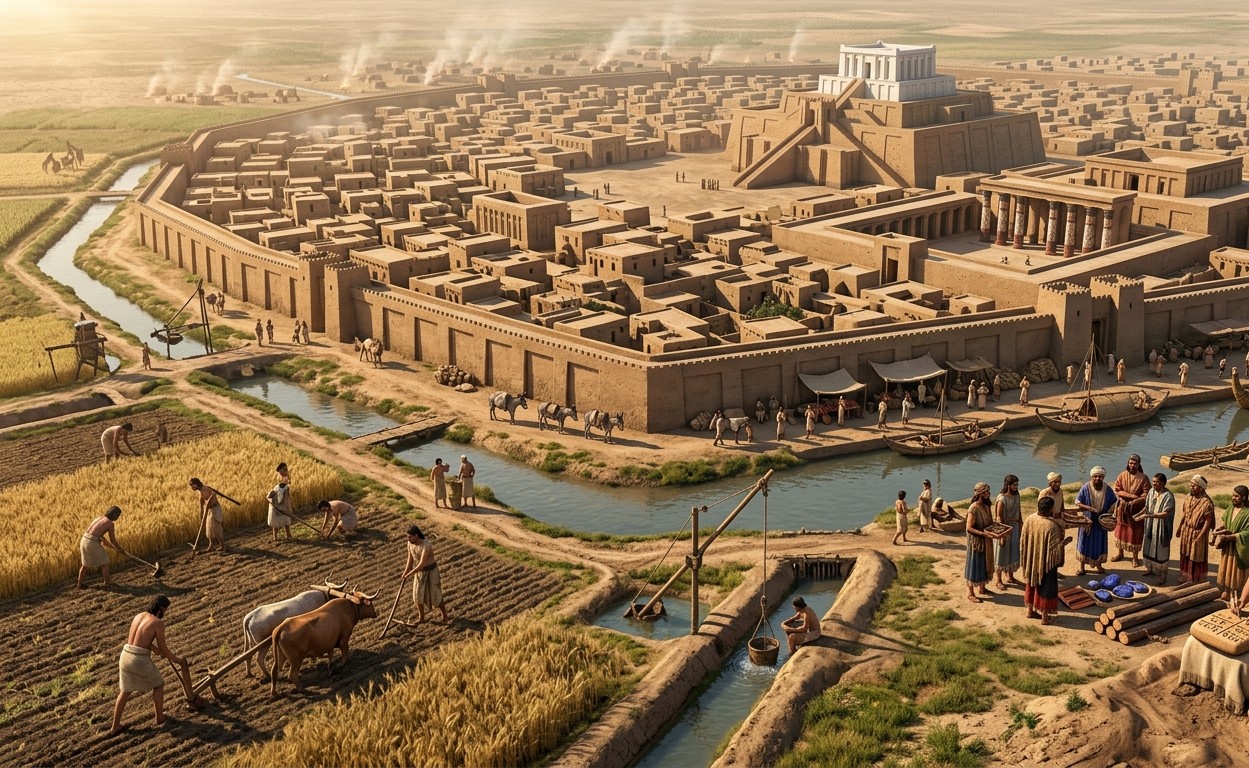
Introduction
Long before the pyramids of Egypt rose above the desert and centuries before the Roman Empire ruled the Mediterranean, another remarkable civilization had already transformed human history. The Sumerians, who lived more than 5,000 years ago, are widely recognized as the creators of the world’s first civilization.
They settled in the fertile land between the Tigris and Euphrates rivers, a region known as Mesopotamia, in present-day southern Iraq. Here, they built the world’s earliest cities, developed one of the first writing systems, established organized governments, and made groundbreaking advances in science, mathematics, agriculture, and engineering.
The Sumerians did not simply create a powerful society—they introduced ideas that became the foundation of later civilizations. Their inventions, from the wheel to cuneiform writing, changed the course of human history and continue to influence the modern world.
But who were these extraordinary people? How did they build the first cities, and why did their civilization eventually disappear? In this article, we will explore the fascinating story of the Sumerians and discover why they are remembered as the pioneers of civilization.
Who Were the Sumerians?
The Sumerians were an ancient people who lived in southern Mesopotamia, in what is now modern-day Iraq, around 4500 BCE. Historians consider them the founders of the world’s first true civilization because they established permanent cities, organized governments, developed writing, and created complex social systems.
Unlike many earlier communities that relied on hunting or simple farming, the Sumerians built thriving urban centers where thousands of people lived and worked together. Each city functioned as an independent city-state, complete with its own ruler, temples, laws, and army.
Some of the most famous Sumerian city-states included Ur, Uruk, Eridu, Lagash, Kish, and Nippur. Among these, Uruk became one of the largest cities in the ancient world and is often regarded as the birthplace of urban civilization.
The origins of the Sumerians remain one of history’s greatest mysteries. Unlike neighboring peoples, their language does not belong to any known language family, making it unique among ancient civilizations. Scholars still debate where they came from, but there is no doubt that they played a crucial role in shaping human history.
Rather than forming a single united kingdom, the Sumerians lived in independent city-states that frequently traded with one another but also competed for land, water, and political power. Despite these rivalries, they shared the same language, religious beliefs, and many cultural traditions, creating one of the earliest advanced civilizations the world had ever seen.
Where Was Sumer Located?
The Sumerians lived in the southern part of Mesopotamia, a region whose name means “the land between two rivers.” These rivers—the Tigris and the Euphrates—flowed through what is now modern-day Iraq and provided the fertile soil that made agriculture possible.
Unlike Egypt, which relied mainly on the predictable flooding of the Nile River, Mesopotamia experienced less predictable floods. To survive, the Sumerians built an impressive network of canals, dams, and irrigation systems that carried water from the rivers to their fields. This engineering achievement allowed them to grow crops even during dry seasons and produce enough food to support large populations.
The fertile plains of southern Mesopotamia became home to several powerful city-states, including Ur, Uruk, Eridu, Lagash, Kish, and Nippur. Each city controlled the surrounding farmland and operated independently, often competing with neighboring cities for land, trade routes, and water supplies.
Sumer’s location also made it an important center of trade. Merchants traveled by land and river to exchange goods with distant regions, including Anatolia (modern Turkey), Persia (modern Iran), and the Indus Valley Civilization. They imported valuable resources such as timber, metals, and precious stones while exporting textiles, pottery, and agricultural products.
Although the region lacked natural resources like stone and metal, its fertile land and strategic position helped the Sumerians build one of the richest and most influential civilizations of the ancient world. Their success proved that geography, combined with innovation and hard work, could transform a challenging environment into the cradle of civilization.
The Rise of the First Cities
One of the Sumerians’ greatest achievements was the creation of the world’s first cities. As farming became more productive, villages grew into large urban centers where thousands of people lived, worked, and traded together. This marked the beginning of organized city life in human history.
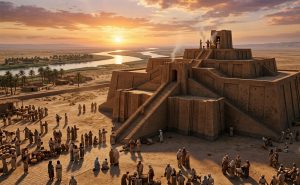
Each Sumerian city was built around a massive temple called a ziggurat. These towering structures served as religious and administrative centers, where priests conducted ceremonies and managed many aspects of daily life. The ziggurat stood at the heart of the city and symbolized the close relationship between religion and government.
The city of Uruk is often considered the world’s first true city. At its peak, it may have been home to more than 40,000 people, making it one of the largest cities on Earth at that time. Other important cities, including Ur, Eridu, Lagash, and Kish, also became centers of trade, culture, and political power.
As these cities expanded, the Sumerians developed organized governments, collected taxes, built defensive walls, and established laws to maintain order. Skilled workers such as potters, blacksmiths, merchants, builders, and scribes specialized in different professions, creating a more advanced and efficient society.
The rise of these cities transformed human civilization forever. Instead of living in small farming villages, people became part of complex urban communities with governments, markets, temples, and public institutions. This revolutionary way of life laid the foundation for every great civilization that followed.
The Invention of Writing: Cuneiform
One of the Sumerians’ greatest contributions to human civilization was the invention of writing. Around 3400 BCE, they developed one of the world’s earliest writing systems, known as cuneiform. This remarkable invention transformed the way people recorded information and communicated.
The word “cuneiform” comes from the Latin word cuneus, meaning “wedge.” Sumerian scribes used a reed stylus to press wedge-shaped marks into soft clay tablets. Once the tablets dried in the sun, they became permanent records that could last for thousands of years.
At first, cuneiform was mainly used for keeping business records, such as tracking trade, taxes, and grain supplies. As the writing system evolved, it was also used to record laws, religious texts, literature, scientific observations, and royal decrees.
Writing became an essential part of Sumerian society. Specially trained scribes learned to read and write cuneiform in schools called edubbas, or “tablet houses.” Because literacy required years of training, scribes were highly respected and often worked for temples, kings, and government officials.
One of the most famous works written in cuneiform is the Epic of Gilgamesh, widely regarded as the world’s oldest surviving epic poem. It tells the story of King Gilgamesh and explores themes of friendship, heroism, and the search for immortality.
The invention of cuneiform changed history forever. It allowed knowledge, laws, and stories to be preserved for future generations, making it one of the greatest achievements of the Sumerian civilization.
Sumerian Government and Kings
As the Sumerian cities grew larger, they needed organized governments to manage trade, agriculture, construction, and defense. Instead of forming one united kingdom, the Sumerians created independent city-states, each with its own ruler, laws, and army.
Every city-state, such as Ur, Uruk, Lagash, and Kish, was ruled by a king known as a lugal, meaning “great man.” In the early days, priests held much of the power because religion was deeply connected to daily life. Over time, kings became more important, especially during periods of war and political competition.
Sumerian kings were not only political leaders but also military commanders and religious figures. People believed that the gods had chosen their rulers, giving kings divine authority to govern. One of the king’s main responsibilities was maintaining the irrigation systems that supplied water to farms, since agriculture was essential for the survival of the cities.
The Sumerians also developed some of the earliest systems of law and administration. Officials collected taxes, managed public works, organized trade, and kept detailed records using cuneiform writing. This efficient system helped the cities function smoothly and supported the growth of a complex society.
One of the most famous Sumerian rulers was Gilgamesh, the legendary king of Uruk. Although many stories about him contain myths and legends, historians believe that he may have been a real ruler who lived around 2700 BCE. His adventures were recorded in the Epic of Gilgamesh, the world’s oldest known epic poem.
The Sumerian system of government became a model for many later civilizations. Their ideas about kingship, administration, and law influenced the Akkadians, Babylonians, Assyrians, and many other ancient societies.
Religion and Daily Life
Religion was at the heart of Sumerian civilization. The Sumerians believed in many gods and goddesses, each responsible for different parts of nature and human life. They thought the gods controlled the weather, harvests, rivers, and even the success of their cities.
Every Sumerian city had a patron deity. For example, the city of Ur worshipped Nanna, the moon god, while Uruk was dedicated to Inanna, the goddess of love, war, and fertility. The people believed that keeping the gods happy through prayers and offerings would bring peace and prosperity.
The most important religious building in every city was the ziggurat. These massive stepped temples stood at the center of the city and served as places of worship. Priests performed daily ceremonies, offered sacrifices, and acted as intermediaries between the people and the gods.
Daily life in Sumer depended on a person’s social status. Most people were farmers, growing crops such as barley, wheat, dates, onions, and vegetables. Others worked as merchants, potters, blacksmiths, builders, weavers, or scribes. Trade was an important part of the economy, connecting Sumer with distant civilizations.
Families usually lived in mud-brick houses built around small courtyards. Children learned skills from their parents, while those who became scribes attended special schools to master cuneiform writing. Education was highly valued because literacy was essential for government, trade, and religion.
Although life was often challenging, the Sumerians created a well-organized society where religion, work, and family were closely connected. Their beliefs and traditions shaped nearly every aspect of daily life and influenced many civilizations that followed.
Amazing Inventions of the Sumerians
The Sumerians were not only the world’s first civilization but also some of history’s greatest inventors. Many of their innovations shaped the development of later civilizations and continue to influence modern life.
One of their most famous inventions was the wheel. First used around 3500 BCE, it made transportation easier and improved farming, trade, and pottery production. The invention of the wheel became one of humanity’s greatest technological achievements.
The Sumerians also created cuneiform, one of the world’s earliest writing systems. This allowed them to record laws, business transactions, literature, and historical events, ensuring that knowledge could be passed down to future generations.
Another remarkable achievement was their advanced irrigation system. By building canals, dams, and reservoirs, they brought water from the Tigris and Euphrates rivers to their fields. This innovation increased food production and supported the growth of large cities.
The Sumerians were also pioneers in mathematics. They developed a base-60 number system, which is still used today to measure 60 minutes in an hour and 360 degrees in a circle.
In addition, they made significant progress in astronomy, carefully observing the stars, planets, and the movement of the Moon. Their knowledge helped them create calendars and determine the best times for farming and religious festivals.
From the wheel and writing to mathematics and engineering, the inventions of the Sumerians laid the foundation for many later civilizations. Their remarkable achievements prove why they are remembered as the pioneers of human civilization.
The Fall of the Sumerian Civilization
Despite their remarkable achievements, the Sumerian civilization did not last forever. Over time, internal conflicts, foreign invasions, and environmental challenges weakened the powerful city-states that had once dominated Mesopotamia.
One of the biggest problems was the constant wars between Sumerian city-states. Cities such as Ur, Uruk, Lagash, and Kish often fought each other for land, water, and political power. These conflicts drained resources and made the region vulnerable to outside enemies.
Around 2334 BCE, a powerful ruler named Sargon of Akkad conquered the Sumerian city-states and established the Akkadian Empire, the world’s first known empire. Although the Sumerians came under Akkadian rule, their language, religion, and culture continued to influence the new empire.
After the Akkadian Empire collapsed, the Sumerians briefly regained power during the Third Dynasty of Ur. However, this revival did not last long. Around 2004 BCE, invading forces from the Elamites captured the city of Ur, bringing an end to Sumerian political independence.
Environmental problems also contributed to their decline. Years of irrigation caused salt to build up in the soil, making farmland less fertile and reducing crop production. As food supplies decreased, the cities became weaker and less able to defend themselves.
Although the Sumerian civilization eventually disappeared as an independent political power, its culture, inventions, and ideas lived on. Later civilizations such as the Akkadians, Babylonians, and Assyrians adopted many Sumerian achievements, ensuring that the legacy of the world’s first civilization would never be forgotten.
The Legacy of the Sumerians
Although the Sumerian civilization disappeared thousands of years ago, its influence can still be seen in the modern world. Many of the ideas and innovations first developed by the Sumerians became the foundation of later civilizations and continue to shape human society today.
Their invention of cuneiform writing inspired future writing systems and allowed knowledge to be preserved across generations. Without writing, recording history, creating laws, and developing literature would have been far more difficult.
The Sumerians also introduced the concept of organized cities, with governments, public buildings, schools, temples, and marketplaces. This model of urban life was later adopted by civilizations such as the Babylonians, Assyrians, Persians, Greeks, and Romans.
Their achievements in mathematics remain part of everyday life. The Sumerian base-60 system is still used to measure time and angles, giving us 60 seconds in a minute, 60 minutes in an hour, and 360 degrees in a circle.
In agriculture and engineering, their advanced irrigation systems demonstrated how humans could control water to grow crops and support large populations. Their ideas influenced farming techniques across the ancient world.
Perhaps most importantly, the Sumerians proved that people could build a complex society based on education, innovation, trade, and organized government. Their remarkable achievements earned them a permanent place in history as the creators of the world’s first civilization.
More than 5,000 years later, the legacy of the Sumerians continues to remind us that many of the foundations of modern civilization were first laid in the fertile lands of ancient Mesopotamia.
Conclusion
The Sumerians were the pioneers of human civilization. More than 5,000 years ago, they transformed small farming communities into thriving cities and introduced innovations that changed the course of history.
From inventing cuneiform writing and the wheel to developing advanced mathematics, irrigation systems, and organized governments, the Sumerians laid the foundations of the modern world. Their achievements influenced later civilizations, including the Akkadians, Babylonians, Assyrians, Persians, Greeks, and Romans.
Although the Sumerian civilization eventually disappeared, its ideas and inventions never did. Many aspects of daily life today—from the way we measure time to the concept of written records—can be traced back to this extraordinary civilization.
More than five millennia later, the story of the Sumerians continues to inspire historians, archaeologists, and curious minds around the world. Their legacy reminds us that the first great civilization was not only the beginning of history—it was the beginning of the world as we know it today.