
 By admin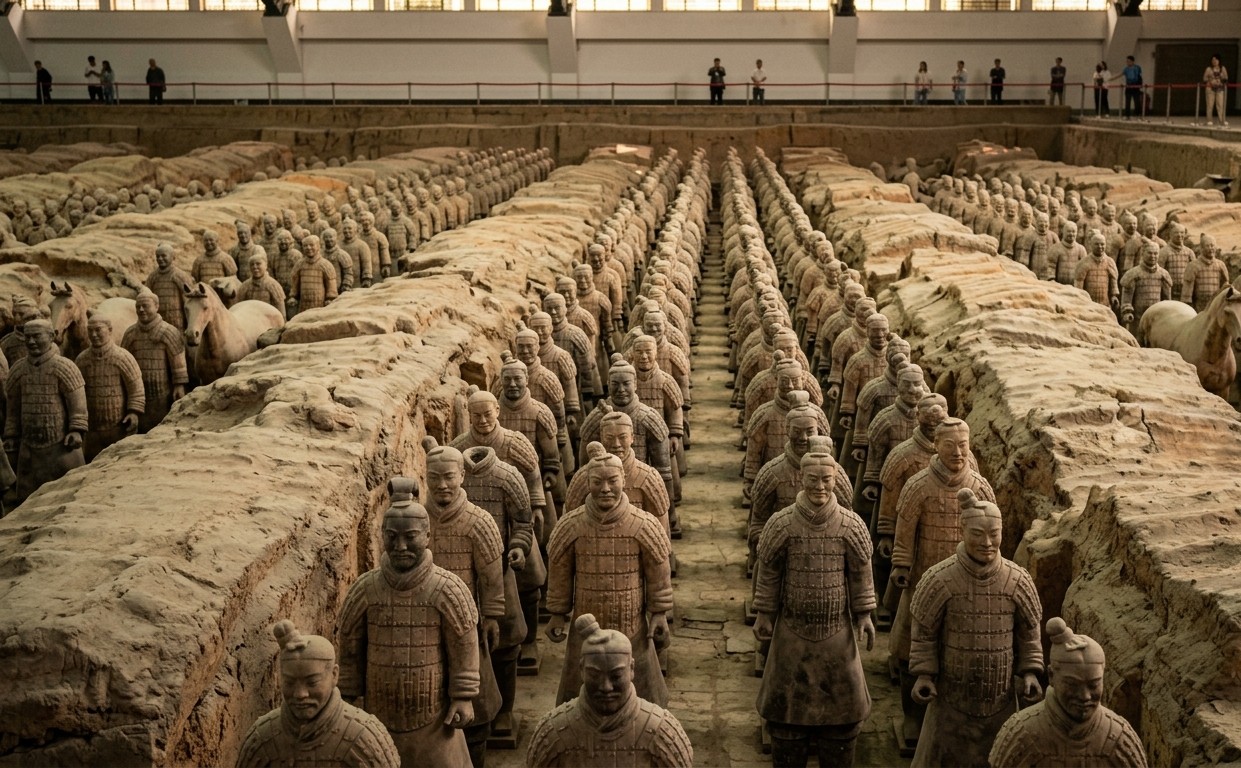
Introduction
Imagine an emperor so powerful that even after death, he wanted the Tomb of Qin Shi Huang to be surrounded by an entire underground world built to protect him.
More than 2,000 years ago, Qin Shi Huang, the first emperor to unify China, ordered the construction of an enormous burial complex near present-day Xi’an. At its center lies the mysterious Tomb of Qin Shi Huang, surrounded by thousands of warriors, horses, weapons, and other figures created to accompany the emperor into the afterlife.
Qin Shi Huang was not an ordinary ruler. He united several warring Chinese states, created a centralized empire, standardized systems of writing and measurement, and began major construction projects that would leave a lasting mark on Chinese history.
But the emperor was also deeply concerned with immortality.
He reportedly searched for ways to extend his life and employed people to look for legendary substances that could help him live forever. At the same time, he was preparing an enormous tomb where he could continue his imperial existence after death.
The scale of the project was extraordinary.
Thousands of workers were involved in constructing the burial complex, while craftsmen created life-sized terracotta soldiers to guard the emperor.
Yet there is something even more fascinating.
Although archaeologists have discovered the famous Terracotta Army surrounding the burial complex, the emperor’s central tomb chamber itself has not been fully excavated.
So what could be hidden inside?
Ancient historical accounts describe an underground palace filled with treasures and strange mechanical features. Some accounts even claim that rivers and seas were represented using flowing mercury.
But how much of this ancient description is actually true?
To understand the mystery, we first need to discover who Qin Shi Huang really was and how he became China’s first emperor.
Who Was Qin Shi Huang?
Before becoming the first emperor of a unified China, Qin Shi Huang was known as Ying Zheng, the young ruler of the state of Qin.
He came to the throne as a child during a period when several powerful Chinese states were constantly fighting for control. This era, known as the Warring States period, was marked by warfare, political rivalries, and shifting alliances.
As Ying Zheng grew older, he gradually strengthened the Qin state and built a powerful army.
Between 230 and 221 BCE, Qin forces defeated the rival states one after another. By 221 BCE, Ying Zheng had conquered his major opponents and unified much of China under a single central government.
He then adopted a new title: Qin Shi Huang, meaning the First Emperor of Qin.
His rule brought major changes. He centralized political power, standardized writing and measurements, and connected defensive walls and roads across his growing empire.
But the emperor’s ambition extended beyond the world of the living.
He wanted his power and status to continue after death. This belief helped inspire the construction of an enormous burial complex that would reflect the grandeur of his empire.
The Tomb of Qin Shi Huang became one of the largest and most mysterious archaeological projects of the ancient world.
And protecting this imperial tomb required something extraordinary: an underground army unlike anything seen before.
The Underground Army of Terracotta Soldiers
The most famous discovery connected to the emperor’s burial complex came thousands of years after his death.
In 1974, farmers digging a well near Xi’an accidentally uncovered fragments of life-sized clay figures. Archaeologists soon realized that they had discovered something extraordinary: an enormous underground army created to guard the emperor in the afterlife.
The figures became known as the Terracotta Army.
Thousands of soldiers have been discovered, along with horses, chariots, weapons, and other figures. The warriors were made in different poses and appear with different hairstyles, facial features, armor, and ranks.
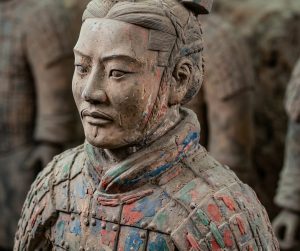
This suggests that the craftsmen did not simply create thousands of identical statues.
Instead, they produced a vast military force designed to represent the real army of Qin Shi Huang.
The soldiers were placed in underground pits arranged in organized formations. Some carried weapons, while others were positioned beside horses and chariots.
The purpose was likely connected to the emperor’s belief that his imperial power would continue into the afterlife.
In other words, Qin Shi Huang was not buried alone.
He was surrounded by an entire underground military force.
But the Terracotta Army may only be the outer part of the emperor’s enormous burial complex.
The greatest mystery lies deeper underground—inside the central tomb itself, which remains largely untouched.
What Could Be Inside the Tomb?
The Terracotta Army is already an extraordinary discovery, but it may not be the most mysterious part of Qin Shi Huang’s burial complex.
At the center lies the emperor’s main burial chamber, which archaeologists have not yet fully excavated. This means that much of what lies inside remains unknown.
Ancient Chinese historian Sima Qian described the tomb as an enormous underground palace. According to his account, the chamber contained treasures and representations of the emperor’s empire.
He also wrote that mercury was used to create artificial rivers and seas, while the ceiling was decorated to represent the heavens.
These descriptions are fascinating, but historians cannot assume every detail is accurate.
Modern scientific investigations have detected unusually high levels of mercury in the soil around the burial mound, which has attracted considerable attention. However, this does not prove that the entire underground chamber contains flowing mercury rivers exactly as Sima Qian described.
The tomb may also contain valuable objects, ceremonial artifacts, and other evidence of Qin Shi Huang’s reign.
But opening the chamber presents a serious challenge.
Archaeologists must consider how excavation could affect fragile objects that have remained sealed underground for more than two thousand years.
So, for now, the central tomb remains closed.
And that means one of China’s greatest archaeological mysteries is still waiting beneath the earth.
Why Has the Tomb Remained Sealed?
More than two thousand years have passed since Qin Shi Huang was buried, yet archaeologists have still not opened the central burial chamber.
This is not because researchers have lost interest. In fact, the opposite is true. The tomb is considered one of the most important archaeological sites in China.
The biggest concern is preservation.
When an ancient tomb is opened, objects that have been protected from oxygen, moisture, and changes in temperature for centuries can suddenly begin to deteriorate. Organic materials, paintings, fabrics, and other delicate artifacts could be damaged soon after exposure.
The discovery of the Terracotta Army provides a good example of this problem. Some painted surfaces on the warriors were remarkably well preserved when first uncovered, but exposure to the modern environment caused some of the delicate colors to deteriorate rapidly.
Archaeologists therefore have to consider whether they currently have the technology needed to safely excavate and preserve everything inside the emperor’s tomb.
There is also another problem: ancient records suggest that the tomb may contain dangerous traps.
Sima Qian wrote that crossbows were installed to automatically fire at anyone attempting to enter the chamber.
Whether these mechanical traps actually existed is uncertain. No one has entered the central chamber to verify the account.
For now, the sealed tomb continues to protect its secrets.
And perhaps the greatest question is still unanswered:
What will archaeologists discover if the tomb is finally opened?
The Emperor’s Search for Immortality
Qin Shi Huang did not only prepare for life after death—he spent much of his life trying to avoid death altogether.
The emperor was deeply fascinated by the idea of immortality. He sent expeditions across China in search of legendary medicines and substances that were believed to grant eternal life.
One famous story tells of a court official named Xu Fu, who was reportedly sent across the sea with a large expedition to search for a legendary land where immortals were said to live.
The emperor’s obsession with immortality may seem surprising, but it helps explain the enormous effort put into his burial complex.
Even while searching for a way to live forever, Qin Shi Huang was preparing for his eventual death.
His underground world was designed to preserve the power and status he had possessed in life. The Tomb of Qin Shi Huang was therefore not simply a place to bury a body—it was intended as an imperial world for the afterlife.
Ironically, some of the substances associated with his search for immortality may have contributed to his death.
Ancient records suggest that Qin Shi Huang consumed substances containing mercury, which were believed to have life-extending properties. Modern historians have considered mercury poisoning as one possible factor in his death, although the exact cause remains uncertain.
The emperor who wanted to escape death ultimately became one of history’s most fascinating figures because of the enormous tomb he left behind
The Discovery That Revealed the Terracotta Army
For more than two thousand years, the emperor’s underground army remained hidden beneath the soil near Xi’an.
Then, in 1974, an accidental discovery changed the story forever.
Local farmers were digging a well when they came across fragments of what appeared to be ancient clay figures. Archaeologists were called to investigate, and what they uncovered was astonishing.
Beneath the ground were enormous pits containing thousands of life-sized terracotta warriors.
The figures were arranged in military formations, accompanied by horses, chariots, and weapons. Some soldiers carried real bronze weapons, including swords, spears, and crossbows.
One of the most remarkable details was that the warriors were not completely identical. Their faces, hairstyles, clothing, and military positions showed considerable variation.
This suggested that the craftsmen had created the figures to represent different types of soldiers within Qin Shi Huang’s army.
The discovery provided researchers with an extraordinary glimpse into the military organization, technology, and artistic abilities of ancient China.
But there was still a much bigger mystery.
The Terracotta Army was only part of the emperor’s enormous burial complex.
Somewhere nearby was the central tomb of Qin Shi Huang, still sealed beneath its ancient mound.
The Emperor’s Underground Palace and the Mystery of Mercury
According to the ancient historian Sima Qian, the burial complex of Qin Shi Huang was designed to represent an entire underground world.
The central chamber was reportedly filled with treasures and objects representing the emperor’s vast empire. The ceiling was said to depict the heavens, while the floor represented the land below.
But the most fascinating detail concerns mercury.
Sima Qian wrote that mercury was used to create artificial rivers and seas inside the tomb. If the account is accurate, it would have been an extraordinary attempt to recreate the emperor’s empire beneath the earth.
Modern scientific research has added another layer to the mystery. Studies have detected unusually high concentrations of mercury around the burial mound compared with surrounding areas.
This has led some researchers to suggest that the ancient description may contain a degree of truth.
However, scientists cannot confirm exactly what is inside the sealed chamber until it is excavated.
For now, the mysterious Tomb of Qin Shi Huang remains largely untouched.
Beneath the enormous burial mound, an ancient imperial world may still be waiting to be discovered.
And unlike the warriors, its secrets had not yet been revealed.
The Secrets and Legends of Qin Shi Huang’s Tomb
The mystery surrounding Qin Shi Huang’s burial complex has inspired countless stories for more than two thousand years.
Ancient records describe the tomb as a vast underground palace filled with treasures, weapons, and representations of the emperor’s empire. Some accounts even describe automatic crossbows designed to attack anyone who tried to enter.
Whether these traps actually existed is still unknown.
Another mystery concerns the emperor’s final resting place. Although archaeologists know the approximate location of the central burial chamber, they have not confirmed exactly how Qin Shi Huang was buried or what objects were placed around him.
The possibility of mercury-filled rivers, hidden treasures, and mechanical defenses has made the site one of the world’s most fascinating archaeological mysteries.
But there is an important distinction between ancient accounts and archaeological evidence.
Some details come from historical writings rather than direct discoveries. Until the central chamber is excavated, researchers cannot know which descriptions are accurate and which may have been exaggerated over time.
That uncertainty is part of what makes the Tomb of Qin Shi Huang so fascinating.
The emperor who once ruled a unified China left behind an enormous underground world—and after more than 2,000 years, much of that world remains hidden.
The Legacy of Qin Shi Huang and His Mysterious Tomb
Qin Shi Huang died in 210 BCE, but his influence on Chinese history lasted far beyond his lifetime.
He created the first unified Chinese empire and introduced major political and administrative changes that shaped the country for centuries. Yet perhaps his most extraordinary legacy lies beneath the earth.
The enormous burial complex surrounding his tomb reflects the emperor’s desire to preserve his power even after death. The Terracotta Army, horses, chariots, weapons, and other discoveries reveal how seriously the ancient Chinese court took the idea of an imperial afterlife.
Today, the archaeological site near Xi’an attracts enormous interest from historians, archaeologists, and visitors from around the world.
Yet the greatest secret remains unopened.
The central chamber of the Tomb of Qin Shi Huang still lies beneath its ancient burial mound. Archaeologists continue to study the surrounding area and search for ways to explore the tomb without destroying the artifacts that may have survived inside.
Perhaps one day, new technology will allow researchers to safely enter the chamber.
Until then, the tomb remains a remarkable time capsule from China’s first imperial dynasty.
And somewhere beneath the earth, the emperor who once united China may still be surrounded by the underground world he prepared for eternity.
Conclusion
The story of Qin Shi Huang’s tomb is more than a tale of buried treasure.
It is the story of an emperor who wanted his power, army, and empire to continue beyond death. The discoveries already made have revealed an extraordinary ancient civilization—but the sealed tomb still holds questions that archaeology has not yet answered.
What is hidden inside the emperor’s final palace?
For now, the answer remains beneath the earth.
[…] admin Aug 10, 2026 […]