
 By admin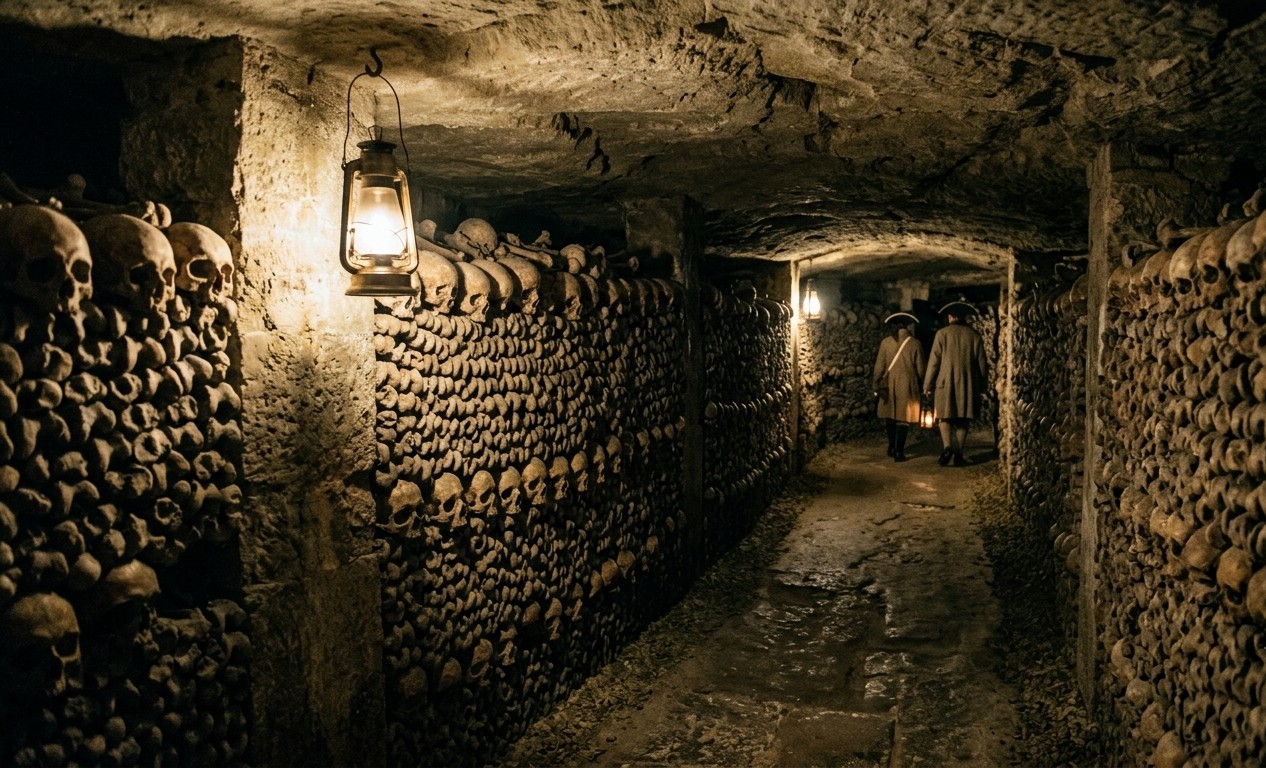
Introduction
Beneath the beautiful streets of Paris lies a world that few visitors ever see.
Far below the cafés, museums, and busy avenues of the French capital stretches a vast network of underground tunnels. Some are narrow and dark, while others open into enormous chambers filled with the remains of millions of people.
This mysterious underground world is known as the Catacombs of Paris.
Today, the Catacombs are one of Paris’s most unusual historical attractions. But they were never originally designed to become a tourist destination. Their story began with a much more serious problem: Paris was running out of space to bury its dead.
By the late 18th century, the city’s cemeteries had become dangerously overcrowded. Graves were packed closely together, and in some areas, decomposing bodies created serious problems for people living nearby.
Paris needed a solution.
The answer came from somewhere beneath the city itself.
Deep underground were abandoned limestone quarries—tunnels that had been dug centuries earlier to provide stone for buildings across Paris. These forgotten tunnels would eventually be transformed into one of the world’s most haunting underground burial sites.
Millions of human remains were moved there.
But how did this enormous underground cemetery come into existence?
And why are the bones arranged in such a strange and organized way?
To understand the mystery of the Catacombs, we first have to return to 18th-century Paris.
When Paris Ran Out of Space for the Dead
The Origins of the Catacombs
The story of the Catacombs of Paris began long before the underground tunnels became a famous historical site.
Beneath Paris was an enormous network of ancient limestone quarries. For centuries, stone was extracted from underground to build churches, palaces, bridges, and many of the city’s famous buildings.
As Paris continued to grow, more and more stone was removed from beneath the city. This eventually created a serious problem: parts of Paris were literally standing above empty underground spaces.
In some areas, streets and buildings began to suffer from collapses. The authorities realized that the underground quarries could no longer be ignored.
From Quarries to Catacombs
At the same time, Paris had another major problem.
By the 18th century, the city’s cemeteries were becoming severely overcrowded. One cemetery in particular, Les Innocents, had become notorious for the enormous number of bodies buried there.
The situation became so serious that authorities decided to remove human remains from several cemeteries and move them underground into the abandoned quarry tunnels.
This decision would eventually transform the forgotten underground quarries into one of the most mysterious places beneath Paris.
The First Bones Entered the Tunnels
In 1786, the former quarries were officially consecrated as an ossuary.
Human remains began to be transferred there, usually during the night to avoid disturbing the people of Paris.
Over the following years, bones from numerous cemeteries were brought underground.
At first, the remains were simply placed inside the tunnels. Later, workers arranged many of the bones into carefully constructed walls and patterns.
What had once been an abandoned mining network slowly became something completely different—a vast underground city of the dead.
How the Catacombs Were Created
By the late 18th century, Paris was facing a serious problem beneath its streets.
For centuries, the city had buried its dead in crowded church cemeteries. As Paris grew, these burial grounds became dangerously overcrowded. One of the worst examples was the Cimetière des Innocents, where bodies had been buried for hundreds of years.
The situation eventually became a public-health concern.
In 1780, part of the wall surrounding the cemetery collapsed after heavy rain, and decomposing remains spilled into a nearby property. This incident helped convince authorities that Paris needed a completely different solution for dealing with its dead.
🦴 The Decision to Move the Dead
In 1786, French authorities officially began transforming abandoned limestone quarries beneath Paris into underground ossuaries.
The first bones were transferred from the Cimetière des Innocents. Workers carefully removed human remains from the old cemeteries and transported them through the streets of Paris, often at night.
The destination was a network of dark, abandoned tunnels far beneath the city.
The underground chambers were eventually given a name inspired by ancient Roman burial sites:
The Catacombs of Paris.
🕯️ Millions of Bones Beneath the City
What began as a practical solution gradually became something much more mysterious.
Over the following decades, bones from numerous Parisian cemeteries were moved underground. Today, the Catacombs are believed to contain the remains of several million people.
But the bones were not simply thrown into piles.
Workers later arranged many of them into carefully constructed walls and patterns. Behind these walls lie countless other remains, creating an eerie underground world unlike almost anywhere else in Paris.
And this was only the beginning of the Catacombs’ strange history…
The Secret Tunnels Beneath Paris
The Catacombs were created as a place to store human remains, but the enormous network of tunnels beneath Paris soon became much more than an underground cemetery.
Beneath the city was a maze of narrow passages, chambers, and abandoned quarry tunnels. Many of these passages were poorly mapped, and some extended far beyond the officially accessible areas.
Over time, people began exploring these hidden spaces.
🕯️ The Cataphiles
In the 20th century, underground explorers known as cataphiles became fascinated with the forbidden parts of the Parisian tunnels. These explorers entered areas that were not open to ordinary visitors, often using unofficial entrances and secret routes.
Some explored the tunnels simply because of curiosity. Others created underground meeting places, decorated walls with artwork, or organized gatherings far away from the streets above.
The underground world became almost like a hidden city beneath the real one.
🚫 A Dangerous Underground World
Exploring the unofficial tunnels is not like visiting the public Catacombs.
The passages can be dark, confusing, narrow, and difficult to navigate. Some areas contain unstable sections, deep water, or places where it is easy to become lost.
Because of these dangers, much of the underground network is closed to the public.
Yet stories of secret rooms, hidden entrances, forgotten passages, and underground gatherings have helped give the Catacombs their mysterious reputation.
What began as a solution to Paris’s cemetery problem had become something much stranger—a hidden world beneath one of the most famous cities on Earth.
The Walls of Bones
One of the most haunting features of the Catacombs of Paris is the way many of the human bones were arranged.
When the remains were first moved underground, they were not carefully organized. Bones were initially placed in the tunnels in a relatively simple manner. Later, however, workers began arranging them into long, decorative walls.
Skulls and larger bones were positioned at the front, while other remains were placed behind them. This created the distinctive appearance that visitors see in parts of the Catacombs today.
🦴 More Than Just a Burial Place
The arrangement was not intended simply to frighten visitors. It was also meant to create a sense of order and respect within the ossuary.
Some sections contain inscriptions and plaques with philosophical or religious messages about death and mortality. These words encourage visitors to think about the temporary nature of human life.
One famous entrance inscription carries the warning:
“Stop! This is the empire of death.”
The message immediately reminds visitors that they are entering a place unlike anywhere else in Paris.
🕯️ A Reminder of Mortality
Walking through the Catacombs can feel like stepping into another world. The streets, buildings, and noise of Paris disappear above, while underground corridors are surrounded by the remains of people who lived centuries ago.
Many of these people were ordinary Parisians whose names and individual stories have been lost to history.
Their bones, however, remain beneath the city.
The Catacombs therefore serve not only as an underground ossuary but also as a powerful reminder that Paris itself was built over generations of human lives.
The Secret Side of the Catacombs
Although the official Catacombs are open to visitors, they represent only a small part of the enormous underground network beneath Paris.
Beyond the areas accessible to tourists are countless tunnels and passages that have attracted underground explorers for generations. Some people are fascinated by the history, while others are drawn to the mystery of discovering places hidden beneath the modern city.
These underground explorers are often called cataphiles.
Some have discovered forgotten chambers, old inscriptions, abandoned rooms, and remarkable underground artwork. Over the years, explorers have even created spaces for gatherings and artistic projects deep beneath the streets.
🎨 An Underground World of Art
The walls of some unofficial tunnels have become covered with graffiti and murals. In certain areas, underground artists have transformed plain limestone walls into elaborate works of art.
This creates a strange contrast: ancient stone tunnels, centuries-old history, and modern artwork existing side by side beneath Paris.
But exploring these areas can be extremely dangerous. The tunnels form a complicated maze, and visitors can easily become lost. Some sections are unstable, flooded, or difficult to navigate.
For this reason, entering restricted areas without authorization is prohibited.
The secret network nevertheless continues to fuel the legend of the Catacombs. Beneath the elegant streets of Paris exists a hidden world that most people will never see—a maze connecting the city’s ancient past with its mysterious present.
The Catacombs During Times of War
The hidden tunnels beneath Paris were not always used only for storing the dead. During some of the city’s most difficult periods, the underground network became a place of shelter, secrecy, and resistance.
During World War II, parts of the underground tunnels were used by members of the French Resistance. The maze-like network provided hidden routes beneath the streets, allowing resistance members to move and meet away from the attention of German occupying forces.
The underground environment offered an important advantage: people walking through the tunnels could remain hidden from what was happening above.
However, the Catacombs were not simply a secret headquarters for the Resistance. The wider quarry network was enormous, and different sections had different uses. Some areas remained completely inaccessible or unknown to most Parisians.
The history of the tunnels therefore became intertwined with the history of Paris itself.
Above ground, the city experienced occupation, battles, liberation, and political change. Below ground, the ancient tunnels remained largely hidden, preserving their own world of darkness and silence.
This combination of war, secrecy, death, and forgotten underground passages helped strengthen the mysterious reputation of the Catacombs.
But after the war, another chapter began: the hidden ossuary gradually became one of Paris’s most unusual historical attractions.
The Catacombs Become a Tourist Attraction
For many years, the Catacombs remained a mysterious underground place known mainly to authorities, workers, and a small number of explorers. But eventually, the city began to recognize their historical and cultural importance.
The official Catacombs of Paris opened to the public in 1809. Visitors were allowed to enter a carefully selected section of the enormous underground network and see the walls of human remains for themselves.
At first, the experience was very different from a typical museum visit. There were no modern exhibitions or elaborate displays. Visitors simply walked through the dark underground passages surrounded by centuries-old bones and stone walls.
Over time, the Catacombs became one of Paris’s most unusual attractions.
🕯️ A Different Side of Paris
Millions of people visit Paris each year to see famous landmarks such as the Eiffel Tower, the Louvre, and Notre-Dame. The Catacombs offer something completely different.
Instead of beautiful architecture above the ground, visitors descend into a dark and silent underground world.
The experience reveals a side of Paris that is rarely visible from the streets—a place shaped by centuries of quarrying, burial, urban expansion, and history.
Today, the official visitor route is carefully managed for safety and preservation. Only a small portion of the vast underground network is accessible to the public.
Yet even this small section provides a remarkable glimpse into the hidden history beneath Paris.
The Catacombs are no longer simply a solution to an ancient burial problem. They have become a place where visitors can walk through history itself, surrounded by the remains of generations who once lived in the city above.
The Mysteries and Legends of the Catacombs
The Catacombs of Paris have inspired countless stories and legends. With miles of dark tunnels beneath one of the world’s most famous cities, it is easy to understand why the underground network has become associated with mystery.
Some stories describe secret rooms, hidden passages, underground parties, and mysterious discoveries made by explorers. Others tell of people becoming lost in the tunnels and struggling to find their way back to the surface.
Many of these stories have been exaggerated over time, making it difficult to separate fact from fiction.
One of the most fascinating aspects of the Catacombs is that the official visitor route represents only a small portion of the underground quarry system. Large sections remain closed to ordinary visitors, which naturally adds to the sense of mystery.
There are also stories about hidden chambers decorated by underground explorers and areas that have been transformed into unusual meeting spaces. Some discoveries are genuine, while others have become part of the mythology surrounding the tunnels.
But perhaps the greatest mystery is not what might still be hidden beneath Paris—it is the history already preserved there.
The tunnels contain the remains of millions of people, traces of ancient quarrying, and evidence of how Paris changed over centuries.
Above ground, Paris is known as the City of Light. Below it lies a completely different world—dark, silent, and filled with stories from the past.
The Catacombs Today
Today, the Catacombs of Paris remain one of the most unusual historical sites in France. Visitors can descend beneath the streets and walk through a carefully preserved section of the underground ossuary, where the remains of millions of people have been kept for more than two centuries.
The official visitor route is only a tiny part of the much larger network of tunnels beneath Paris. Many areas are closed to the public because of safety and preservation concerns.
The Catacombs also continue to attract historians, archaeologists, artists, and underground explorers who are fascinated by the hidden history beneath the city. Every tunnel and chamber tells something about Paris—from the ancient limestone quarries that helped build the city to the transformation of old cemeteries into an underground ossuary.
What makes the Catacombs particularly fascinating is the contrast between the Paris above and the Paris below. Above ground are busy streets, beautiful monuments, restaurants, and museums. Beneath them lies a silent world filled with bones, stone tunnels, and centuries of forgotten history.
The Catacombs are therefore more than a collection of human remains. They are a reminder of how cities grow, how societies deal with death, and how much history can remain hidden beneath the places we think we know.
Even today, the underground world beneath Paris continues to raise questions—and its secrets ensure that the Catacombs remain one of the city’s most haunting historical mysteries.
The Legacy of the Catacombs
The Catacombs of Paris are more than an underground collection of human remains. They are a remarkable part of Paris’s history, revealing how the city dealt with overcrowded cemeteries while also preserving evidence of its ancient underground quarries.
For more than two centuries, the Catacombs have reminded visitors that beneath the beautiful streets of Paris lies a very different world. The bones arranged along the walls represent generations of people who once lived, worked, loved, and died in the city above.
At the same time, the tunnels tell another story—the story of how Paris expanded, how limestone was extracted to build the city, and how these abandoned spaces were eventually transformed into an enormous ossuary.
The Catacombs have also become a symbol of the mystery hidden beneath familiar places. Their dark passages, forgotten chambers, and fascinating history continue to attract people from around the world.
Perhaps the most remarkable thing about the Catacombs is that they show how death and the growth of a city became permanently connected. What began as a practical solution to a serious problem eventually became one of Paris’s most extraordinary historical sites.
Today, the Catacombs remain a powerful reminder that history is not always found in grand palaces or famous monuments.
Sometimes, it is hidden deep beneath our feet.
Conclusion
The Catacombs of Paris are a remarkable reminder that some of history’s most fascinating stories are hidden beneath the places we know best.
What began as a solution to Paris’s overcrowded cemeteries became an enormous underground ossuary, preserving the remains of millions of people. At the same time, the ancient quarry tunnels reveal another side of Paris—a hidden world shaped by centuries of construction, change, conflict, and human life.
Today, the Catacombs continue to fascinate visitors because they offer something very different from the famous landmarks above ground. They are a place where history, mystery, and mortality meet beneath the streets of Paris.
The City of Light may be famous for what shines above its streets, but beneath it lies a silent world that reminds us how much of history remains hidden from view.
[…] you enjoyed this story about ancient Egyptian tombs, you may also enjoy reading The Catacombs of Paris, The Roman Dodecahedron, and The Child of Llullaillaco. Each one reveals a different mystery from […]