
 By admin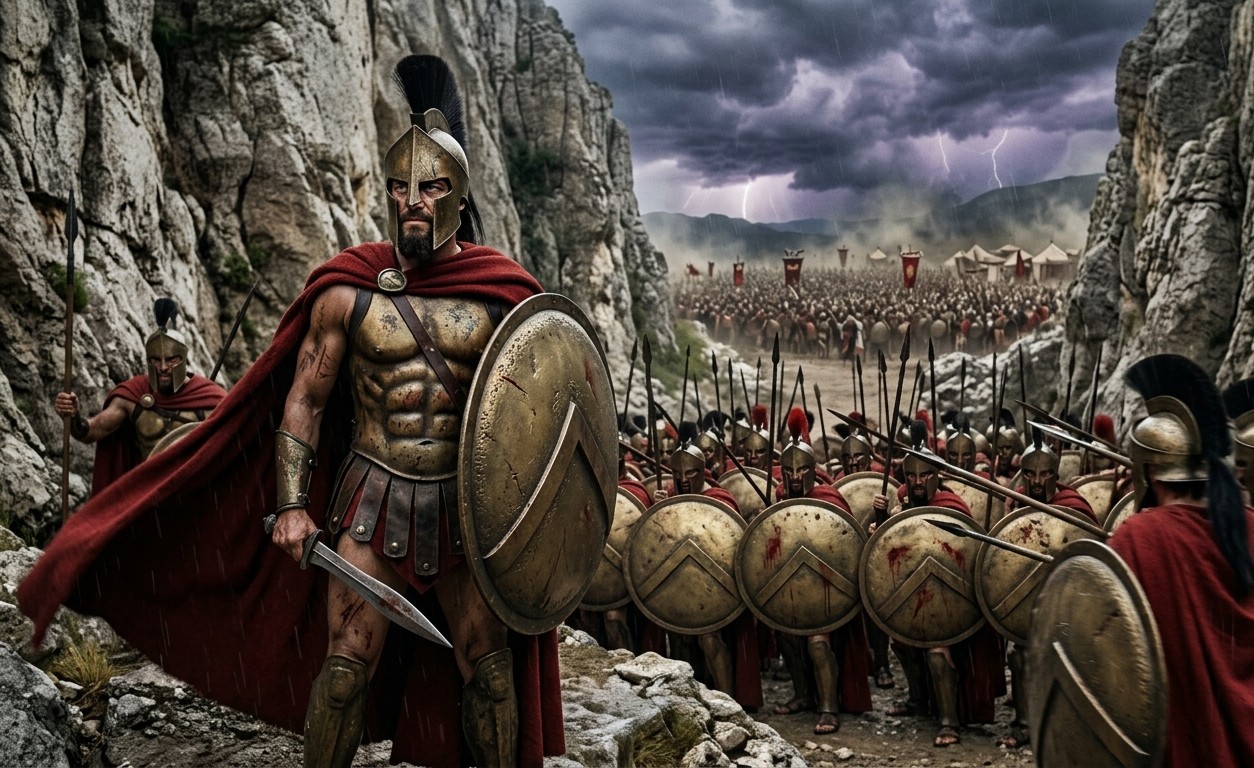
Introduction
In 480 BCE, a small Greek force stood at a narrow mountain pass against one of the largest invading armies of the ancient world.
On one side was the mighty Persian Empire, led by King Xerxes I, whose forces had invaded Greece with the goal of bringing the Greek city-states under Persian control. On the other side were Greek warriors determined to stop the invasion.
At the center of this dramatic confrontation stood King Leonidas I of Sparta and his famous 300 Spartan warriors.
The battle took place at Thermopylae, a narrow coastal pass whose name means “Hot Gates.” The location was strategically important because the narrow terrain prevented the much larger Persian army from using its full numerical advantage.
For several days, the Greeks managed to hold the pass against repeated Persian attacks. The Spartans became famous for their discipline, courage, and willingness to fight even when the situation became hopeless.
But the famous story of the “300 Spartans” is only part of what actually happened.
Hundreds of other Greek soldiers fought alongside them, including warriors from Thespiae and Thebes. Their combined resistance gave the other Greek forces valuable time to prepare for the continuing Persian invasion.
Eventually, however, the Persians discovered a mountain path that allowed them to surround the Greek defenders.
Leonidas and his remaining warriors chose to stay and fight.
Their final stand would become one of the most famous episodes in ancient military history—a story of courage, sacrifice, strategy, and resistance against overwhelming odds.
But to understand why this battle happened, we first need to look at the conflict between Persia and Greece.
Why Did Persia Invade Greece?
The Battle of Thermopylae was part of a much larger conflict between the Persian Empire and the Greek city-states.
The tension had begun years earlier during the Ionian Revolt, when several Greek cities in Asia Minor rebelled against Persian rule. Athens supported the rebels, angering the Persian king Darius I.
Darius later launched an invasion of Greece, but the Persians were defeated by the Athenians at the Battle of Marathon in 490 BCE.
The defeat did not end Persia’s ambitions.
Years later, Darius’s son Xerxes I decided to launch an even larger invasion. His goal was to punish the Greeks, expand Persian power, and bring the independent Greek city-states under Persian control.
Xerxes gathered an enormous army and marched toward Greece in 480 BCE. The exact size of the Persian army is still debated by historians, but it was certainly much larger than the Greek force defending Thermopylae.
The Greek city-states were often divided by rivalries and political disagreements. However, the Persian invasion created a common threat that encouraged several of them to cooperate.
Athens and Sparta became important leaders of the Greek resistance.
The Greeks knew they could not easily defeat the Persian army in an open battlefield. Instead, they needed to use the geography of Greece to their advantage.
That was why Thermopylae became so important.
The narrow mountain pass could restrict the movement of the much larger Persian army, allowing a relatively small Greek force to hold its position against overwhelming numbers.
And it was here that Leonidas and his warriors were sent to make a stand.
King Leonidas and the Spartan Warriors
At the center of the Greek defense was King Leonidas I of Sparta, a warrior king known for his courage and military discipline.
Leonidas did not arrive at Thermopylae with the entire Spartan army. Sparta was observing an important religious festival known as the Carneia, which restricted military activity. As a result, Leonidas was sent with a smaller force of 300 specially selected Spartan warriors.
These men were experienced soldiers, and many were fathers with living sons—an important detail because their families would continue the Spartan line if they died.
The Spartans were famous throughout Greece for their strict military training. From childhood, Spartan boys were prepared for warfare, learning discipline, endurance, teamwork, and obedience.
But the Spartans were not alone at Thermopylae.
Other Greek city-states also sent soldiers to defend the pass. Thousands of Greek warriors participated during different stages of the battle, including troops from Thespiae, Thebes, Corinth, and several other communities.
The famous 300 therefore represented only one part of the Greek force.
Still, Leonidas and his Spartans became the symbol of the resistance because they remained at Thermopylae when the Greek position was finally overwhelmed.
For Leonidas, the battle was not simply about winning.
It was about holding the pass for as long as possible and giving the rest of Greece time to prepare for the Persian invasion.
And soon, the enormous Persian army finally reached Thermopylae.
The Persian Army Arrives at Thermopylae
In the summer of 480 BCE, Xerxes’ enormous army reached the area around Thermopylae.
The Greek defenders had chosen the location carefully. Thermopylae was a narrow pass between steep mountains and the sea. In such a confined space, the Persians could not easily surround the Greeks or take full advantage of their much larger numbers.
Leonidas positioned his troops at the narrowest part of the pass and waited for the Persian attack.
According to the ancient historian Herodotus, Xerxes initially expected the Greeks to surrender. When they refused, he ordered his soldiers to attack.
The first Persian assaults failed.
Wave after wave of Persian troops moved toward the Greek line, but the heavily armed Greek hoplites fought in a tight formation known as the phalanx. Their large shields protected them while their long spears allowed them to strike at approaching enemies.
The narrow battlefield made the Greek formation especially effective.
The Persians could send more soldiers into the battle, but only a limited number could fight at the same time. As a result, the Greek defenders were able to hold their position despite being greatly outnumbered.
Even the Persian Immortals, an elite unit of the Persian army, struggled to break through the Greek defense.
For the first two days, the Greeks successfully resisted the Persian attacks.
But then Xerxes received information that would completely change the course of the battle.
A local Greek named Ephialtes revealed the existence of a mountain path that could allow Persian troops to move behind the Greek position.
The defenders were about to be surrounded.
The Betrayal of Ephialtes
The Greek defense at Thermopylae seemed strong, but its greatest weakness was the terrain surrounding the pass.
During the night, a Greek named Ephialtes of Trachis approached the Persian camp. According to Herodotus, he told the Persians about a hidden mountain path known as the Anopaea path.
This route allowed Persian soldiers to move around the Greek position and approach the defenders from behind.
Xerxes immediately ordered a large force under Hydarnes to use the path. The Persian troops began climbing through the mountains while the Greek defenders remained unaware of the danger approaching from behind.
At dawn, the Greek soldiers guarding the mountain route realized that the Persians were coming.
The situation had suddenly become hopeless.
Leonidas understood that the main Greek force could be surrounded and destroyed. He therefore ordered most of the Greek troops to withdraw from Thermopylae.
However, Leonidas and a smaller group remained behind.
The 300 Spartans stayed, along with Thespian warriors and some Theban soldiers. Their decision was not simply a reckless attempt to die. By remaining at the pass, they could delay the Persian advance and give the retreating Greek forces more time to escape.
The final battle was about to begin.
Leonidas and his remaining soldiers moved forward to make their last stand against the Persian army.
What happened next would turn Thermopylae into one of the most famous stories of courage in ancient history.
The Final Stand of the 300 Spartans
By the third day, the situation at Thermopylae had become desperate.
Persian troops had discovered the mountain route and were moving toward the Greek position from behind. Leonidas knew that his remaining soldiers could not stop the entire Persian army forever.
Instead of retreating, however, Leonidas chose to stay.
The remaining Greek warriors moved forward into the wider part of the battlefield. Their goal was no longer simply to hold the narrow pass—they were now fighting for as long as possible before they were completely surrounded.
The battle became extremely fierce.
The Greeks continued fighting even after many of their spears had been broken. According to the ancient accounts, they eventually fought with their swords and even with their hands and teeth when their weapons were lost.
Leonidas was killed during the fighting.
The Spartans and their allies then fought desperately to protect his body. Eventually, the Persian army overwhelmed the remaining Greek defenders.
The 300 Spartans were killed, along with the other warriors who had chosen to remain at Thermopylae.
The Persian army had won the battlefield—but the Greek resistance had achieved something important.
The stand at Thermopylae had delayed the Persian advance and bought valuable time for the Greek forces to prepare elsewhere.
The defeat therefore became more than a military loss.
It became a powerful symbol of courage and sacrifice.
But the Persian invasion was far from over. Xerxes’ army continued deeper into Greece, and the Greeks would soon face another decisive battle—this time at sea.
The Battle of Salamis and the Greek Counterattack
The fall of Thermopylae did not end the Persian invasion.
After breaking through the Greek defenses, Xerxes’ army continued southward. Athens was eventually evacuated, and Persian forces entered the city and burned parts of it.
But the Greek resistance was still alive.
The Greek fleet gathered near the narrow waters of Salamis, an island close to Athens. The location gave the Greeks an important advantage: the narrow strait prevented the much larger Persian fleet from using its full strength.
The Persian navy entered the waters expecting an easy victory.
Instead, the Greek ships attacked from the narrow channel.
The battle quickly became chaotic for the Persian fleet. Their larger numbers became a disadvantage because their ships had difficulty maneuvering in the confined waters. Greek ships were able to ram and damage Persian vessels while maintaining a more organized formation.
The result was a major Greek naval victory.
The defeat at Salamis was a turning point in the Persian invasion. Xerxes eventually returned to Asia, leaving part of his army behind under the command of Mardonius.
The following year, the Greeks defeated the remaining Persian forces at the Battle of Plataea, effectively ending the major Persian invasion of Greece.
Thermopylae had been a defeat for the Greeks, but the sacrifice of Leonidas and his warriors became part of a much larger resistance that ultimately helped preserve Greek independence.
The story of the 300 Spartans had only just begun to become a legend.
Why the 300 Spartans Became a Legend
The Battle of Thermopylae was a military defeat for the Greeks, but its story survived for more than two thousand years.
The courage of Leonidas and the 300 Spartans became a powerful symbol of resistance against overwhelming odds. Their willingness to remain at Thermopylae, even when surrounded by the Persian army, made them legendary.
However, the story is sometimes simplified. The famous 300 Spartans were not the only Greeks who fought and died at Thermopylae. Other Greek warriors, particularly the 700 Thespians, also chose to remain and fight alongside Leonidas. Their sacrifice is often overshadowed by the fame of the Spartans.
The battle also became an important part of Greek identity. The defenders were remembered as men who placed their duty to their homeland above their own survival.
A famous monument at Thermopylae later commemorated the Spartan dead with words traditionally translated as:
“Go tell the Spartans, you who pass by, that here, obedient to their laws, we lie.”
The message captures the spirit associated with the battle: discipline, loyalty, and sacrifice.
Over centuries, Thermopylae became more than a historical event. It became a story about standing firm when defeat seems inevitable.
Even today, the image of the 300 Spartans continues to appear in books, films, documentaries, and popular culture.
But behind the legend lies a real historical event—and the sacrifice of many Greek warriors who fought at one of the most famous battles of the ancient world.
The Historical Importance of Thermopylae
The Battle of Thermopylae was important not because the Greeks won, but because the battle demonstrated how strategy, geography, and determination could allow a smaller force to resist a much larger army.
The narrow pass limited the Persian army’s ability to surround the Greek defenders. This allowed the heavily armed Greek hoplites to use their formation effectively and hold the Persians back for several days.
The battle also gave the Greek resistance valuable time. While Thermopylae was being fought, Greek forces were preparing defenses elsewhere, particularly at sea. The later victory at Salamis became a crucial turning point in the Persian invasion.
Thermopylae also became an enduring example of military sacrifice. Leonidas and his men knew that their position had become nearly impossible to defend, yet they continued fighting.
For the ancient Greeks, their stand represented the defense of their homeland against a powerful foreign empire.
However, historians today also look beyond the legend. The battle was not simply 300 Spartans against millions of Persians. Ancient sources provide different estimates, and modern historians generally believe the Persian army was large but nowhere near the enormous numbers sometimes claimed in ancient accounts.
The real story is arguably even more impressive: a relatively small Greek force used terrain, discipline, and cooperation to delay a vastly larger invading army.
That is why Thermopylae remains one of the most studied battles of the ancient world.
The Legacy of the 300 Spartans
The Battle of Thermopylae has remained one of the most famous stories from ancient Greece. Although Leonidas and his warriors were defeated, their final stand became a lasting symbol of courage, loyalty, and sacrifice.
The battle also reminds us that the famous story was not only about 300 Spartans. Thousands of Greek warriors participated in the wider defense, and the Thespians who stayed behind also made an extraordinary sacrifice.
Thermopylae became especially important because the Persian invasion did not end with the Greek defeat there. The Greek resistance continued, eventually leading to victories at Salamis and Plataea and the failure of Xerxes’ attempt to conquer Greece.
Over the centuries, the story of Leonidas has been retold in countless forms. His final stand has inspired historians, writers, filmmakers, and military leaders, turning Thermopylae into a symbol recognized around the world.
Yet perhaps the most important lesson of Thermopylae is not the number of soldiers who fought there.
It is the idea that a determined force can sometimes delay or challenge a much stronger opponent by using courage, discipline, strategy, and the advantages of the battlefield.
More than 2,500 years later, the name of Thermopylae still survives—and the story of the 300 Spartans remains one of history’s most enduring tales of resistance.
Conclusion
The Battle of Thermopylae was ultimately a Greek defeat, but its significance went far beyond the battlefield.
In 480 BCE, King Leonidas and the 300 Spartans stood alongside other Greek warriors against the invading Persian army. They knew they were facing overwhelming odds, yet they continued fighting after the Greek position had been surrounded.
Their sacrifice bought valuable time for the wider Greek resistance and became part of the chain of events that eventually led to Persian defeats at Salamis and Plataea.
The story of Thermopylae has survived for more than two thousand years because it represents something larger than military victory. It is a story of courage, discipline, sacrifice, and standing firm when defeat seems certain.
The 300 Spartans became the most famous symbol of the battle, but their story should also remind us of the many other Greek warriors who fought and died at Thermopylae.
Today, the ancient battlefield remains a powerful reminder that sometimes a battle can be historically important even when the side that fights it loses.
[…] admin Aug 9, 2026 […]