
 By admin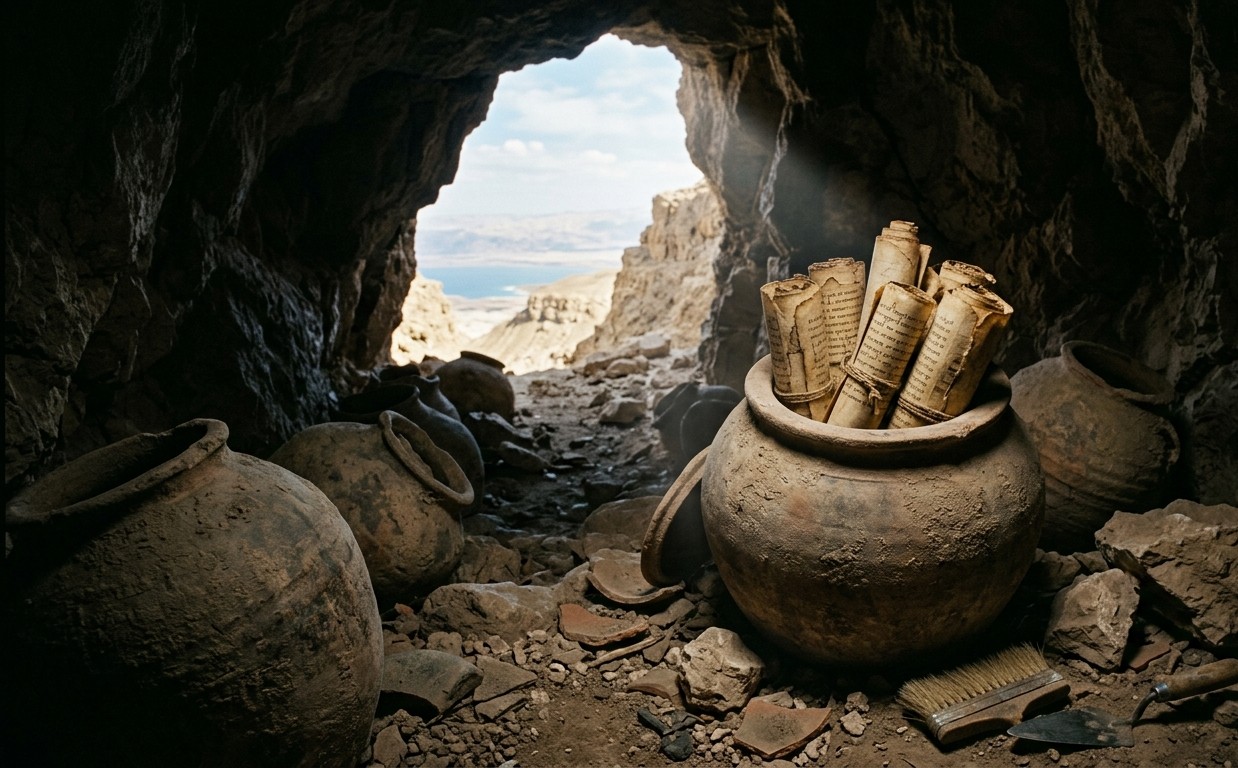
Introduction
What if a group of ancient scrolls could change our understanding of history forever?
In 1947, a young shepherd searching for a lost goat made an unexpected discovery inside a cave near the Dead Sea. Hidden in clay jars were hundreds of ancient manuscripts that had remained untouched for nearly 2,000 years.
These manuscripts later became known as the Dead Sea Scrolls, one of the greatest archaeological discoveries of the twentieth century.
The scrolls contain parts of the Hebrew Bible, religious writings, and documents that reveal how people lived, worshipped, and thought during ancient times. Their discovery gave historians and archaeologists valuable information about the history of Judaism and the world in which Jesus lived.
But who wrote these mysterious scrolls?
Why were they hidden inside caves? And how did they survive for thousands of years in the harsh desert?
In this article, we’ll explore the fascinating story behind The Dead Sea Scrolls, one of history’s greatest discoveries that continues to amaze researchers and readers around the world.
What Are the Dead Sea Scrolls?
The Dead Sea Scrolls are a collection of nearly 900 ancient manuscripts discovered in a series of caves near the Dead Sea in the West Bank. These scrolls were written between the third century BCE and the first century CE, making them some of the oldest surviving religious texts ever found.
The manuscripts were written mainly in Hebrew, while others were written in Aramaic and Greek. They include copies of books from the Hebrew Bible, prayers, hymns, legal documents, and community rules. Some of these biblical manuscripts are more than 1,000 years older than any previously known copies, making them extremely valuable to historians and biblical scholars.
The scrolls were originally made from parchment, with a smaller number written on papyrus. They were carefully rolled up and stored inside clay jars, which helped protect them from moisture and damage for nearly two thousand years.
Today, the Dead Sea Scrolls are considered one of the greatest archaeological discoveries in history. They provide an extraordinary glimpse into the religious beliefs, daily life, and culture of ancient Jewish communities, helping researchers better understand one of the most important periods in human history.
How Were the Dead Sea Scrolls Discovered?
The discovery of the Dead Sea Scrolls happened by pure accident in 1947. According to the most widely accepted story, a young Bedouin shepherd named Muhammad edh-Dhib was searching for a lost goat near the cliffs overlooking the Dead Sea.
While exploring the rocky hills, he threw a stone into a small cave. Instead of hearing the sound of the stone hitting the ground, he heard the breaking of a clay jar. Curious, he climbed into the cave to investigate.
Inside, he found several tall clay jars. Some were empty, but others contained ancient leather scrolls wrapped in cloth. At first, the shepherd had no idea how valuable they were. He and his companions took the scrolls to a local antique dealer, believing they might be worth a little money.
News of the discovery quickly reached archaeologists and historians. Their investigations led to one of the most important archaeological discoveries of the twentieth century.
Over the following years, researchers searched the surrounding area and uncovered eleven caves containing hundreds of additional scrolls and thousands of manuscript fragments. Together, these became known as the Dead Sea Scrolls, providing an extraordinary window into the religious and cultural life of the ancient world.
Who Wrote the Dead Sea Scrolls?
One of the biggest mysteries surrounding the Dead Sea Scrolls is who actually wrote them. Although historians have studied the scrolls for decades, there is still no complete agreement.
The most widely accepted theory is that the scrolls were written by a Jewish group known as the Essenes. The Essenes were a religious community that lived a simple and disciplined life near Qumran, close to the Dead Sea. They devoted themselves to prayer, copying sacred texts, and following strict religious rules.
Many archaeologists believe the Essenes hid the scrolls inside nearby caves to protect them from the Roman Army during the First Jewish Revolt (66–73 CE). As Roman forces advanced through the region, the community may have hidden their valuable manuscripts, hoping to return one day. However, they never came back.
Not everyone agrees with this theory.
Some researchers argue that the scrolls were written by different Jewish groups or collected from libraries in Jerusalem before being hidden in the caves. Because there is no direct evidence identifying the authors, the debate continues today.
Even though their exact creators remain uncertain, the Dead Sea Scrolls provide an incredible record of ancient Jewish beliefs, traditions, and daily life. They remain one of the most valuable historical discoveries ever made.
Why Are the Dead Sea Scrolls So Important?
The Dead Sea Scrolls are considered one of the greatest archaeological discoveries because they have helped historians understand the ancient world in ways that were once impossible.
One of their greatest importance is that they contain some of the oldest known copies of the Hebrew Bible. Before the scrolls were discovered, the oldest surviving biblical manuscripts were written nearly 1,000 years later. By comparing these ancient texts, scholars found that many parts of the Bible had been preserved with remarkable accuracy over the centuries.
The scrolls also provide valuable information about Jewish beliefs, traditions, and daily life during the Second Temple period. They describe religious practices, community rules, prayers, and expectations about the future, giving historians a clearer picture of life more than two thousand years ago.
In addition, the Dead Sea Scrolls help researchers better understand the historical background of early Judaism and the period in which Jesus lived. Although the scrolls do not mention Jesus directly, they reveal the religious environment of that time and explain many beliefs shared by different Jewish communities.
Today, scholars from around the world continue to study the Dead Sea Scrolls. Even after decades of research, these ancient manuscripts still provide new insights into history, religion, and one of the most fascinating civilizations of the ancient world.
Where Are the Dead Sea Scrolls Today?
Today, most of the Dead Sea Scrolls are carefully preserved in museums and research centers, where experts work to protect these priceless manuscripts for future generations.
The largest collection is kept at the Shrine of the Book, part of the Israel Museum in Jerusalem. There, visitors can see some of the most famous scrolls, including the Great Isaiah Scroll, one of the oldest complete copies of a biblical book ever discovered.
Because the scrolls are more than 2,000 years old, they are extremely fragile. Exposure to light, heat, or humidity can damage them. To prevent this, scientists store the manuscripts in special climate-controlled rooms and use advanced technology to preserve them.
In recent years, researchers have also used high-resolution photography and digital scanning to create detailed images of the scrolls. This allows historians and scholars around the world to study them without handling the original manuscripts, reducing the risk of damage.
Although many of the Dead Sea Scrolls are now available online for research, archaeologists continue to search the Judean Desert. From time to time, new fragments are discovered, offering fresh clues about the ancient world and adding to the remarkable story of one of history’s greatest archaeological discoveries.
Conclusion
The Dead Sea Scrolls remain one of the greatest archaeological discoveries in history. Hidden for nearly 2,000 years inside caves near the Dead Sea, these ancient manuscripts have transformed our understanding of the ancient world.
Their discovery provided historians with some of the oldest known copies of the Hebrew Bible, along with valuable writings about religion, culture, and daily life during the Second Temple period. The scrolls have helped scholars better understand the beliefs and traditions of ancient Jewish communities while preserving an important part of human history.
Although many questions remain unanswered—such as who wrote all of the scrolls and why they were hidden—their historical importance is beyond doubt. Every new study continues to reveal fresh insights into one of the most fascinating periods of the ancient world.
Today, the Dead Sea Scrolls are carefully preserved and studied by experts from around the globe. More than seventy years after their discovery, they continue to inspire historians, archaeologists, and readers alike, proving that some of history’s greatest treasures are not made of gold—but of knowledge.
[…] admin Aug 8, 2026 […]
[…] city of Athens, archaeologists uncovered a burial site unlike any other. Among the remains were the mysterious 79 Shackled Men—dozens of people buried together, many still wearing iron shackles around their […]