
 By admin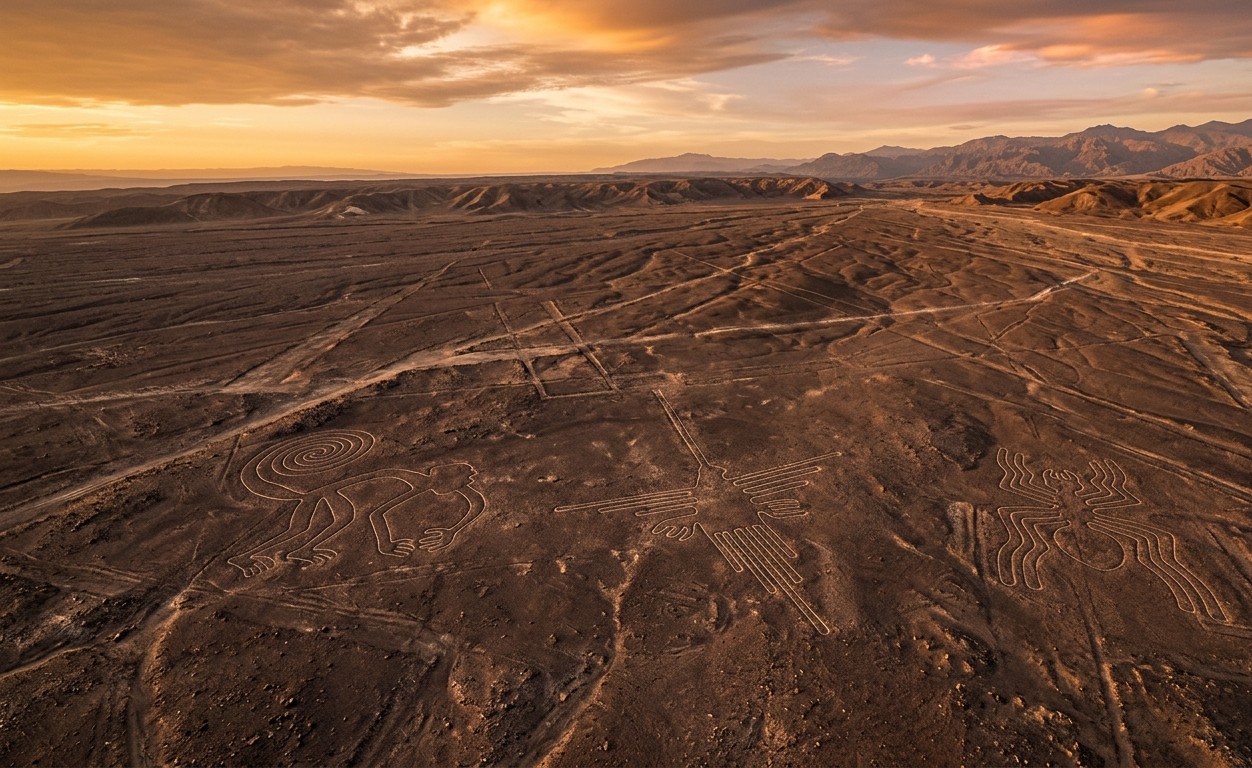
What Are the Nazca Lines?
Imagine flying over a quiet desert in Peru.
At first, all you see is endless sand and dry land. But as the plane gets higher, something incredible begins to appear. Giant drawings cover the desert floor—a hummingbird, a monkey, a spider, and long straight lines stretching for miles.
These are the Nazca Lines, one of the greatest mysteries in history.
The Nazca Lines were created by the Nazca civilization between 500 BCE and 500 CE in southern Peru. Instead of painting on the ground, the people carefully removed the dark rocks from the surface to reveal the lighter soil underneath. This simple method created enormous designs that have survived for nearly 2,000 years.
The strange thing is that these drawings are so large you can’t fully see them while standing on the ground. They only make sense when viewed from high above.
So why did the Nazca people create them?
Were they part of religious ceremonies? Did they mark important routes? Were they connected to the stars? Or is there another explanation we haven’t discovered yet?
Even today, historians and archaeologists continue to study the Nazca Lines. Although several theories exist, no one knows their exact purpose.
That mystery is exactly what makes the Nazca Lines so fascinating.
The Discovery of the Nazca Lines
The story of the Nazca Lines begins in one of the driest places on Earth—the Nazca Desert in southern Peru.
For centuries, local people walked across the desert without realizing they were standing on one of history’s greatest mysteries. From the ground, the lines looked like nothing more than shallow grooves in the sand. It was impossible to see the giant shapes they formed.
Everything changed in the early 20th century.
In the 1920s, pilots flying over the Nazca Desert noticed strange patterns below. From the sky, they could clearly see enormous drawings of birds, animals, plants, and long straight lines stretching across the landscape. It was a discovery that amazed the world.
Archaeologists soon began studying the site. They found that the drawings had been created by the Nazca civilization, which lived in the region between 500 BCE and 500 CE.
The people didn’t dig deep into the ground. Instead, they simply removed the dark reddish stones covering the desert surface. Underneath was a lighter-colored layer of soil. By clearing away the top layer, they created huge images that could only be fully seen from above.
Some of these geoglyphs are over 300 meters (1,000 feet) long. They include a hummingbird, a monkey, a spider, a whale, and many other figures, along with hundreds of straight lines and geometric shapes.
What makes the Nazca Lines even more remarkable is how well they have survived. The Nazca Desert receives very little rainfall, and there is almost no wind. Because of these unique conditions, the drawings have remained visible for nearly 2,000 years.
As researchers continued their work, one question became impossible to ignore:
Why would an ancient civilization create enormous drawings that could only be fully appreciated from the sky?
That question is still being debated today, making the Nazca Lines one of the world’s greatest archaeological mysteries.
How Were the Nazca Lines Made?
One of the biggest questions about the Nazca Lines isn’t just why they were made—it’s how.
At first, many people assumed that creating such enormous drawings without modern technology would have been impossible. After all, some of the figures stretch for hundreds of meters and can only be fully seen from the air.
But the answer may be simpler than it seems.
The Nazca people didn’t carve deep into the ground. Instead, they removed the dark stones that covered the desert floor. Beneath those stones was a lighter layer of soil. By clearing away the top layer, they created lines that stood out clearly against the surrounding landscape.
Archaeologists believe the Nazca people used wooden stakes, ropes, and careful measurements to plan the designs. In fact, researchers have found wooden stakes at several Nazca sites, supporting this idea.
Experiments have also shown that a small group of people can recreate similar geoglyphs using only simple tools. This suggests that the Nazca civilization did not need advanced technology to create these giant artworks.
Another reason the lines have survived for nearly 2,000 years is the unique climate of the Nazca Desert. The region receives very little rain, has almost no strong winds, and remains extremely dry throughout the year. These conditions have protected the drawings from erosion.
Even though experts have a good idea of how the Nazca Lines were created, one mystery still remains.
Creating them was possible.
But why did the Nazca people spend so much time and effort making giant drawings that could only be fully appreciated from high above?
That question continues to puzzle historians today.
Why Did the Nazca People Create the Nazca Lines?
This is the biggest mystery of all.
We know how the Nazca Lines were made. But no one knows for certain why they were created.
Over the years, historians and archaeologists have suggested several theories. Some are supported by evidence, while others remain pure speculation.
Theory 1: Religious Ceremonies
The most widely accepted theory is that the Nazca Lines had a religious purpose.
The Nazca people lived in one of the driest regions in the world, where water was precious. Many experts believe the giant drawings were connected to ceremonies asking the gods for rain and good harvests.
Some of the long lines may even have been used as walking paths during religious rituals.
Theory 2: An Ancient Calendar
Another idea is that the Nazca Lines were linked to astronomy.
Some researchers noticed that a few of the lines point toward the sunrise or sunset during certain times of the year. Because of this, they suggested the lines may have helped the Nazca people keep track of the seasons.
However, later studies found that many of the alignments could simply be a coincidence, so this theory remains uncertain.
Theory 3: Messages for the Gods
Since the giant figures can only be fully seen from above, some people believe they were created for the gods rather than for humans.
According to this idea, the Nazca people made the drawings as offerings or symbols of respect, hoping their gods would protect them and provide enough water to survive.
Theory 4: Ancient Aliens
Perhaps the most famous theory comes from books and television shows about ancient aliens.
Some people claim the Nazca Lines were created with help from extraterrestrials or served as landing strips for alien spacecraft.
While this idea is popular in movies and documentaries, there is no scientific evidence to support it. Most archaeologists reject this theory.
Today, the religious explanation remains the strongest because it matches what researchers know about the Nazca civilization and its beliefs.
Still, without written records from the Nazca people themselves, the true purpose of the Nazca Lines remains one of history’s greatest unanswered questions.
What Do Historians Really Think About the Nazca Lines?
The Nazca Lines have inspired countless theories over the years. But what do professional historians and archaeologists actually believe?
Most experts agree on one thing: the Nazca people created the lines themselves.
There is strong evidence that the drawings were made between 500 BCE and 500 CE using simple tools such as wooden stakes, ropes, and careful planning. Archaeologists have even found wooden stakes at some of the sites, supporting this idea.
However, when it comes to why the lines were created, there is still no single answer.
Many researchers believe the geoglyphs were connected to religion. The Nazca civilization depended heavily on rainfall, and water was extremely scarce in the desert. Because of this, the giant drawings may have played an important role in ceremonies asking the gods for rain and successful harvests.
Others think the lines may have marked important routes or gathering places where people held festivals and rituals.
What most historians do not believe is the ancient alien theory.
Although it has become popular through books, documentaries, and television shows, there is no archaeological evidence that extraterrestrials were involved in creating the Nazca Lines. Everything discovered so far points to human craftsmanship.
Modern technology has also helped researchers learn more about the site. Using drones, satellite images, and artificial intelligence, scientists have discovered dozens of new geoglyphs that were previously hidden or too faint to notice.
These discoveries show that the Nazca civilization created far more designs than people once believed.
Even after decades of research, the Nazca Lines continue to surprise experts. Every new discovery brings us a little closer to understanding them, but many questions still remain unanswered.
That is why the Nazca Lines remain one of the world’s greatest archaeological mysteries.
Lessons From the Nazca Lines
The Nazca Lines are more than just giant drawings in the desert. They remind us that history is often more complex than it first appears.
Lesson 1: Ancient people achieved amazing things with simple tools.
The Nazca civilization had no airplanes, satellites, or modern technology. Yet they created enormous geoglyphs that have survived for nearly 2,000 years. Their work shows that creativity, planning, and teamwork can accomplish incredible things.
Lesson 2: Not every mystery has a clear answer.
Even after decades of research, no one knows exactly why the Nazca Lines were created. Several theories exist, but none have been proven beyond doubt. Sometimes history leaves us with questions instead of answers.
Lesson 3: Science continues to reveal new discoveries.
Researchers are still finding new geoglyphs in the Nazca Desert using drones, satellite imagery, and artificial intelligence. Every discovery helps us understand the Nazca civilization a little better.
Lesson 4: We should separate facts from speculation.
The Nazca Lines have inspired many exciting stories, including theories about ancient aliens. While these ideas are entertaining, historians rely on evidence. So far, the strongest evidence points to the Nazca people themselves as the creators of the lines.
Today, millions of people visit Peru or view aerial photographs of the Nazca Lines to admire one of the world’s greatest archaeological wonders.
Although their true purpose remains uncertain, the Nazca Lines continue to inspire curiosity, research, and imagination. And perhaps that is their greatest legacy.
Conclusion
More than 2,000 years after they were created, the Nazca Lines continue to puzzle historians, archaeologists, and travelers from around the world.
At first glance, they may look like simple lines in the desert. But from the sky, they reveal enormous drawings that have survived for centuries. Their size, precision, and mysterious purpose make them one of the greatest archaeological wonders ever discovered.
Were the Nazca Lines created for religious ceremonies? Did they help mark important events or water sources? Or were they connected to the stars? While researchers have developed several theories, no one can say with complete certainty why they were made.
What we do know is that the Nazca people were highly skilled. With simple tools and careful planning, they created massive geoglyphs that continue to amaze the modern world.
Today, new technologies such as drones and satellite imaging are helping researchers uncover more hidden designs, proving that there is still much to learn about this ancient civilization.
The Nazca Lines remind us that history is full of mysteries waiting to be explored. Sometimes the most fascinating questions don’t have easy answers—and that is exactly what keeps people searching for the truth.
Whether you see them as works of art, symbols of faith, or one of history’s greatest unsolved mysteries, the Nazca Lines remain a powerful reminder of human creativity and curiosity.
[…] admin Aug 4, 2026 […]
[…] the middle of the night to the smell of smoke. Within hours, flames spread through narrow streets, wooden houses collapsed, and thousands of people fled with only what they could carry. This nightmare […]