
 By admin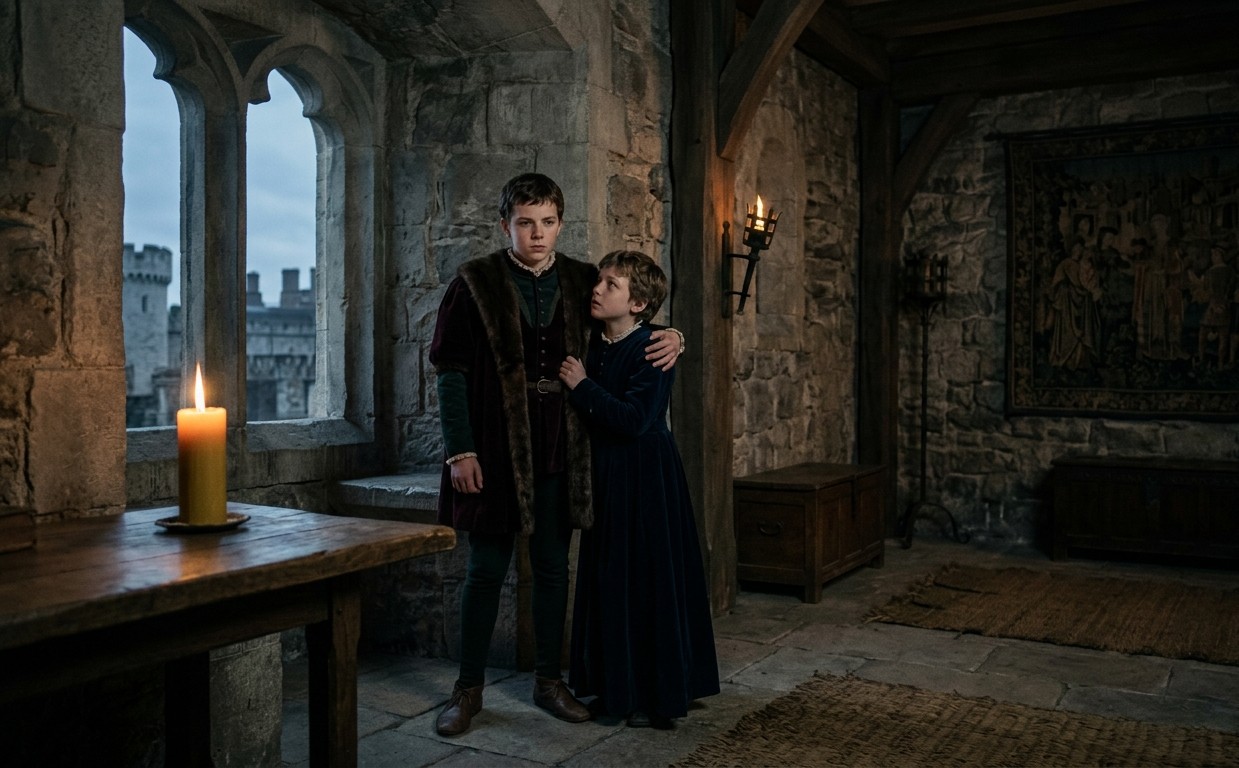
The Two Princes Who Disappeared
Imagine being one of the Princes in the Tower, living inside one of England’s most famous castles, surrounded by guards and royal servants—and then suddenly disappearing without a trace.
This is the mystery of the Princes in the Tower, one of the most enduring unsolved mysteries in English history.
The two boys were Edward V and his younger brother Richard, Duke of York. They were the sons of King Edward IV and members of the powerful House of York.
In 1483, their father died, leaving Edward, who was still a child, as the new king of England.
Because Edward V was too young to rule independently, his uncle Richard, Duke of Gloucester, was appointed Lord Protector.
The young king was taken to the Tower of London, which at that time was not simply a prison. It was also a royal residence where kings and members of the royal family could stay.
Soon, Edward’s younger brother Richard joined him there.
At first, their stay did not seem unusual.
But within a few months, the political situation changed dramatically.
The two princes gradually disappeared from public view, and rumors began spreading throughout England.
What happened to them?
Were they secretly killed?
Were they moved somewhere for their own protection?
Or did they survive and escape the dangerous struggle for the English throne?
More than five centuries later, historians still debate the fate of the Princes in the Tower.
Why Were the Princes Taken to the Tower?
After the death of King Edward IV in April 1483, his eldest son Edward V became king.
But the new king was still a child, so he could not rule on his own. His uncle, Richard, Duke of Gloucester, took responsibility for protecting him and managing the kingdom until Edward was old enough to govern.
Edward V was traveling toward London when Richard intercepted him and escorted him to the Tower of London.
At first, this may not have seemed suspicious. The Tower was a royal residence, and it was common for important members of the royal family to stay there.
Soon, however, Edward’s younger brother Richard, Duke of York, was also brought to the Tower.
The two brothers were seen together inside the royal residence, but their situation became increasingly uncertain.
Then came a major political development.
Richard of Gloucester’s supporters claimed that Edward IV’s marriage to Elizabeth Woodville, the princes’ mother, had been invalid. If that claim were true, Edward V and his brother would have been considered illegitimate and therefore unable to inherit the throne.
In June 1483, Parliament accepted this argument through a document known as Titulus Regius.
Richard of Gloucester was then declared the rightful king and became Richard III.
The two young princes, meanwhile, remained inside the Tower.
And this is where the mystery becomes darker.
After a certain point, the boys were seen less and less frequently.
Eventually, they disappeared from public view completely.
No reliable record explains exactly what happened to them afterward.
The Last Sightings of the Two Princes
After Richard III took the throne, the two young princes remained inside the Tower of London. At first, they were still occasionally seen by people around the royal household. Some historical accounts describe the boys playing together and appearing at the Tower windows.
But as the weeks passed, their public appearances became less frequent. By the summer of 1483, reports about the princes had almost completely disappeared. Eventually, they vanished from public view.
Their sudden disappearance created rumors throughout England. People began asking why the two sons of the former king were no longer being seen. No official announcement clearly explained where they had gone. Some believed the princes had been secretly killed, while others thought they had been moved to another location.
Their disappearance was especially significant because their existence represented a potential threat to Richard III’s claim to the throne. If Edward V and his younger brother were still alive, supporters of the House of York could potentially use them to challenge Richard’s authority.
However, there is an important problem for historians: there is no surviving contemporary record that conclusively explains what happened to the boys. Later writers claimed that the princes had been murdered inside the Tower, but these accounts were written after the events and sometimes contained political motives or conflicting details. Therefore, they cannot be treated as unquestionable evidence.
The political situation at the time made the mystery even more complicated. Several powerful groups had reasons to support or oppose Richard III, and stories about the princes could easily be used as political weapons.
Over time, one question became central to the mystery:
Were the Princes in the Tower murdered—or did they somehow survive?
Were they killed inside the Tower? Were they secretly taken somewhere else? Or did someone else decide their fate?
The answers may have disappeared with the princes themselves.
Richard III — The King Accused of Murder
Richard III became one of the most controversial figures in English history largely because of what happened to his two nephews.
After the princes disappeared, suspicion quickly fell on their uncle. Richard had gained the crown after Parliament declared the boys illegitimate, and their disappearance removed two potential rivals to his throne.
Later writers accused Richard III of ordering the princes to be murdered inside the Tower.
One of the most famous accounts came from Thomas More, who wrote that the boys were secretly killed and buried. However, More’s account was written years after the disappearance, and historians still debate how reliable his story is.
Richard’s enemies also had strong political reasons to portray him as a cruel murderer.
In 1485, Richard III was defeated and killed at the Battle of Bosworth Field by Henry Tudor, who became King Henry VII.
The Tudor dynasty had a strong interest in presenting Richard as a dangerous and illegitimate ruler. Later portrayals, including Shakespeare’s famous play Richard III, helped strengthen the image of Richard as a ruthless king responsible for his nephews’ deaths.
But history is rarely that simple.
There is no surviving document proving that Richard ordered the murder of the princes.
At the same time, there is also no definitive evidence proving that the boys survived.
This uncertainty is what has kept the mystery alive for more than five centuries.
The Bones Found in the Tower of London
The mystery took an unexpected turn more than a century after the disappearance of the two princes.
In 1674, workers renovating the Tower of London discovered a wooden box containing the bones of two young children beneath a staircase.
The remains were believed by some to belong to Edward V and Richard, Duke of York.
King Charles II ordered the bones to be placed in an urn at Westminster Abbey, where they remain today.
However, the discovery did not solve the mystery completely.
The bones were never conclusively identified as those of the two princes. Their exact ages, identities, and causes of death remained uncertain.
In 1933, the remains were examined again by a team of scientists. Their investigation suggested that the bones could belong to two children of approximately the right ages, but the evidence was still not sufficient to establish their identities with certainty.
Modern scientific techniques, particularly DNA analysis, could potentially provide more information. However, attempts to conduct definitive genetic testing have faced ethical, legal, and practical complications.
As a result, the bones in Westminster Abbey remain an important but unresolved piece of evidence.
If they really are the remains of the Princes in the Tower, they could provide clues about one of England’s greatest historical mysteries.
But if they are not, the true fate of the two boys becomes even more mysterious.
Theories About What Happened to the Princes
The disappearance of Edward V and Richard, Duke of York has produced several theories over the centuries. But no single explanation has been proven beyond doubt.
Theory 1: Richard III Ordered Their Murder
The most famous theory is that Richard III ordered the princes to be killed because they were potential rivals to his throne.
This theory became popular through later historical accounts, but there is no surviving document that directly proves Richard gave such an order.
Theory 2: Henry Stafford Was Responsible
Another possibility is Henry Stafford, Duke of Buckingham, one of Richard III’s former allies.
Buckingham later rebelled against Richard and was executed in 1483. Some historians have suggested that he may have played a role in the princes’ disappearance, although there is no conclusive evidence connecting him to their deaths.
Theory 3: Someone Else Removed Them
Another possibility is that the princes were secretly taken away from the Tower by someone trying to protect them—or by someone who wanted to use them for political purposes.
Because the political situation was unstable, several powerful groups had motives to control the boys.
Theory 4: They Died Naturally
There is also a less dramatic possibility: the princes may have died from illness or another natural cause.
However, their sudden disappearance and the lack of a public explanation make this theory difficult to establish.
The truth may never be known.
What makes the mystery so fascinating is that each theory has unanswered questions, while the strongest evidence—the fate of the two boys themselves—has never been conclusively established.
Could the Princes Have Survived?
The disappearance of the two princes does not necessarily prove that they were murdered.
Over the centuries, several people appeared claiming to be one of the missing sons of Edward IV. The most famous was Perkin Warbeck, who appeared in the 1490s and claimed to be Richard, Duke of York.
Warbeck was convincing enough to gain support from several European rulers and English opponents of Henry VII. He even attracted political and military backing for his claim to the English throne.
However, Henry VII eventually captured Warbeck. He was imprisoned in the Tower of London and later executed in 1499.
Most historians consider Warbeck’s claim to have been false, but his story shows how powerful the mystery of the missing princes had become.
If either Edward V or his younger brother had actually survived, they could have posed a serious threat to the Tudor monarchy.
Yet no credible evidence has ever established that either prince lived into adulthood.
The possibility of survival therefore remains part of the legend, rather than a proven historical fact.
The mystery continues because the evidence disappears at exactly the point where the story should become clear.
What Does History Really Tell Us?
More than five centuries after their disappearance, the fate of Edward V and Richard, Duke of York remains uncertain.
What we know is that the two boys were taken to the Tower of London in 1483 and gradually disappeared from public view. After that, reliable evidence about their lives becomes extremely limited.
The discovery of children’s bones inside the Tower in 1674 created a possible clue, but the remains have never been conclusively proven to belong to the princes.
Richard III remains the person most strongly associated with their disappearance, largely because he benefited politically from their removal. However, historians cannot point to definitive contemporary evidence proving that he ordered their deaths.
Other suspects and explanations have also been proposed, but none has been conclusively established.
This uncertainty is exactly what makes the Princes in the Tower such a fascinating historical mystery.
The story is not simply about two missing children. It is also about political power, royal succession, propaganda, and how difficult it can be to separate historical evidence from stories created long after an event.
The truth may still be hidden somewhere in the archives, beneath the Tower, or perhaps it has been lost forever.
And until new evidence emerges, one question will continue to echo through English history:
What really happened to the two princes who disappeared from the Tower?
Conclusion
The mystery of the Princes in the Tower has survived for more than 500 years because it has never received a definitive answer.
They may have been murdered, secretly removed, or met another fate that history failed to record.
The Mystery That Still Remains
The story of the Princes in the Tower has survived for more than five centuries, yet the final answer remains frustratingly out of reach.
Edward V and Richard, Duke of York disappeared during one of the most turbulent periods in English history. Their disappearance was followed by political upheaval, the fall of Richard III, and the rise of the Tudor dynasty.
The discovery of two children’s skeletons inside the Tower provided a possible clue, but without conclusive identification, the mystery remains unresolved.
Perhaps future archaeological or scientific research will reveal new evidence. DNA testing, historical documents, or another unexpected discovery could potentially change what we know about the two princes.
Until then, the fate of the boys remains one of England’s most haunting historical questions.
They entered the Tower as young members of the royal family.
They disappeared as children.
And centuries later, the world is still asking:
What happened to the Princes in the Tower?
[…] admin Aug 10, 2026 […]