
 By admin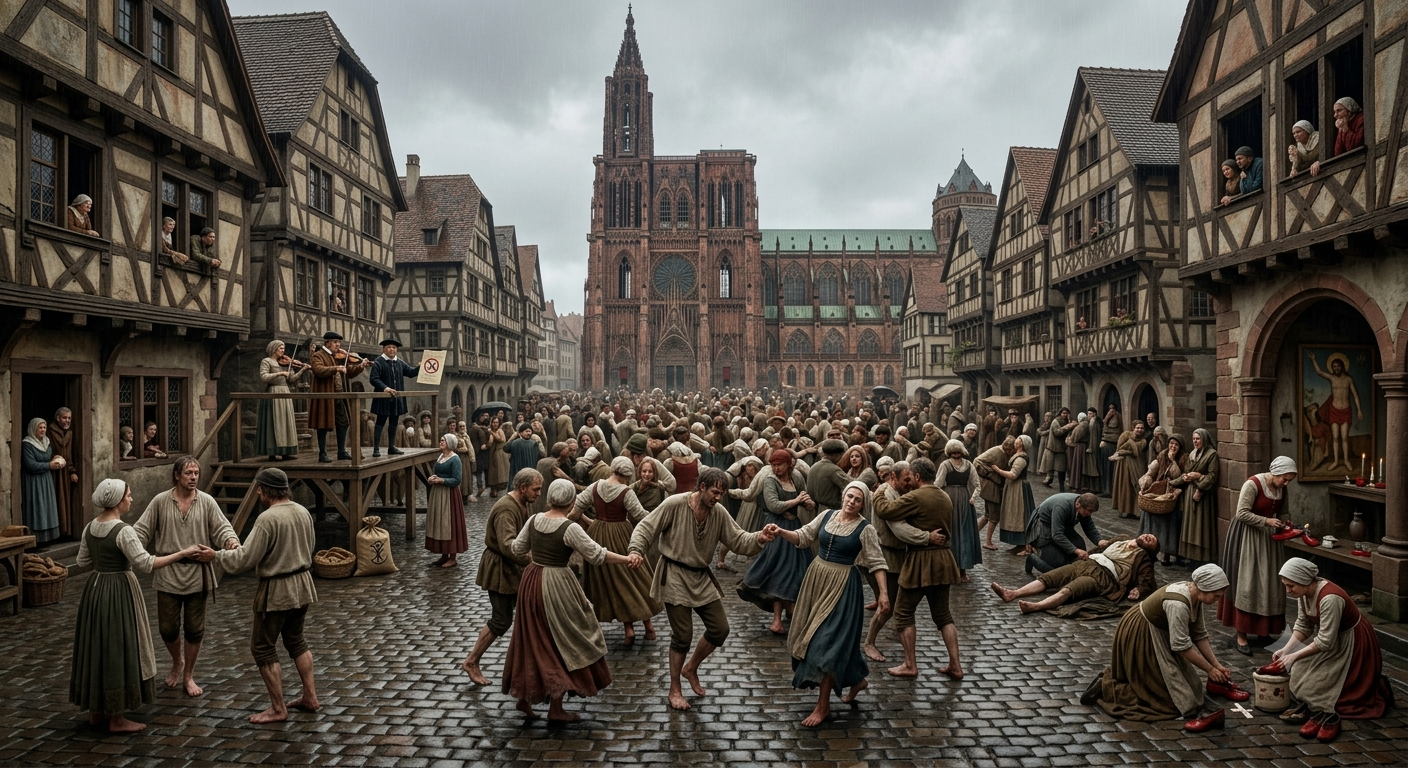
Introduction
Imagine walking through the streets of Strasbourg in 1518 and seeing a woman dancing all by herself. At first, you might think she is celebrating something or simply enjoying the music in her mind.
But then something strange happens.
She doesn’t stop.
Hours pass, then an entire day. She keeps dancing without taking a real break. Soon, other people begin to join her. Within days, dozens of men and women are dancing in the streets. Before long, hundreds of people are moving nonstop, unable to control their bodies.
This was not a festival.
There was no music, no celebration, and no reason to dance. Many people became exhausted, collapsed from fatigue, and some even died after dancing for days.
This bizarre event became known as the Dancing Plague of 1518, one of the strangest mysteries in history. It took place in Strasbourg, a city that is now part of France, and it has puzzled historians and scientists for more than 500 years.
So what caused hundreds of ordinary people to dance until they could no longer stand?
Was it a mysterious disease, mass panic, poisoned food, or something that science still cannot fully explain?
Let’s uncover the incredible mystery behind the Dancing Plague of 1518.
How the Dancing Plague of 1518 Began
The story of the Dancing Plague of 1518 began in July 1518 in the city of Strasbourg, which was part of the Holy Roman Empire at the time and is now located in modern-day France.
It all started with a single woman named Frau Troffea.
According to historical records, she suddenly walked into the street and began dancing. At first, the people around her thought she was celebrating something or simply acting strangely. No one imagined that they were about to witness one of history’s most mysterious events.
Hours passed, but Frau Troffea did not stop.
She continued dancing throughout the day, even though she looked completely exhausted. Instead of resting, she kept moving as if she had lost control of her own body. Witnesses said she appeared unable to stop, no matter how tired she became.
Over the next few days, something even more unbelievable happened.
Other people started dancing too.
One by one, men and women joined her. Within a week, dozens of people were dancing in the streets. Before the end of the month, historical reports claimed that around 400 people had become part of the strange outbreak.
The city quickly fell into confusion.
Families watched in fear as their loved ones danced without stopping. Some dancers collapsed from exhaustion, only to get back on their feet and continue moving. Others became so weak that they reportedly died from heart attacks, strokes, or extreme physical exhaustion.
No one understood what was happening.
What had begun with one woman had suddenly become one of the most mysterious events ever recorded in European history.
How Did the Authorities Respond?
As more and more people became part of the Dancing Plague of 1518, the city authorities grew increasingly worried. No one understood what was causing the strange behavior, and every day the number of dancers continued to rise.
Instead of trying to stop the dancing, the officials made a surprising decision.
At that time, local doctors believed the dancers were suffering from an illness caused by “overheated blood.” They thought the only way to recover was to let the dancers continue until the condition passed naturally.
Following this advice, the authorities built wooden stages in public squares so the dancers would have more space. They even hired musicians and drummers to keep the dancers moving, believing this would help them recover more quickly.
Unfortunately, the plan had the opposite effect.
The music encouraged even more people to join the dancing. What had started with a single woman soon became a much larger outbreak, and the streets of Strasbourg filled with exhausted men and women who seemed unable to stop.
As the situation became more serious, the authorities finally realized that their approach was not working. They changed their strategy and stopped the public performances. The remaining dancers were taken to a nearby religious shrine, where they were encouraged to rest, pray, and seek spiritual healing.
Gradually, the strange outbreak began to disappear.
However, the most important question remained unanswered.
Why had hundreds of perfectly ordinary people suddenly started dancing without being able to stop?
That mystery continues to puzzle historians more than 500 years later.
What Could Have Caused the Dancing Plague?
For more than 500 years, historians, doctors, and scientists have tried to explain the Dancing Plague of 1518. Although many theories have been suggested, no one has found a single answer that explains everything.
One of the most widely accepted theories is mass psychogenic illness, sometimes called mass hysteria. According to this idea, the people of Strasbourg were living under extreme stress. Disease, hunger, poverty, and fear had become part of everyday life. Some experts believe this emotional pressure may have caused large groups of people to experience the same unusual behavior without realizing it.
Another popular theory involves ergot poisoning. Ergot is a fungus that can grow on rye, a type of grain commonly used to make bread. The fungus contains chemicals that can affect the brain and cause hallucinations or unusual behavior. At first, this explanation seemed possible.
However, many researchers no longer believe it is the main cause. They argue that people poisoned by ergot would have struggled to dance continuously for days because the poisoning usually causes severe pain, muscle spasms, and weakness.
Some people at the time believed the outbreak was a curse from God or the result of supernatural forces. Since religion played an important role in everyday life during the sixteenth century, many families accepted this explanation and turned to prayer instead of medicine.
So which theory is correct?
The truth is that no one knows for certain. Every explanation answers some questions but leaves others unanswered. That uncertainty is exactly why the Dancing Plague of 1518 remains one of history’s most fascinating and mysterious events.
Why Does the Mystery Still Fascinate People Today?
More than 500 years have passed since the Dancing Plague of 1518, yet the story continues to capture the imagination of people around the world. Historians still study it, scientists continue to debate its cause, and millions of people discover the mystery through books, documentaries, and the internet.
One reason the story remains so fascinating is that it really happened. Unlike many famous legends, the Dancing Plague is supported by historical records written by people who witnessed the event. These documents describe how hundreds of people danced for days without being able to stop, leaving behind a mystery that has never been fully explained.
The event also reminds us how different life was in the sixteenth century. Medical knowledge was limited, and many illnesses were misunderstood. People often believed that unusual events were caused by curses, angry saints, or supernatural forces. Without modern science, even experienced doctors struggled to understand what they were seeing.
But could something like this happen today?
Most experts believe a similar event is very unlikely. However, they also point out that stress and fear can sometimes affect large groups of people in unexpected ways. This is one reason why the Dancing Plague of 1518 is still studied by psychologists, historians, and medical researchers.
Even after centuries of research, one fact remains unchanged.
No one has been able to explain exactly why hundreds of ordinary people suddenly began dancing without stopping. That unanswered question is what keeps the mystery alive and makes the Dancing Plague of 1518 one of the strangest events in human history.
Conclusion
The Dancing Plague of 1518 remains one of the strangest and most puzzling events in history. What began with a single woman dancing in the streets of Strasbourg soon turned into an outbreak that involved hundreds of people, leaving an entire city confused and frightened.
Over the centuries, experts have suggested many explanations. Some believe it was caused by mass psychogenic illness, while others have blamed poisoned food or even supernatural forces. Although each theory offers possible answers, none has been able to explain every detail of the event.
So what really happened during the Dancing Plague of 1518?
The truth is that no one knows for certain.
That is exactly why this mystery continues to fascinate historians, scientists, and curious readers around the world. It reminds us that, despite all the knowledge we have today, some events from the past still refuse to reveal their secrets.
The Dancing Plague of 1518 is more than just a strange historical story. It is a reminder that history is filled with mysteries waiting to be understood, and sometimes the questions are even more fascinating than the answers.
Read next: The Mary Celeste: The Ghost Ship Found Without a Crew
[…] admin Aug 5, 2026 […]