
 By admin
 Introduction
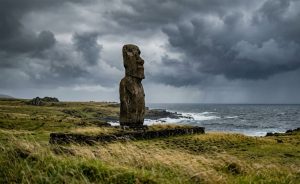
Imagine standing on a remote island in the middle of the Pacific Ocean and seeing hundreds of enormous Moai of Easter Island staring silently across the landscape.
Some are more than 10 meters tall. Many weigh several tons. They were carved centuries ago, long before modern machinery existed.
These mysterious statues are called Moai, and they are one of the most recognizable symbols of Easter Island.
But who built them?
Why were they created?
And perhaps the biggest mystery of all—how did ancient people move such enormous statues across the island?
The story of the Moai is not simply a mystery about giant stone statues. It is the story of an extraordinary society, its beliefs, its achievements, and the dramatic changes that eventually transformed the island.
A Remote Island in the Pacific
Easter Island, known by its Indigenous name Rapa Nui, is one of the most isolated inhabited islands on Earth.
It lies thousands of kilometers from mainland South America, surrounded by the vast Pacific Ocean. Despite its isolation, Polynesian settlers reached the island centuries ago and established a distinctive culture there.
Over time, the people of Rapa Nui developed their own traditions, religious beliefs, social structure, and remarkable stone-carving skills.
The most famous expression of their culture became the Moai.
These enormous figures were not random monuments. They were deeply connected to the beliefs and ancestors of the people who created them.
And once you understand why the Moai were built, the mysterious statues begin to tell a very different story.
Why Did the People of Rapa Nui Build the Moai?
The Moai were created between roughly the 13th and 17th centuries, during a period when the culture of Rapa Nui was developing and expanding.
The statues are generally believed to have represented important ancestors or powerful individuals. The people of Rapa Nui believed that influential ancestors could continue to protect and influence the living after death.
This may explain an important feature of the Moai: many of them were positioned so that they faced inland toward the communities, rather than looking out toward the ocean.
The statues were usually placed on ceremonial platforms called ahu. These platforms served as important religious and social spaces.
The Moai themselves were often given a distinctive appearance—large heads, strong facial features, and elongated ears. Their enormous heads were not simply artistic exaggerations. In Polynesian cultures, the head was often considered an important source of spiritual power.
Some Moai were also fitted with red volcanic-stone topknots, known as pukao. These may have represented hairstyles or other symbols of status.
But creating the statues was only the beginning.
The real challenge came afterward:
How could the people of Rapa Nui move statues weighing several tons from the quarry to different parts of the island?
How Were the Giant Moai Carved?
Most of the Moai of Easter Island were carved from volcanic tuff, a relatively soft rock formed from compacted volcanic ash. The main quarry was Rano Raraku, a volcanic crater on Rapa Nui.
Ancient carvers worked directly into the volcanic rock using hard stone tools. Instead of carving the Moai of Easter Island completely free from the mountain immediately, they gradually shaped the figure while it was still attached to the rock.
The face, body, arms, and other features were carefully formed. Once the Moai of Easter Island was almost finished, the workers separated it from the bedrock and prepared it for transportation.
Some unfinished Moai can still be seen at Rano Raraku today. They provide an extraordinary glimpse into the carving process and show that the statues were made through careful, skilled craftsmanship rather than mysterious technology.
An Enormous Undertaking
Creating a Moai was not a quick task.
The largest completed statues could reach more than 10 meters in height and weigh many tonnes. Moving one across the island would have required considerable organization and cooperation.
And this is where one of the greatest Moai mysteries begins.
For years, researchers debated whether the statues were dragged horizontally using ropes and wooden supports, transported on sledges, or moved using some completely different method.
But archaeological experiments have produced another fascinating possibility:
Perhaps the Moai were actually “walked.”
Researchers have demonstrated that teams using ropes could rock an upright statue from side to side, gradually moving it forward.
Could this explain how the ancient people of Rapa Nui transported their enormous statues?
How Did the Moai “Walk” Across Easter Island?
Moving a stone statue weighing several tons sounds almost impossible without modern machinery. Yet the people of Rapa Nui managed to transport hundreds of Moai of Easter Island from the quarry at Rano Raraku to different ceremonial sites across the island.
For many years, researchers proposed different explanations.
Some believed the statues were placed on wooden sledges and dragged across logs. Others suggested that they were transported horizontally using ropes and wooden structures.
But another theory became particularly fascinating: the Moai may have been transported upright.
The “Walking” Method
In experimental archaeology, researchers have shown that a large replica of a Moai can be moved while standing upright.
Teams of people attach ropes to different parts of the statue and pull it alternately from side to side. As the statue rocks, its base moves slightly forward.
With coordinated movements, the statue appears to “walk.”
This idea is especially interesting because some ancient Moai have a slightly curved or tilted shape that may have made this type of movement possible.
The technique would have required teamwork, rhythm, strength, and careful coordination. Rather than relying entirely on huge amounts of wood or complicated machinery, the islanders could potentially use ropes, human power, and the statue’s own shape.
However, researchers continue to debate exactly how every Moai was transported. Different methods may have been used at different times or for different statues.
Whatever technique was used, the achievement remains extraordinary.
The people of Rapa Nui were able to transform volcanic rock into enormous statues—and then transport those statues across a remote Pacific island.
But eventually, the society that created the Moai experienced dramatic changes.
The Mystery of the Fallen Moai
For centuries, the Moai stood across Rapa Nui as symbols of ancestors, status, and spiritual power. But today, many of the statues are no longer standing.
Some were deliberately toppled during periods of conflict and social change, while others fell because of weathering, earthquakes, or the natural deterioration of their stone platforms.
For a long time, the fallen statues were used as evidence for a dramatic story: that the people of Rapa Nui had destroyed their own environment, exhausted their resources, and collapsed into chaos.
But modern research has made that story much more complicated.
Did the Islanders Destroy Their Environment?
One popular theory claimed that the islanders cut down almost all of the island’s trees to transport the Moai, eventually causing ecological collapse and widespread famine.
However, researchers have found evidence suggesting that the history of Rapa Nui was more complex.
The island’s environment certainly changed, and humans played a role in those changes. But factors such as drought, invasive Polynesian rats, changes in vegetation, and later European contact also affected the island’s population and environment.
The arrival of Europeans in the 18th century brought new diseases, slavery, and other devastating disruptions to Rapa Nui society.
So the dramatic idea of a civilization simply destroying itself may not tell the whole story.
A Civilization That Survived
Despite enormous challenges, the people of Rapa Nui did not simply disappear.
Their descendants still live on the island today, and Rapa Nui culture, language, traditions, and identity continue to survive.
The Moai of Easter Island therefore represent more than a mysterious ancient achievement.
They are also evidence of a resilient Polynesian society that developed remarkable traditions in one of the most isolated places on Earth.
Why Did the Moai Building Tradition End?
For centuries, the people of Rapa Nui continued to carve and erect Moai. But eventually, the tradition began to decline.
The exact reason remains uncertain, and historians do not believe there was one single event that suddenly ended Moai construction.
Changes in Rapa Nui Society
Over time, Rapa Nui society experienced significant environmental and social changes. Competition between communities and changing religious beliefs may have reduced the importance of the traditional ancestor statues.
Some Moai were deliberately toppled from their ahu platforms during periods of conflict. As the island’s social and religious systems changed, the enormous statue-building tradition gradually lost its central role.
A new religious tradition also emerged, associated with the Birdman cult, or Tangata manu. This represented a major shift in the spiritual and political life of Rapa Nui.
European Contact Changed Everything
Then, in 1722, the Dutch explorer Jacob Roggeveen became the first recorded European to reach the island.
European contact brought devastating consequences over the following centuries. Diseases to which the islanders had little immunity spread through the population. Slave raids also removed many people from the island, causing enormous suffering and disrupting traditional society.
By this period, the era of constructing giant Moai had already largely ended.
The statues that remained standing continued to dominate the landscape, while many others lay fallen beside their ceremonial platforms.
Yet the story of the Moai was far from over.
Centuries later, archaeologists would begin studying these mysterious statues and uncovering clues about the remarkable civilization that created them.
The Rediscovery of the Moai
For centuries, the Moai stood across Rapa Nui as silent reminders of the people who created them. European visitors began documenting the statues after the island was encountered by Europeans in the 18th century, but the true history behind the monuments remained poorly understood.
As archaeologists and researchers began studying Rapa Nui more systematically, they discovered that the famous statues were only one part of a much larger cultural landscape.
They found hundreds of Moai, along with ceremonial platforms, stone tools, roads, quarry sites, and unfinished statues.
The Quarry Revealed the Secret
One of the most important discoveries was made at Rano Raraku, the volcanic quarry where most of the Moai were carved.
The quarry contains numerous unfinished statues still attached to the rock. These statues effectively preserve different stages of the carving process.
They show that the islanders had developed sophisticated techniques for shaping enormous figures from volcanic stone.
Researchers also discovered evidence that the statues were connected to a wider system of roads and ceremonial sites across the island.
This changed the way historians viewed the Moai.
They were not isolated monuments created without a plan. They were part of a complex society with skilled craftspeople, religious traditions, transportation systems, and organized communities.
More Than Giant Statues
Modern archaeological research has also challenged some of the older stories about Rapa Nui.
The idea that the island’s civilization simply collapsed because its people recklessly destroyed every tree is now considered far too simplistic. Evidence suggests that the islanders adapted to difficult environmental conditions in several ways.
The Moai themselves provide perhaps the clearest evidence of their ingenuity.
From carving enormous figures inside a volcanic quarry to transporting them across the island, the people of Rapa Nui accomplished something extraordinary without modern machinery.
And yet, one mystery still fascinates researchers:
Why do the Moai look the way they do—and what did these enormous faces mean to the people who built them?
The Faces of the Ancestors: What Did the Moai Represent?
The enormous stone faces of the Moai are one of the most recognizable sights on Rapa Nui. But these statues were not simply decorative monuments.
For the people who created them, the Moai appear to have had deep spiritual and ancestral significance.
Many researchers believe the statues represented important ancestors, chiefs, or other highly respected members of society. Their role may have been connected to the idea that the power and spiritual influence of important ancestors could continue after death.
Why Did the Moai Face Inland?
One of the most interesting features of the Moai is their orientation.
Many statues were positioned on ahu, or ceremonial platforms, facing toward the communities and settlements rather than toward the open ocean.
This may have symbolized the ancestors watching over and protecting their descendants.
However, not every Moai follows exactly the same arrangement, so researchers continue to study the different ceremonial sites to understand their individual purposes.
The Mysterious Red Topknots
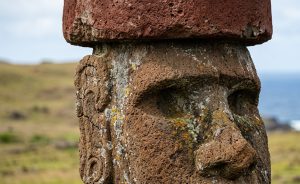
Some of the largest Moai were originally topped with enormous red stone cylinders called pukao.
These were made from a different volcanic stone and had to be transported separately from the statues themselves.
Researchers believe the pukao may have represented a traditional hairstyle, a symbol of status, or another form of ceremonial significance.
The combination of the enormous body, distinctive facial features, and red pukao created a powerful visual representation of authority and ancestral presence.
The Moai therefore were not simply giant statues scattered across an isolated island.
They were part of a religious and social system that connected the living with their ancestors.
And perhaps the most remarkable part is that the people of Rapa Nui created hundreds of these monuments while living on one of the most isolated islands on Earth.
The Moai Today: A Symbol of Rapa Nui
Today, the Moai remain the most powerful symbol of Rapa Nui and one of the world’s most remarkable archaeological treasures.
Although many statues were toppled over the centuries, numerous Moai have been restored and carefully preserved. Archaeologists and local communities continue to study and protect them, helping future generations understand the culture that created these extraordinary monuments.
The island itself is now internationally recognized for its archaeological importance. Rapa Nui National Park protects many of the major archaeological sites, including the famous quarry at Rano Raraku and numerous ceremonial platforms.
🗿 More Than an Ancient Mystery
For modern visitors, it can be tempting to see the Moai simply as mysterious giant statues. But they represent much more than that.
They tell the story of a Polynesian society with remarkable artistic, engineering, religious, and organizational abilities.
The people of Rapa Nui lived thousands of kilometers from other major population centers, yet they developed a distinctive civilization capable of carving, transporting, and erecting enormous stone monuments.
Their achievements challenge the idea that technological sophistication always requires modern tools.
A Culture That Survived
Perhaps the most important part of the Moai story is that Rapa Nui culture did not disappear.
The descendants of the island’s original Polynesian settlers continue to live on Rapa Nui today. Their language, traditions, identity, and connection to the Moai remain an important part of the island’s cultural heritage.
The statues therefore should not be viewed only as relics of a vanished civilization.
They remain connected to a living culture.
And after centuries of mystery, one thing is clear: the Moai were not created by some unknown civilization or supernatural force.
They were created by the skilled people of Rapa Nui—and their enormous achievements continue to fascinate the world.
Conclusion: The Enduring Mystery of the Moai
The Moai of Rapa Nui are among the most extraordinary monuments ever created by an ancient society.
Carved from volcanic stone, transported across a remote island, and placed on ceremonial platforms, these enormous statues demonstrate the remarkable skill and organization of the people who built them.
For centuries, the Moai were connected to ancestors, community, spirituality, and social power. They were not simply giant stone figures—they were an important part of Rapa Nui culture.
Their story also reminds us that the history of Rapa Nui is more complicated than the popular tale of a civilization that simply destroyed itself. Environmental changes, social transformations, and devastating consequences of European contact all played roles in shaping the island’s history.
Today, the Moai continue to stand as symbols of Rapa Nui’s heritage and resilience.
Perhaps the greatest mystery is no longer “Who built these statues?” We know that the ancestors of today’s Rapa Nui people created them.
The more fascinating question is how a small Polynesian society, living on one of the most isolated islands on Earth, achieved something so extraordinary.
The Moai remain silent—but they continue to tell the story of the people who carved them.