
 By admin
Introduction
Wari-Bateshwar is one of the most fascinating archaeological sites in Bangladesh. Hidden in the villages of Narsingdi, this ancient settlement tells the story of a time when people were already building fortified cities, using coins, making beautiful beads, and trading with distant regions. Archaeologists believe that the main urban settlement became active around the middle of the first millennium BC, making Wari-Bateshwar one of the oldest known urban sites in Bangladesh.
Today, the area may look like a quiet rural landscape. But beneath its soil are the remains of a much older world.
Where Is Wari-Bateshwar?
Wari-Bateshwar is located in the Belabo area of Narsingdi District, Bangladesh. The ancient settlement developed beside an old channel of the Brahmaputra River.
Its location was very important.
Thousands of years ago, rivers were not only sources of water. They were also the main roads of the ancient world. People used rivers to move goods, travel between settlements, and connect different regions.
Wari-Bateshwar was situated in a place where river routes could connect the settlement with other parts of Bengal and beyond. This may have helped the area grow into an important center of trade.
Archaeological research has found evidence of roads, fortified areas, workshops, houses, pottery, beads, coins, and other objects. Together, these discoveries show that this was much more than a simple village.
It was an organized settlement with a busy economic life.
How Old Is Wari-Bateshwar?
The history of Wari-Bateshwar goes back more than two thousand years.
Archaeological evidence suggests that there may have been earlier settlement activity in the area, possibly going back to the second millennium BC. However, the strongest evidence for the main urban period comes from the Iron Age and Early Historic period.
Radiocarbon research places the main occupation of the site mainly between the 4th and 1st centuries BC.
This means that while powerful civilizations were developing in other parts of South Asia, people in this part of present-day Bangladesh were also living in organized settlements and taking part in long-distance economic networks.
The Discovery of the Ancient City
The story of Wari-Bateshwar’s modern discovery is almost as interesting as the ancient city itself.
Local people had known for a long time that strange objects could be found in the soil. After rain or during farming, people sometimes discovered old coins, beads, pottery, and other objects.
In the 1930s, a local schoolteacher named Hanif Pathan became interested in these discoveries. Instead of ignoring the objects, he began collecting them and trying to understand their history.
His work was later continued by his son, Habibulla Pathan.
For decades, however, the site did not receive enough attention from professional archaeologists. Archaeological exploration began in 1989, while regular excavation started around 2000.
This was the beginning of a new chapter in the study of ancient Bengal.
A Fortified City Hidden Under the Soil
One of the most exciting discoveries at Wari-Bateshwar was evidence of a fortified settlement.
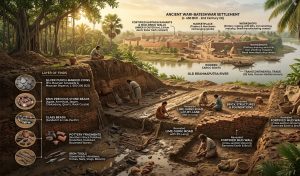
Archaeologists found defensive structures, a citadel, roads, buildings, and other signs of planned settlement.
A large defensive wall known locally as Asom Rajar Garh extends for about 5.75 kilometers. It is several meters wide and rises above the surrounding land.
Think about what that means.
More than two thousand years ago, people living here were capable of organizing large construction projects. They had to collect materials, plan structures, and maintain a settlement that was important enough to need protection.
This changes the way we imagine ancient Bengal.
It was not simply a land of small farming communities. At least in some places, complex settlements and urban centers were already developing.
The Silver Coins That Changed the Story
Among the most important discoveries at Wari-Bateshwar are silver punch-marked coins.
These coins are especially important because they provide evidence of an early money-based economy in the region.
Two major types of punch-marked coins have been found at the site: regional Janapada or pre-Mauryan coins and Mauryan imperial coins.
Punch-marked coins were made by placing different symbols on pieces of silver. Instead of showing a single portrait like many later coins, they often carried several small symbols.
Their discovery at Wari-Bateshwar shows that the people living there were connected to wider economic networks.
Coins are more than pieces of metal.
They can tell us about trade, wealth, political connections, and the movement of people.
The presence of these coins suggests that Wari-Bateshwar was part of a larger economic world that existed across ancient South Asia.
Beads, Pottery and Signs of Trade
Coins are not the only evidence of Wari-Bateshwar’s importance.
Archaeologists have discovered large numbers of semi-precious stone beads and glass beads. There is also evidence of bead production at the site.
These objects tell us something about everyday life.
People wore ornaments. Craftsmen produced decorative items. Traders moved goods from one place to another.
Different types of pottery have also been discovered, including Northern Black Polished Ware, Rouletted Ware and Knobbed Ware.
Some of these pottery types are connected with regions outside Bengal. Their presence at Wari-Bateshwar suggests that the settlement was involved in wider networks of exchange across the Indian subcontinent and possibly Southeast Asia.
Did Wari-Bateshwar Trade With Distant Lands?
This is one of the most interesting questions about the site.
Archaeological discoveries suggest that Wari-Bateshwar had connections beyond its immediate region.
Some pottery and glass objects have been linked by researchers to wider South Asian and Southeast Asian trade networks. There have also been suggestions of connections with the Mediterranean world.
However, it is important not to turn these possibilities into proven facts.
Archaeologists continue to study the evidence, and the exact nature of these long-distance connections is still debated.
What we can say with confidence is that Wari-Bateshwar was not isolated.
Its location, coins, pottery, beads and other artifacts show that the settlement was connected to wider networks of movement and exchange.
What Was Life Like in the Ancient City?
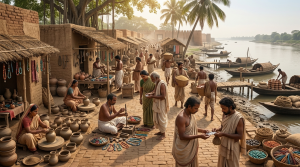
Imagine walking through Wari-Bateshwar more than two thousand years ago.
Instead of modern roads and houses, you would see a busy settlement surrounded by defensive structures.
Traders could be carrying goods.
Craftsmen could be making beads from stone.
People could be buying and selling products using silver coins.
Potters were producing different kinds of vessels.
Iron workers were making tools and weapons.
The streets would have been very different from modern streets, but the basic idea of city life would have felt surprisingly familiar.
People worked, traded, built homes, produced goods and protected their settlement.
Archaeological discoveries of brick structures, floors and streets made from pottery fragments provide evidence of organized settlement activity.
Iron Tools and Ancient Technology
Wari-Bateshwar has also produced many iron objects, including axes, knives and other tools.
Iron was extremely important in ancient societies.
It could be used for farming tools, construction, crafts and weapons. The presence of iron objects at Wari-Bateshwar gives us another clue about the technological abilities of the people who lived there.
The settlement was not only a place where goods were exchanged.
It was also a place where people made things.
That combination of trade, craft production and organized settlement is one of the reasons the site is so important.
Was Wari-Bateshwar the Ancient “Sounagora”?
There is another fascinating mystery surrounding the site.
Some researchers have suggested that Wari-Bateshwar may have been connected with an ancient trading place called Sounagora, mentioned by the Greek geographer Ptolemy.
The idea is based on the site’s location, archaeological discoveries and its apparent role in trade.
But this identification is not universally accepted as a proven fact.
It is better to think of Sounagora as a historical possibility that researchers continue to investigate.
This uncertainty actually makes Wari-Bateshwar more interesting.
There are still questions that archaeology has not completely answered.
Why Did the City Disappear?
One of the biggest mysteries is what happened to the ancient settlement.
Wari-Bateshwar did not simply vanish overnight. The archaeological record shows different phases of occupation and later activity in the area.
Changes in river channels, the environment, trade routes and political conditions may have affected the settlement over time.
The river system was especially important.
The same rivers that helped Wari-Bateshwar grow may also have changed course over the centuries. When river routes change, trading centers can lose their importance.
Eventually, the once-important settlement became buried under layers of soil and gradually disappeared from historical memory.
But the people living nearby continued to farm the land.
And every time someone dug into the soil, pieces of the old city sometimes came back to the surface.
A Lost City That Was Never Completely Lost
That is what makes Wari-Bateshwar special.
For centuries, the ancient city was hidden, but it was never completely forgotten.
Local people continued to find coins, beads and other objects. The work of Hanif Pathan and later Habibulla Pathan helped preserve many of these discoveries and brought attention to the site.
Later archaeological research helped reveal the much bigger story.
What first looked like scattered ancient objects turned out to be pieces of a much larger picture—a fortified settlement, a trading center, a place of craft production and an important part of the history of ancient Bengal.
Why Wari-Bateshwar Matters Today
Wari-Bateshwar is important because it changes our understanding of the ancient history of Bangladesh.
When people think about ancient civilizations, they often imagine Egypt, Rome, Greece, Mesopotamia or the Indus Valley.
But ancient Bengal had its own history.
People here built settlements, used technology, produced crafts, traded goods and connected with other parts of the ancient world.
Wari-Bateshwar gives us physical evidence of that past.
The coins tell us about economic life.
The beads tell us about craftsmanship and trade.
The pottery tells us about cultural connections.
The fortifications tell us about organized settlement and defense.
The roads and structures tell us about urban life.
Together, these discoveries bring an almost forgotten world back to life.
The Story Is Still Being Written
Even after decades of research, Wari-Bateshwar still has many unanswered questions.
Who exactly controlled the city?
How large was its population?
What goods did its traders export?
Where did its merchants travel?
How closely was it connected to other ancient cities?
And what finally caused its decline?
Archaeology rarely gives us every answer at once.
Every excavation can reveal another piece of the puzzle.
That is why Wari-Bateshwar is not simply an old archaeological site. It is an ongoing historical mystery.
Conclusion
Today, Wari-Bateshwar may look peaceful and ordinary. But beneath its fields and villages lies the story of a very different Bangladesh—a Bangladesh that existed more than two thousand years ago.
The discovery of coins, beads, pottery, iron tools, roads and defensive structures shows that ancient Bengal was connected to a wider world.
Wari-Bateshwar reminds us that history is not always found in huge monuments or famous books. Sometimes, it is hidden beneath the soil of a quiet village, waiting for someone to discover it.
And perhaps the most exciting part is this:
We may still have much more to learn about the ancient city hidden beneath Wari-Bateshwar.
[…] Sonargaon was once one of the most important cities in Bengal. Long before modern Dhaka became the center of the region, Sonargaon was a powerful political, cultural, and trading center. Located near the old Brahmaputra River, the city connected Bengal with distant parts of Asia through river routes and international trade. Today, much of that great city has disappeared, leaving behind ruins, old buildings, mosques, and stories of a forgotten past. […]