
 By admin
Introduction
Sonargaon was once one of the most important cities in Bengal. Long before modern Dhaka became the center of the region, Sonargaon was a powerful political, cultural, and trading center. Located near the old Brahmaputra River, the city connected Bengal with distant parts of Asia through river routes and international trade. Today, much of that great city has disappeared, leaving behind ruins, old buildings, mosques, and stories of a forgotten past.
But Sonargaon was never just an ordinary medieval town.
For centuries, it stood at the heart of Bengal’s history.
Where Is Sonargaon?
Sonargaon is located in present-day Narayanganj District, about 25 kilometers southeast of Dhaka.
The location was one of the main reasons for its success.
In medieval Bengal, rivers were like highways. They carried people, goods, soldiers, and ideas from one place to another. Sonargaon developed near important river routes, giving it easy access to different parts of Bengal and the wider world.
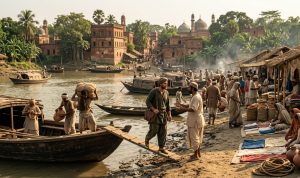
The city was surrounded by fertile land and connected to major waterways. This made it suitable for farming, trade, transportation, and settlement.
Over time, Sonargaon grew into an important urban center.
The Early History of Sonargaon
The history of Sonargaon goes back much further than its famous medieval period.
The region was part of ancient Bengal and was connected with several early political centers. But Sonargaon’s importance increased greatly during the medieval period, especially when Bengal became divided among different rulers and regional powers.
By the 13th and 14th centuries, Sonargaon had become an important center in eastern Bengal.
Its position beside major rivers gave it a major advantage.
Merchants could bring goods into the city by boat, while products from Bengal could be sent toward other ports and distant markets.
This combination of geography and trade helped Sonargaon become one of the great cities of medieval Bengal.
Sonargaon Becomes a Capital
One of the most important moments in Sonargaon’s history came in the 14th century.
In 1338, Shamsuddin Iliyas Shah’s contemporary, Fakhruddin Mubarak Shah, established an independent sultanate in eastern Bengal with Sonargaon as its capital. Later, Sonargaon became one of the important political centers of the Bengal Sultanate.
This was a major change.
Sonargaon was no longer simply a trading settlement. It became a center of political power.
Rulers governed territories from the city, armies moved through the region, and officials, scholars, merchants, and craftsmen gathered there.
The city became part of a much larger story—the rise of an independent Bengal.
A Busy Medieval Trading City
Perhaps the most fascinating part of Sonargaon’s history is its role in international trade.
The city was connected to river routes that linked Bengal with other parts of South Asia and beyond. Historical accounts describe Sonargaon as an important commercial center and port.
Merchants from different regions came to Bengal looking for valuable goods.
Bengal was famous for textiles, rice, spices, metals, and other products. Among these, fine cotton cloth became one of the region’s most valuable exports.
Sonargaon’s location allowed merchants to collect goods from surrounding areas and transport them through the river network.
The city therefore became a meeting point between local producers and international traders.
Ibn Battuta Visits Sonargaon
One of the most exciting pieces of evidence about medieval Sonargaon comes from the famous Moroccan traveler Ibn Battuta.
During his travels across Asia, Ibn Battuta visited Bengal in the 14th century. His journey brought him to Sonargaon, giving us a valuable description of the region during its medieval golden period.
Imagine arriving in Bengal after traveling thousands of kilometers across the Islamic world.
Instead of a quiet village, Ibn Battuta encountered a busy region filled with rivers, boats, markets, and trade.
His writings help us understand that Bengal was not isolated from the wider world.
It was part of a large network connecting South Asia with Southeast Asia, the Indian Ocean, and the Islamic world.
For historians, accounts like Ibn Battuta’s are extremely valuable because they allow us to imagine what Sonargaon may have looked and felt like when it was still alive and powerful.
The Famous Muslin of Bengal
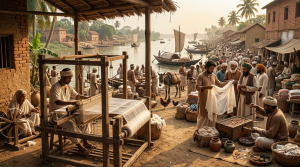
When people talk about Bengal’s textile history, muslin is impossible to ignore.
Fine cotton textiles from Bengal became famous far beyond the region. The quality of some fabrics was so high that they became luxury goods for wealthy people and rulers.
Sonargaon was closely associated with textile production and trade.
Skilled weavers worked with delicate cotton fibers to create extremely fine cloth. The process required patience, experience, and favorable environmental conditions.
These textiles were not simply everyday clothing.
Some varieties were valuable enough to be traded across long distances.
The fame of Bengal’s fine cotton helped connect places like Sonargaon to the wider Indian Ocean trading world.
A Center of Islamic Learning
Sonargaon was also important for religion and education.
As Muslim rulers established their power in Bengal, Islamic institutions developed in major cities.
Mosques, madrasas, shrines, and other religious centers became part of urban life.
Sonargaon attracted scholars and religious figures from different parts of the Islamic world. The city became known not only for trade and politics but also for learning.
One famous figure associated with the region was Shah Jalal al-Din Tabrizi, although traditions surrounding individual saints and their exact connections to Sonargaon vary.
The city nevertheless became an important center of Islamic culture in medieval Bengal.
Ghiyasuddin Azam Shah and Sonargaon’s Golden Period
Another important ruler connected with Sonargaon was Ghiyasuddin Azam Shah, who ruled Bengal in the late 14th and early 15th century.
He is remembered as a powerful ruler who maintained diplomatic relations with foreign powers.
Historical traditions also connect him with scholars and poets from the wider Muslim world.
During this period, Bengal’s political and cultural connections reached beyond the region.
Sonargaon was part of that growing network.
The city was not only looking inward.
It was connected to a world that stretched across the Indian Ocean.
A City Connected to the Wider World
Medieval Bengal may seem far away from the famous civilizations we usually read about, but Sonargaon shows how connected the region actually was.
Ships and boats carried goods across rivers and seas.
Merchants traveled between ports.
Scholars moved from one center of learning to another.
Ideas, languages, religions, technology, and cultural traditions traveled with them.
Sonargaon was one of the places where these different worlds met.
This is why the city’s history is important beyond Bangladesh.
It is part of the larger history of Asian trade and cultural exchange.
The Rise of Panam City
When people visit Sonargaon today, one of the most famous places they see is Panam City, also known as Panamnagar.
The long street lined with old buildings creates an impressive image of a forgotten city.
But there is an important historical difference.
The surviving buildings of Panamnagar mostly belong to a much later period than the medieval capital of Sonargaon. Many were built during the 19th and early 20th centuries, when the area had become a wealthy commercial center.
So Panam City should not simply be described as the medieval capital itself.
Instead, it is one of the later layers of Sonargaon’s long history.
That makes the area even more interesting.
Different periods of Bengal’s past can be found in the same landscape.
Why Did Sonargaon Decline?
Like many great cities, Sonargaon’s decline did not happen in a single day.
Political power gradually shifted toward other centers.
Dhaka became increasingly important during the Mughal period, especially after it was established as the provincial capital in the early 17th century.
As political and economic activity moved elsewhere, Sonargaon’s importance slowly decreased.
River routes also changed over time.
This mattered enormously because Sonargaon’s strength had always been connected to its waterways.
When the river system changed and major political centers moved, the city could no longer maintain the same position it once held.
The once-busy capital gradually became quieter.
Markets disappeared.
Political buildings fell into ruin.
Parts of the old city were covered by vegetation and soil.
And eventually, the great medieval city survived mostly through fragments.
The Lost Capital That Survived
Today, it is easy to look at Sonargaon and see only old buildings and ruins.
But those ruins tell a much bigger story.
They remind us of a time when Bengal was wealthy, connected, and politically powerful.
The old mosques show the growth of Islamic architecture.
The surviving buildings of Panam City show a later period of commercial prosperity.
The archaeological remains reveal older layers of settlement.
And the rivers remind us why this place became important in the first place.
Sonargaon may have lost its position as a capital, but it never completely disappeared.
Its history survived in buildings, manuscripts, archaeological remains, local traditions, and the landscape itself.
What Happened to the People?
One question naturally comes to mind:
Where did everyone go?
The decline of a city does not mean that its people suddenly vanished.
Farmers continued living in the surrounding areas.
Traders moved to other commercial centers.
Craftsmen followed new markets.
Officials and wealthy families relocated as political power shifted.
Over generations, the urban population changed.
The city that once depended on political power and international trade slowly became a quieter part of the countryside.
This is how many historical cities disappear—not through one dramatic event, but through slow change.
Sonargaon Today
Today, Sonargaon is one of Bangladesh’s most important historical areas.
Visitors can explore old mosques, shrines, archaeological remains, museums, and the famous Panam City.
The Goaldi Mosque, built in 1519 during the Bengal Sultanate, is one of the best-known surviving monuments in the area.
The old buildings of Panam Nagar offer another glimpse into a later period of Sonargaon’s history.
But perhaps the most interesting thing about visiting Sonargaon is realizing that what we see today is only a small part of what once existed.
The medieval capital was much larger.
Its markets, houses, roads, palaces, workshops, and river ports have largely disappeared.
What remains is only a fragment of a much bigger city.
Conclusion
Sonargaon was once a place where rulers governed, merchants traded, craftsmen worked, scholars taught, and travelers arrived from distant lands.
For centuries, its rivers connected Bengal to the wider world.
Its textiles traveled across long distances.
Its rulers helped shape the political history of Bengal.
And its markets brought together people from different cultures and regions.
Then, slowly, its importance faded.
Today, the old capital stands quietly in the landscape of Bangladesh.
But the silence can be misleading.
Under the ruins and beside the old river routes lies the memory of a city that was once one of Bengal’s great centers of power and trade.
Sonargaon may be called a lost capital, but its story is far from lost.
Its surviving monuments and archaeological remains continue to remind us that Bengal’s history was never isolated. It was part of a much larger Asian world, connected by rivers, trade, culture, and people.
And perhaps that is the most fascinating thing about Sonargaon:
A city can disappear from the map and still remain alive in history.
[…] India, Nalanda attracted students, monks, teachers, and scholars from different parts of Asia. For centuries, people came here to study Buddhist philosophy, logic, medicine, grammar, astronomy, and other […]