
 By admin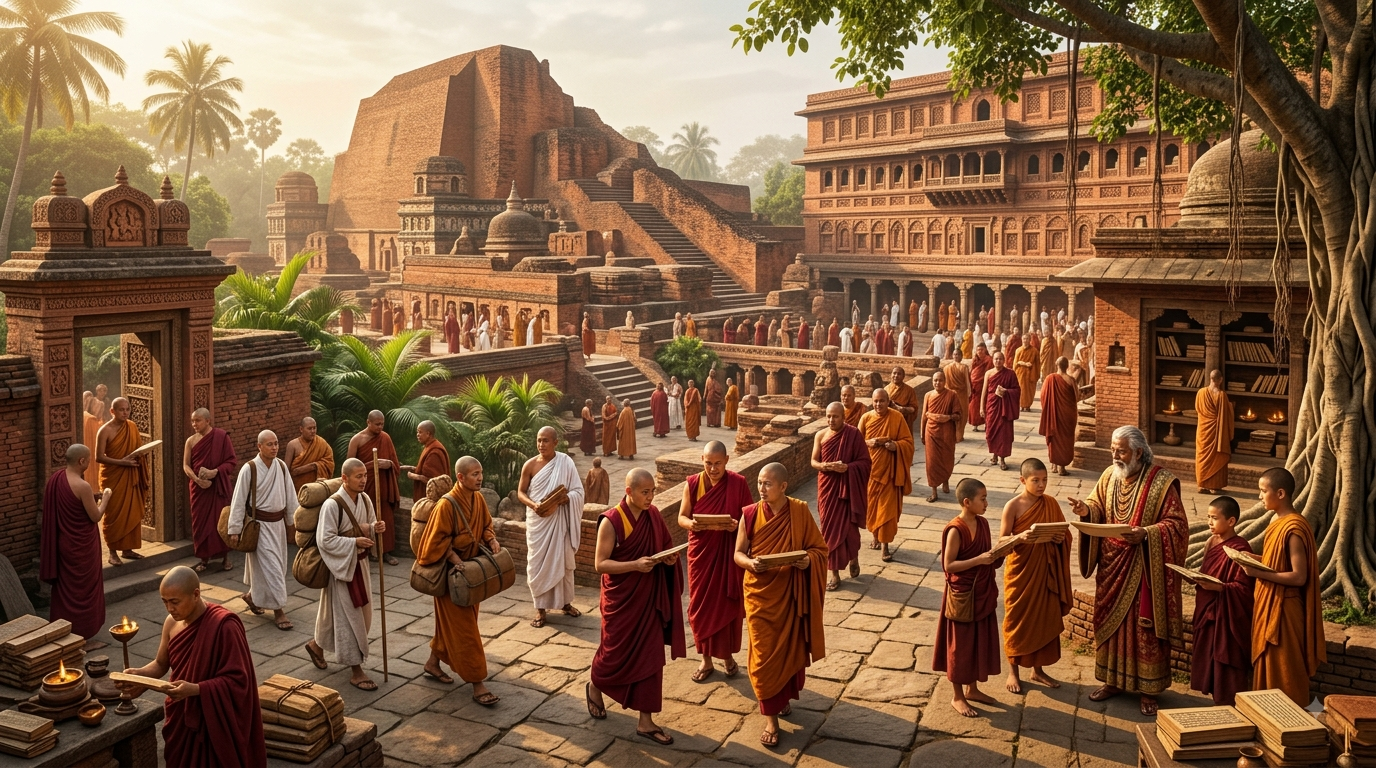
Introduction
Nalanda University was one of the greatest centers of learning in the ancient world. Located in present-day Bihar, India, Nalanda attracted students, monks, teachers, and scholars from different parts of Asia. For centuries, people came here to study Buddhist philosophy, logic, medicine, grammar, astronomy, and other subjects. Its vast monasteries, temples, libraries, and lecture spaces made Nalanda more than a religious institution—it became a remarkable center of higher learning.
Today, only the ruins remain.
But those ruins tell the story of a place where knowledge once brought together people from across Asia.
Where Was Nalanda?
Nalanda University was located in the modern Indian state of Bihar, in northeastern India.
The ancient site covered a large area and included monasteries, temples, stupas, courtyards, shrines, classrooms, and residential spaces.
The surviving archaeological site covers about 23 hectares, with remains of 11 viharas and 14 temples, along with many smaller structures.
The buildings were mainly made of brick, and many were arranged in an organized layout.
Walking through the ruins today, it is easy to imagine how impressive the complex must have looked when it was full of students and teachers.
How Old Was Nalanda?
The history of Nalanda is much older than its famous university period.
Archaeological remains at the site date back to around the 3rd century BCE. However, Nalanda developed into a major monastic and educational center from around the 5th century CE, continuing until the 13th century.
This means that Nalanda remained connected with organized learning for roughly 800 years.
That is an extraordinary length of time.
Think about how many generations of students could have walked through its gates during those centuries.
Kings changed.
Dynasties rose and fell.
Political borders shifted.
Yet Nalanda continued to function as an important center of knowledge.
The Rise of a Great Center of Learning
Nalanda’s growth was closely connected with the development of Buddhism and the support of powerful rulers.
The Gupta period played an important role in the early development of the institution, while later rulers, especially the Pala dynasty, supported and expanded the great monastic centers of eastern India.
Under royal patronage, Nalanda developed into a large and organized institution.
Monks lived there.
Teachers taught there.
Students traveled long distances to study there.
Scholars debated ideas there.
The institution became increasingly famous across Asia.
Who Studied at Nalanda University?
Nalanda was not only for people from the local region.
Students and scholars came from different parts of Asia, including areas that are now associated with China, Korea, Tibet, and other parts of South and Southeast Asia.
One of the most famous visitors was the Chinese Buddhist monk and scholar Xuanzang, also known as Hiuen Tsang.
He traveled to India during the 7th century to study Buddhist teachings and collect manuscripts.
His visit gives us one of the most valuable descriptions of Nalanda.
According to historical accounts, Xuanzang studied at Nalanda and spent considerable time learning from its scholars.
His journey shows just how far people were willing to travel to study in ancient India.
Xuanzang and the Journey to Nalanda University
Imagine traveling thousands of kilometers across mountains, deserts, rivers, and unfamiliar lands just to study.
That was the journey undertaken by Xuanzang.
He left China and traveled across Central Asia before reaching India.
When he arrived at Nalanda, he found a major center of Buddhist learning.
He studied under the scholar Shilabhadra, who was regarded as one of the leading teachers of the institution.
Xuanzang spent years studying Buddhist philosophy and related subjects.
After returning to China, he translated many Sanskrit Buddhist texts into Chinese.
His writings helped preserve valuable information about India and Nalanda.
Because of travelers like Xuanzang, historians today have a better idea of how important Nalanda was during its golden period.
What Did Students Study?
Nalanda was closely associated with Buddhist learning, but education there was not limited to one subject.
Students studied subjects such as:
- Buddhist philosophy
- Logic
- Grammar
- Medicine
- Astronomy
- Mathematics
- Literature
- Philosophy
- Debate
UNESCO notes that Nalanda’s scholarly traditions helped develop important schools of Indian logic and Buddhist philosophy, including Yogachara and Madhyamika traditions.
Learning was not simply about memorizing books.
Debate was extremely important.
Students and teachers discussed ideas, questioned arguments, and defended their positions.
In this way, learning became an active process.
The Famous Entrance Test
Nalanda was not a place where anyone could simply arrive and become a student.
Historical records describe an entrance examination in which prospective students had to demonstrate their knowledge before being admitted.
UNESCO’s documentation describes Nalanda as having a structured system of admission, administration, learning, and manuscript repositories.
This tells us something important.
Nalanda was not just a collection of monks living together.
It had an organized educational system.
Students had to prove that they were prepared for advanced study.
For a university-like institution operating more than a thousand years ago, this is remarkable.
Life Inside Nalanda
What was everyday life like?

Students lived within the monastic complex.
The viharas contained residential rooms arranged around courtyards. These spaces served both religious and educational purposes.
Teachers and students could meet in courtyards, halls, and other shared spaces.
The atmosphere was probably very different from a modern university campus, but there were some familiar elements.
There were teachers.
There were students.
There were discussions.
There were examinations.
There were libraries.
And there was a constant exchange of ideas.
The difference was that much of this intellectual life was connected to Buddhist monastic traditions.
The Great Libraries of Nalanda
Perhaps the most fascinating part of Nalanda’s story is its libraries.
Historical sources describe major manuscript repositories associated with names such as Ratnasagara, Ratnaranjaka, and Ratnodadhi.
The Nalanda nomination documents note that Ratnodadhi was described in traditional accounts as a nine-story structure containing manuscripts on a wide range of subjects, although no physical remains of the library buildings have survived.
Imagine entering a library where scholars had spent generations collecting, copying, studying, and translating manuscripts.
The books were mainly handwritten manuscripts rather than printed books.
A single text could require enormous effort to produce.
Scholars also translated texts between languages, helping ideas travel across Asia.
Nalanda’s libraries therefore represented more than storage.
They were part of a much larger system of preserving and sharing knowledge.
Nalanda and the Spread of Knowledge Across Asia
Nalanda’s influence did not stop at India’s borders.
Students who studied there returned to their own regions carrying texts, ideas, philosophical traditions, and methods of learning.
Buddhist teachings associated with Nalanda influenced intellectual traditions in Tibet, China, Korea, and other parts of Asia.
UNESCO notes that Nalanda’s educational and philosophical traditions continued to influence Buddhist institutions across South and Southeast Asia.
This makes Nalanda important not only in Indian history but also in the wider history of Asian education.
It was part of a network through which knowledge traveled across mountains, deserts, rivers, and seas.
The Golden Age of Nalanda
Nalanda reached some of its greatest heights between the 7th and 12th centuries.
During this long period, powerful rulers supported the institution.
The Pala rulers of eastern India were particularly important patrons of Buddhist monasteries and centers of learning.
The campus expanded.
New monasteries and temples were built.
Scholars continued to arrive.
Nalanda became one of the most respected intellectual centers of its time.
It was not simply a school.
It was a living academic community.
A University Before the Modern University
It is tempting to compare Nalanda directly with modern universities.
The comparison can be useful, but there are differences.
Nalanda was a Buddhist monastic and scholastic institution, not a modern university in the exact sense.
However, it had several features that we associate with higher education today.
There were organized admissions.
There were teachers and students.
There were residential facilities.
There were libraries.
There was a structured system of learning.
There were debates and examinations.
And students came from distant regions.
That is why Nalanda is often remembered as one of the earliest major university-like institutions in the world.
UNESCO describes it as one of the earliest and longest-serving organized higher-learning establishments of the Indian subcontinent.
The Destruction of Nalanda
Then came the end of an extraordinary chapter.
During the late 12th and early 13th centuries, political conditions in northern India changed dramatically.
Nalanda suffered attacks and eventually ceased to function as the great institution it had once been.
The exact details of its destruction have been debated, but by the 13th century the institution had been sacked and abandoned as a major center of learning. UNESCO places the functional end of Nalanda in the 13th century.
Later traditions strongly associate the destruction with forces led by Bakhtiyar Khalji.
However, the history was more complicated than a single dramatic event.
Nalanda had already faced a changing political environment, and its decline happened over time.
Some limited occupation continued after the major destruction, but the institution never returned to its former glory.
What Happened to the Books?
The story of Nalanda’s libraries is one of the most famous parts of its history.
Popular accounts often say that the library burned for months.
However, historians must be careful with such claims because the exact details of the destruction and the duration of any fire are difficult to establish from surviving evidence.
What we do know is that Nalanda’s manuscript collections were an important part of its intellectual life, and the institution suffered severe destruction during its final decline.
Much of the knowledge that once existed there was lost.
But not everything disappeared.
Some texts had already traveled with scholars to other parts of Asia.
That is one reason Nalanda’s intellectual legacy survived even after the institution itself declined.
Nalanda Falls Silent
After centuries of activity, Nalanda slowly became a place of ruins.
Buildings collapsed.
Bricks were covered by soil.
Vegetation grew over the remains.
The once-busy courtyards became silent.
Yet the memory of Nalanda survived through historical records, Buddhist traditions, and the writings of travelers.
The site was not completely forgotten.
It remained part of the historical memory of South Asia and the Buddhist world.
The Rediscovery of Nalanda
Centuries later, archaeologists began investigating the large mounds in the area.
In the 19th and early 20th centuries, scholars and archaeological teams worked to identify and excavate the ancient remains.
Systematic archaeological excavation revealed monasteries, temples, stupas, sculptures, inscriptions, coins, pottery, and other objects.
The ruins slowly began to reveal the scale of the ancient institution.
What had looked like ordinary mounds turned out to be the remains of one of the greatest educational centers of ancient Asia.
Nalanda Today
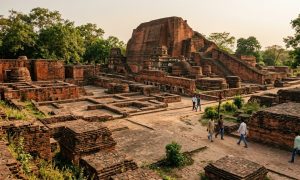
Today, the archaeological site of Nalanda is one of India’s most important heritage sites.
The surviving ruins include brick monasteries, temples, stupas, courtyards, shrines, and other structures.
Visitors can walk through the remains and see the foundations of buildings where generations of students and monks once lived and studied.
In 2016, the Archaeological Site of Nalanda Mahavihara was inscribed on the UNESCO World Heritage List.
UNESCO recognizes Nalanda for its outstanding historical, architectural, educational, and cultural importance.
The site is now protected and maintained as an archaeological heritage area.
Why Nalanda Still Matters
Nalanda’s importance goes beyond its ruins.
It reminds us that education has a much longer history than the modern university system.
More than a thousand years ago, students were already traveling across countries to study.
Teachers were developing systems of debate and scholarship.
Libraries were collecting and preserving manuscripts.
Knowledge was being translated from one language to another.
And ideas were traveling across Asia.
Nalanda shows that the ancient world was deeply connected.
People did not need modern airplanes or the internet to exchange knowledge.
They traveled by foot, horse, caravan, and ship.
They carried manuscripts with them.
They carried ideas with them.
And those ideas could survive long after the buildings that produced them had disappeared.
Conclusion
Today, Nalanda is quiet.
There are no crowds of ancient students walking through its courtyards.
There are no teachers debating philosophy beneath its brick walls.
The great libraries are gone.
But the idea behind Nalanda remains powerful.
It was a place where knowledge was treated as something worth traveling thousands of kilometers to find.
A place where students from different lands could meet.
A place where debate was part of learning.
A place where manuscripts were collected, studied, translated, and passed from one generation to another.
Nalanda may have disappeared as a university, but it never disappeared from history.
Its ruins still tell the story of a remarkable age when learning connected India with the wider world.
And perhaps that is Nalanda’s greatest legacy:
Buildings can fall, libraries can disappear, and kingdoms can fade—but knowledge can travel far beyond the place where it was first taught.