
 By admin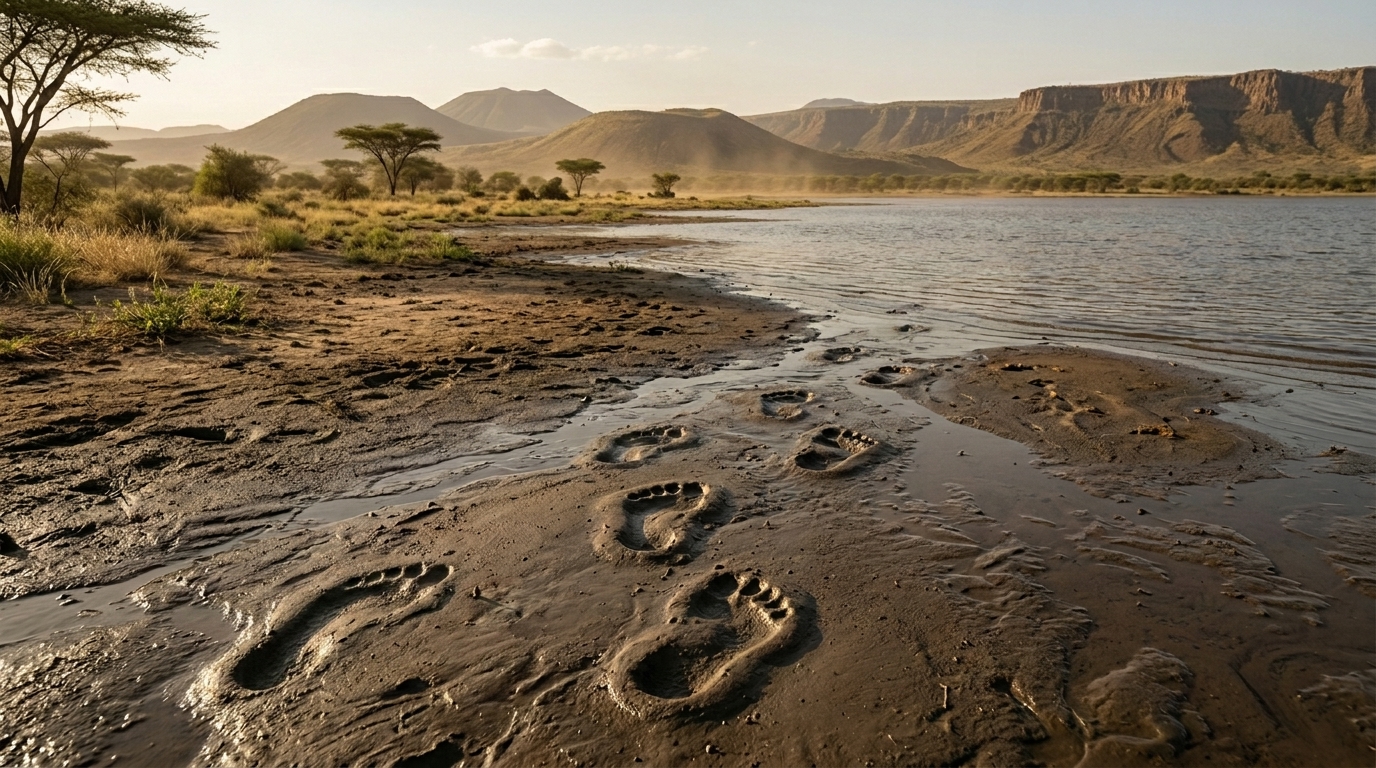
Introduction
The 1.43-million-year-old footprints discovered near Lake Turkana in Kenya offer an extraordinary glimpse into the distant past. Long before modern humans appeared, ancient human relatives walked across the landscape, leaving footprints behind in soft ground. Millions of years later, those tracks were discovered and preserved as evidence of a world that existed long before recorded history.
But these footprints are more than just marks in the ground. They may reveal how ancient human relatives moved, interacted, and possibly lived alongside one another.
The Discovery in Kenya
The 1.43-million-year-old footprints were found at a site known as GaJi10, near the eastern shore of Lake Turkana in northern Kenya.
Researchers identified 21 fossil footprints, representing the movements of several ancient hominins. The tracks were preserved in sediments that date back roughly 1.43 million years.
This makes the site especially valuable for understanding human evolution.
Fossil bones can tell scientists what an ancient species looked like, but footprints can tell a different story. They capture a moment when an individual was actually moving across the landscape.
In a sense, these footprints are like a snapshot frozen in time.
Who Made the Footprints?
One of the biggest questions surrounding the discovery is the identity of the individuals who left the tracks.
Researchers believe the footprints were most likely made by Paranthropus boisei, an extinct hominin species that lived in eastern Africa.
Paranthropus boisei had a very different appearance from modern humans. It had a powerful jaw and large teeth, features that suggest it was adapted to a particular diet.
For many years, scientists have studied fossil remains of this species to understand where it fits in the human family tree.
The footprints provide another important piece of evidence.
A Group Walking Together?
Perhaps the most fascinating part of the discovery is that several footprints appear to have been made around the same time.
This raises the possibility that multiple individuals were moving through the area together.
Imagine the scene more than one million years ago.
A small group of ancient hominins walks across the muddy surface near an ancient lake. Each step leaves a shallow impression in the wet sediment.
The environment changes.
The mud dries.
New layers of sediment cover the footprints.
Eventually, the area becomes buried beneath the earth.
Millions of years later, scientists uncover those same tracks.
We cannot know exactly what the group was doing, but the footprints provide a rare glimpse of movement and possible social interaction.
How Big Were These Ancient Hominins?
The footprints also provide clues about body size.
Some of the individuals appear to have been surprisingly large. Researchers estimate that certain individuals could have stood around 1.8 meters tall, or approximately six feet.
That is remarkable when we remember how ancient these footprints are.
The discovery challenges some earlier assumptions about the physical size and behavior of Paranthropus boisei.
It also shows why footprints are so important. Fossil bones provide measurements of individual body parts, while footprints can give researchers information about walking patterns, body size, and movement.
What Did Their Walk Look Like?
Walking leaves a very specific pattern.
Scientists can examine the length of each footprint, the distance between steps, the direction of movement, and the shape of the foot impression.
These details can help researchers understand how an ancient hominin moved.
The footprints from Kenya appear to show individuals using a form of upright walking.
That is particularly important because walking on two legs is one of the defining features of human evolution.
Modern humans are not the only species that walked upright. Several ancient hominins developed forms of bipedal movement long before Homo sapiens appeared.
The 1.43-million-year-old footprints give researchers a chance to study that movement directly.
Life Around Ancient Lake Turkana

The area around Lake Turkana looked very different 1.43 million years ago.
The region was part of a changing landscape influenced by water, vegetation, animals, and climate.
Ancient hominins would have depended on their environment for food and water.
The lake and surrounding ecosystems could have attracted many different animals, creating opportunities for ancient humans and other species to survive.
The footprints therefore represent more than individual footsteps.
They are part of a much larger story about life in ancient East Africa.
Why Are Footprints So Important?
Fossil footprints are extremely rare.
Bones can survive for millions of years under the right conditions, but footprints usually disappear quickly. Rain, wind, animals, and natural erosion can destroy them.
For footprints to survive, they need to be covered and preserved under the right geological conditions.
That is why the Kenyan discovery is so valuable.
A fossil bone can show what an animal looked like.
A footprint can show what it was doing.
This difference makes trace fossils such as footprints incredibly useful to researchers.
What Do the Footprints Tell Us About Human Evolution?
Human evolution was not a simple straight line.
Many different hominin species lived in Africa over millions of years. Some disappeared, while others may have contributed to later populations.
The 1.43-million-year-old footprints add another piece to this complicated story.
They show that ancient hominins were already capable of efficient upright movement long before our own species existed.
They also suggest that groups of individuals could move through the same environment at similar times.
Although the footprints cannot tell us everything about their behavior, they provide evidence that would be impossible to obtain from bones alone.
A Moment Preserved for 1.43 Million Years
There is something extraordinary about looking at an ancient footprint.
It was created in only a few seconds.
A foot touched the ground.
The individual moved forward.
And then the moment disappeared beneath layers of sediment.
For more than a million years, those tracks remained hidden.
Today, scientists can study them and reconstruct a tiny part of the lives of creatures that lived unimaginably long ago.
The footprints are therefore more than fossils.
They are traces of movement left behind by individuals who could never have known that their steps would one day become evidence of human evolution.
What We Still Don’t Know
Despite the discovery, many questions remain unanswered.
Were these individuals traveling together?
Were they part of the same social group?
What were they looking for near the ancient lake?
How did they interact with each other?
And what happened to them after they left the area?
The footprints cannot provide all the answers.
But they give researchers something incredibly rare—a direct record of ancient movement.
Conclusion
The 1.43-million-year-old footprints of Kenya remind us that the story of humanity began long before modern humans appeared.
Millions of years ago, ancient hominins walked across the landscapes of East Africa, searched for food and water, and lived their lives without knowing that traces of their existence would survive for an extraordinary length of time.
Today, those simple footprints help scientists understand a much bigger story—the long and complicated journey of human evolution.
One step lasted only a moment. But that moment survived for 1.43 million years. 👣
[…] Baddow Hoard, the largest recorded hoard of Iron Age gold coins ever found in Britain. But the greatest mystery surrounding the Great Baddow Hoard is not how much gold was buried. It is why it was buried in the […]