
 By admin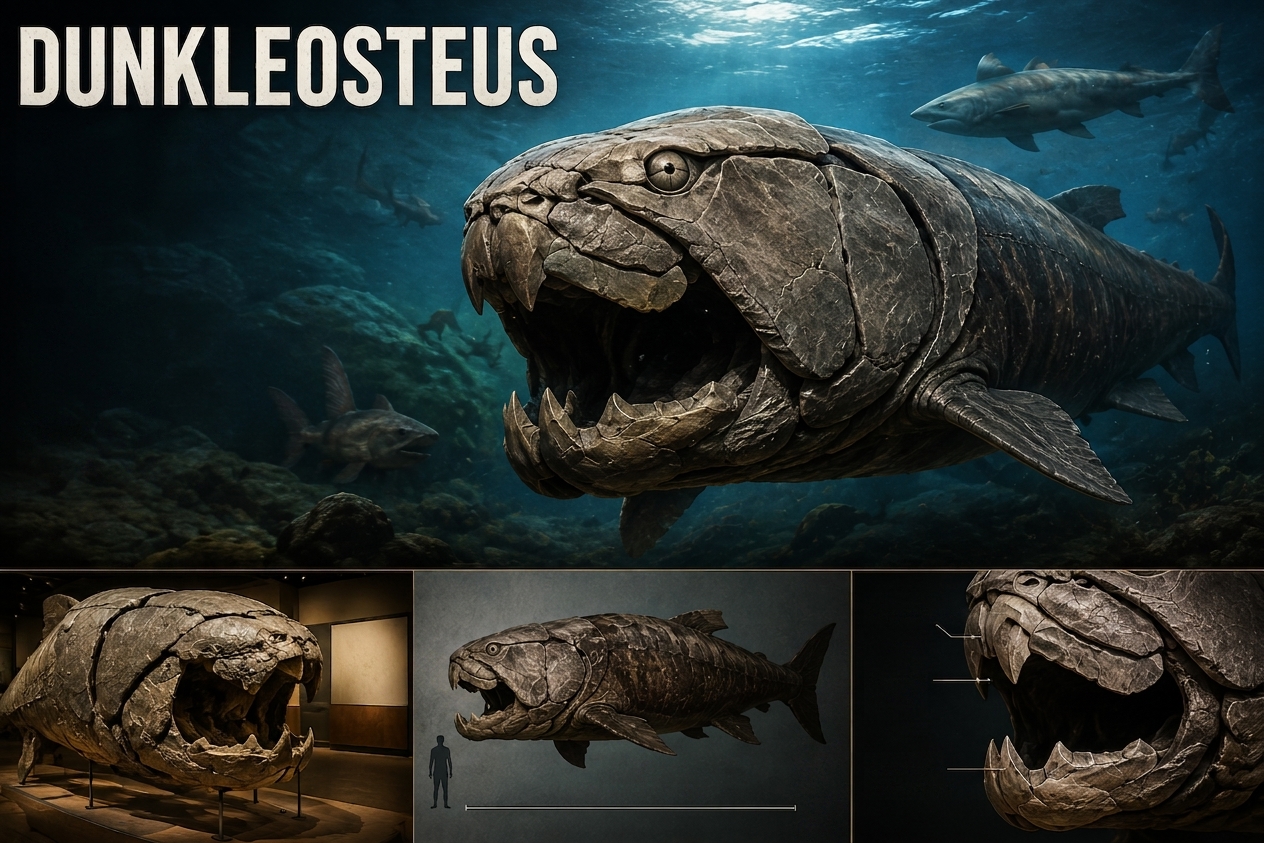
Introduction
Imagine diving into the ocean nearly 400 million years ago. There are no modern whales, dolphins, or familiar fish around you. Instead, the water is filled with strange armored creatures that look nothing like the animals we know today. Among them was Dunkleosteus, one of the most formidable predators of the ancient seas.
And somewhere in those ancient seas, a massive predator is hunting.
Its head is covered with thick armor. Instead of ordinary teeth, its jaws are lined with sharp, blade-like bony plates. It can open its mouth incredibly quickly and then close its jaws with enormous force.
This terrifying predator was Dunkleosteus.
Living during the Devonian Period, roughly 419–359 million years ago, Dunkleosteus belonged to a group of extinct armored fish called placoderms. The Devonian is often called the “Age of Fishes” because fish diversified dramatically during this period.
But what made Dunkleosteus so frightening? And was it really the enormous, 33-foot-long monster that many popular images and posts claim?
The real story is even more fascinating.
What Was Dunkleosteus?
Dunkleosteus was an extinct armored fish and apex predator of the Devonian seas.
Unlike modern fish, much of its front body was protected by thick bony armor. The most famous species, Dunkleosteus terrelli, is known mainly from fossilized skull and armor elements. Fossils of this species have been found in places including Ohio in the United States.
Its appearance was unlike anything swimming in today’s oceans. A heavily armored head sat at the front of its body, while the rest of the animal was much less heavily protected.
But the most frightening part was its mouth.
A Jaw Made of Blades
Dunkleosteus didn’t have teeth like a great white shark.
Instead, it had sharp bony jaw plates that functioned like blades. When the jaws came together, these edges could slice through prey.
Researchers have found that the skull of Dunkleosteus had an unusual mechanical system that allowed it to combine speed with tremendous biting power. A 2007 biomechanical study estimated that a large, approximately 6-meter individual could produce more than 4,400 newtons of force at the front of the jaw and over 5,300 newtons at the rear dental plates.
That combination was extraordinary.
The animal could open its jaws rapidly and then deliver a powerful bite. According to the study, its jaws could move from closed to maximum gape in roughly 20 milliseconds under the modeled conditions.
In other words, Dunkleosteus wasn’t simply a giant fish with a strong bite.
It was a highly specialized predator.
Was Dunkleosteus Really 33 Feet Long?
This is where the story gets interesting.
For years, Dunkleosteus was commonly reconstructed as a gigantic fish reaching around 30–33 feet (9–10 meters) in length. That’s the version often seen in documentaries, illustrations, and social-media posts.
However, scientists have since questioned those older estimates.
A 2023 study examined the way body length had been estimated from the jaws of Dunkleosteus and concluded that previous estimates of 5.3–8.8 meters were likely too large. The researchers argued that using the mouth dimensions of modern sharks to estimate Dunkleosteus’s body length could produce major overestimates because arthrodires had unusually large mouths relative to their bodies.
The Smithsonian now presents around 4 meters (13 feet) as a maximum length estimate for Dunkleosteus terrelli, considerably smaller than the older 30-foot-plus reconstructions.
So the famous 33-foot monster may have been an overestimate.
But don’t let the smaller size fool you.
A 13-foot armored predator with blade-like jaws would still have been an extraordinary animal.
What Did Dunkleosteus Eat?
Dunkleosteus lived in a Devonian world filled with armored fish and other hard-bodied creatures.
Its powerful jaws were particularly well suited for dealing with prey protected by hard materials. The biomechanical research suggests that the sharp edges of its jaws could produce extremely high pressure over a small area, allowing them to puncture and fragment hard prey.
This may have allowed Dunkleosteus to hunt a wide variety of animals.
The Devonian seas contained sharks, other armored fish, ammonoids, and numerous other marine creatures. With its combination of speed, armor, and powerful jaws, Dunkleosteus was well equipped to occupy the role of an apex predator.
Why Was Its Bite So Powerful?
The secret wasn’t simply having huge muscles.
Dunkleosteus had an unusual skull structure that worked almost like a mechanical system.
Researchers modeled its skull as a four-bar linkage, a mechanism that helped transmit muscle forces efficiently to the jaws. This allowed the fish to achieve both rapid jaw movement and powerful biting forces.
This is one of the most fascinating things about Dunkleosteus.
Its terrifying bite wasn’t just brute strength—it was the result of an incredibly efficient biological design that evolved hundreds of millions of years before humans began building mechanical systems.
A Predator From the “Age of Fishes”
The Devonian Period was a remarkable chapter in Earth’s history.
Around 400 million years ago, oceans were dominated by an extraordinary variety of fish. Many species had armor, while jawed fish were becoming increasingly diverse and successful. Placoderms became some of the most important predators in these ancient ecosystems.
Dunkleosteus was among the most impressive of them.
It wasn’t just surviving in this dangerous environment.
It was near the top of the food chain.
What Happened to Dunkleosteus?
Despite its dominance, Dunkleosteus eventually disappeared.
The end of the Devonian brought major environmental changes and extinction events that devastated marine ecosystems. Many groups of armored fish disappeared, including the once-successful placoderms.
Sharks and bony fish survived and later became major components of marine ecosystems.
Dunkleosteus, however, became part of Earth’s fossil record.
Today, scientists study its fossilized skulls and armor to understand how early jawed vertebrates evolved and how some of the earliest large marine predators hunted.
The Monster Was Real—But the Story Is Still Changing
The image of a 33-foot Dunkleosteus with a bite comparable to a T. rex makes for an incredible story.
But science is rarely that simple.
Older research produced impressive estimates of its size and bite force, while newer studies have challenged some of the assumptions behind those reconstructions. What remains certain is that Dunkleosteus was a formidable Devonian predator with an unusual skull, blade-like jaws, and an exceptionally powerful feeding system.
And perhaps that’s what makes this ancient fish even more fascinating.
We may still be discovering what Dunkleosteus was really like.
Enjoyed this story about Dunkleosteus?
If you found it interesting, you can explore our other historical stories and discover more fascinating events from the past:
Khoka Ghumalo Para Joralo: The Story Behind the Famous Bengali Rhyme
Hazrat Adam (AS): The Story of the First Human
The Shroud of Turin: The Mystery Behind the Ancient Cloth
Click on any title above to continue exploring history and uncover more fascinating stories from the past.
[…] Dunkleosteus: The Terrifying Fish That Ruled the Ancient Seas […]
[…] Dunkleosteus: The Terrifying Fish That Ruled the Ancient Seas […]