
 By admin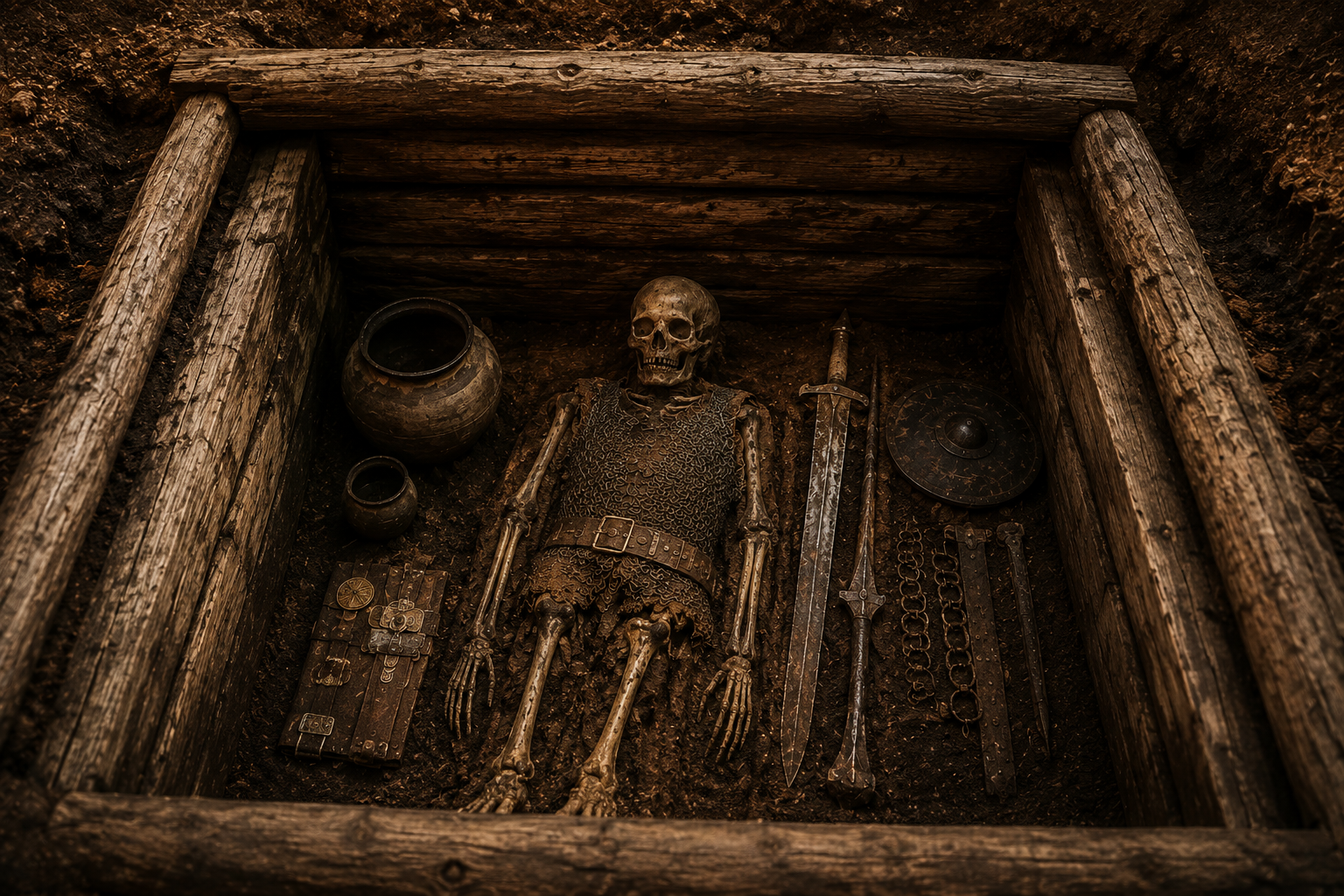
Introduction
Imagine uncovering a Suzdal chamber grave buried beneath the soil for more than a thousand years. Inside lies more than human remains—there are weapons, horse-riding equipment, coins and other objects that offer clues about the identity, status and life of the person buried there.
That is the story behind the Suzdal chamber grave, discovered at the Gnezdilovo burial ground near the historic Russian town of Suzdal.
The discovery offers a fascinating glimpse into the world of medieval Rus, when trade, warfare, social hierarchy and cultural influences were shaping the communities of North-Eastern Europe.
Where Was the Suzdal Chamber Grave Found?
The grave was discovered at the Gnezdilovo burial ground, located in the Suzdal Opolye region near Suzdal in Vladimir Oblast, Russia.
Gnezdilovo is not a newly discovered archaeological site. It was first investigated in the 19th century, but modern archaeological work has revealed that large parts of the cemetery remained unexplored.
Researchers from the Institute of Archaeology of the Russian Academy of Sciences and the State Historical Museum have been studying the site since 2020.
The cemetery contains burials from the early medieval period, including graves dating to the 10th–12th centuries. Archaeologists have found evidence of different burial practices, suggesting that the community had a complex social and cultural structure.
What Made the Grave So Unusual?
One of the most interesting discoveries was Burial 19, investigated in 2021.
The grave was unusually large, measuring approximately 3.3 by 1.6 metres. Inside the pit were wooden structures with specially cut corners. These features resemble the construction of a chamber grave, a type of prestigious burial known from parts of medieval Europe and Rus.
However, there is an important detail.
Researchers note that Burial 19 was not a classic underground chamber with a ceiling. Instead, the grave was relatively shallow, with wooden structures built inside the burial pit.
So while archaeologists associate it with the chamber-grave tradition, calling it a conventional underground chamber would oversimplify the evidence.
Who Was Buried There?
The remains belonged to a man who appears to have held a relatively high social position.
His identity is unknown, but the objects buried alongside him provide important clues.
Among the grave goods were:
- A fragment of a silver dirham
- Folding scales and weights
- A bronze buckle
- A knife
- A fire-steel and flint
- A pair of stirrups
- A horse-bit
- A girth buckle
- A battle axe
- A handmade vessel
This unusual combination suggests that the man was not an ordinary member of the community. Researchers believe he may have been connected with administrative or fiscal activities, although this remains an interpretation rather than a proven fact.
Why Were Scales and Weights Buried With Him?
Perhaps the most intriguing objects were the folding scales and weights.
In the medieval world, scales were valuable tools for weighing small amounts of precious metals and other goods. Their presence in a grave can tell archaeologists something about the person’s activities during life.
Combined with the silver dirham fragment and horse equipment, the objects have led researchers to suggest that the buried man may have had responsibilities involving trade, taxation or administration.
But archaeologists cannot say with certainty that he was a tax collector. It is better to describe this as a possible interpretation based on the archaeological evidence.
The Battle Axe and Horse Gear
The battle axe is another important clue.
Weapons were often associated with status and military identity in early medieval burials. At Gnezdilovo, archaeologists have found a notable number of battle axes, along with equipment connected to horse riding.
The presence of stirrups, a horse-bit and a girth buckle suggests a strong connection between the buried man and horseback riding.
This is significant because the archaeological evidence from Gnezdilovo points toward the cemetery being associated with people who may have belonged to the military or administrative elite of medieval Rus.
A Glimpse Into Medieval Rus
The Suzdal chamber grave is fascinating because it is more than just an ancient burial.
Every object found inside the grave tells part of a story.
The weapon may suggest authority or military connections. The horse equipment points toward riding and status. The scales and weights may indicate economic or administrative activity. The imported silver coin fragment hints at the wider trading world connected to medieval Rus.
Together, these objects show that the people living in this region were part of a much larger network of cultural and economic connections.
When Was the Grave Created?
Researchers date Burial 19 to around the turn of the 10th and 11th centuries through the first quarter of the 11th century. This places the burial roughly around the period when Suzdal was becoming an important centre in North-Eastern Rus.
Interestingly, the dating also overlaps with a significant period in Suzdal’s early history.
The chronicles first mention Suzdal in connection with events of 1024, when a rebellion associated with the so-called “Magi” occurred and Yaroslav intervened. The burial itself is not claimed to be directly connected with those events, but the chronological overlap provides useful historical context.
What Does the Suzdal Chamber Grave Tell Us?
The biggest mystery is not necessarily who the man was, but why he was buried in this particular way.
The size of the grave, its wooden construction and the collection of valuable or functional objects suggest that the burial was designed to express status.
Yet we do not know his name, his exact profession or the circumstances of his death.
Archaeology can recover objects and physical evidence, but sometimes the person behind those objects remains silent.
That is what makes the Suzdal chamber grave so compelling.
More than a thousand years later, the grave still gives us only fragments of a story—and historians must piece those fragments together.
The Mystery That Remains
The Gnezdilovo cemetery continues to reveal new information about medieval society in the Suzdal region.
Recent excavations have uncovered additional burials containing weapons, jewellery and horse equipment, showing that the cemetery was used by people of different social positions.
But the identity of the man in Burial 19 remains unknown.
Was he a warrior?
A trader?
An administrator?
Perhaps someone involved in collecting taxes or managing goods?
We may never know his exact role.
What we do know is that his burial was carefully prepared, and the objects placed beside him were meaningful enough to preserve a remarkable snapshot of life in medieval Rus.
And that is why, after more than a thousand years, the Suzdal chamber grave still has a story to tell.
Explore More Historical Stories
If you enjoyed this story about the Suzdal chamber grave, you can explore our other historical stories and discover more fascinating events from the past:
Dunkleosteus: The Terrifying Fish That Ruled the Ancient Seas
Boleyn Sisters and Henry VIII: The Sister Who Changed England
The Fall of Icarus: A Skydiver Crosses the Sun
Click on any title above to continue exploring history and uncover more fascinating stories from the past.
[…] The Suzdal Chamber Grave: A Medieval Mystery […]