
 By admin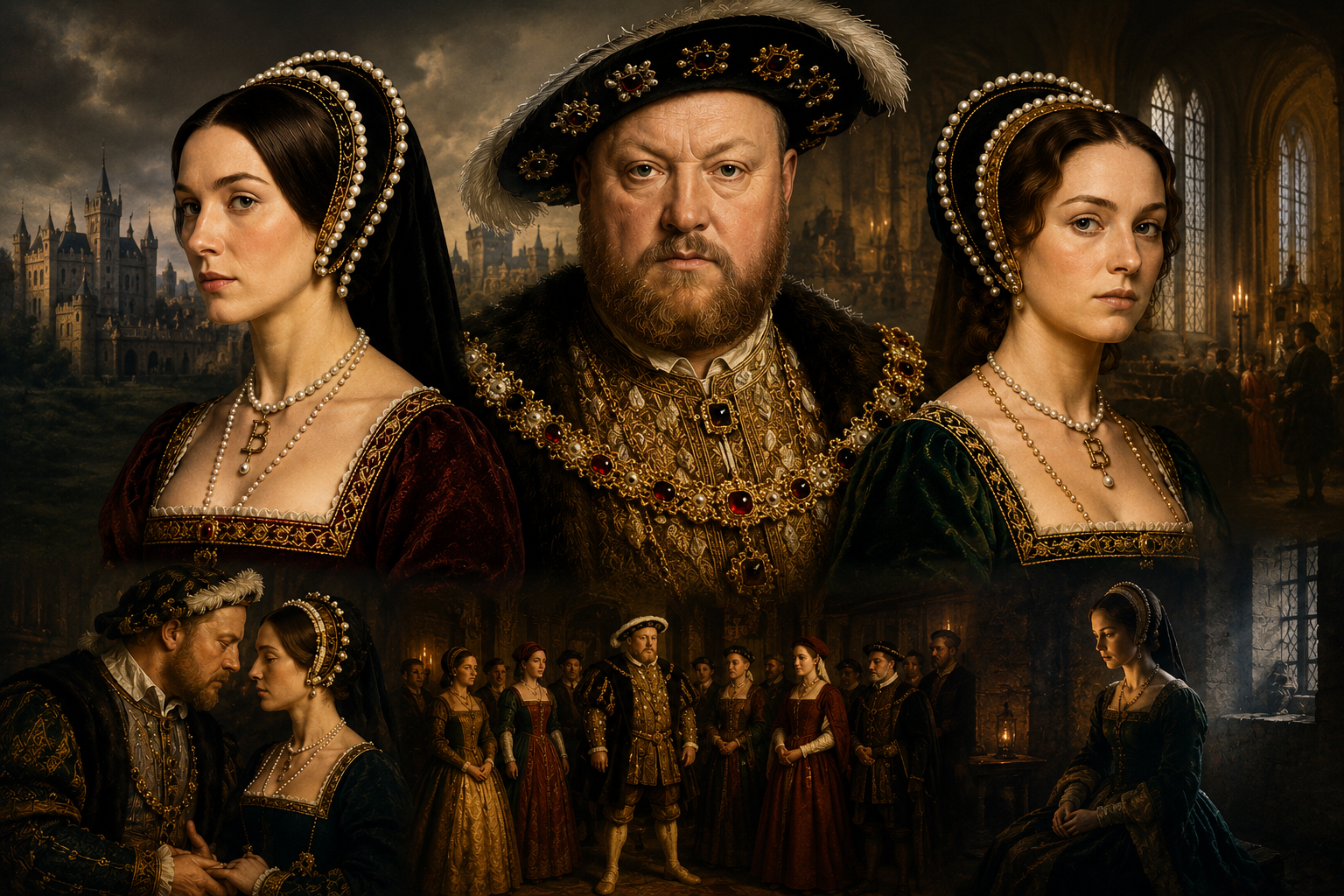
Anne or Mary Boleyn: The Sister Who Changed Henry VIII
Two sisters. One king. A royal court filled with ambition, romance, rivalry, and betrayal. The story of the Boleyn Sisters and Henry VIII is one of the most fascinating chapters in Tudor history.
Mary Boleyn was the elder sister. Anne was younger, more determined, and eventually became Queen of England. Both sisters were connected to Henry VIII, but their relationships with the king had very different consequences.
Mary may have been Henry’s mistress in the early 1520s, while Anne later became the woman who refused to remain simply a royal favourite. Instead, she demanded something far more dangerous—a legitimate marriage.
That decision would change the English monarchy forever.
Anne or Mary Boleyn Family
The Boleyn family rose in importance during the Tudor period. Their father, Thomas Boleyn, was an ambitious diplomat and courtier who built a powerful career through royal service and international connections.
His children grew up in a world where education, marriage, and political connections could transform a family’s fortunes.
Mary, the elder daughter, spent part of her youth abroad before returning to the English court. Anne also spent several years in Europe, where she experienced the sophisticated culture of the French court.
When Anne returned to England around 1522, she quickly attracted attention at court.
But by then, her sister Mary already had a connection with Henry VIII.
Mary Boleyn and Henry VIII
Mary Boleyn became closely associated with Henry VIII during the early 1520s.The story of the Boleyn Sisters and Henry VIII began with Mary, but it would later become far more complicated when Anne entered the king’s life.
Historic Royal Palaces notes that Mary had become Henry’s mistress by 1522 and possibly remained so until around 1525.
The exact details of their relationship remain uncertain.
Two children, Catherine Carey and Henry Carey, were later born to Mary and her husband William Carey. Because their births coincided with the period of Mary’s reported relationship with Henry, later historians have debated whether Henry could have been their biological father. However, Henry VIII never officially acknowledged either child as his own.
This uncertainty is an important reminder that Tudor history is often filled with rumours, political propaganda, and incomplete evidence.
Mary’s relationship with Henry eventually ended.
And then Anne entered the story.
Anne Boleyn Enters the Royal Court
Anne was very different from her sister.
She was intelligent, confident, fashionable, and highly aware of the politics surrounding the Tudor court. She attracted admirers, including Henry Percy and the poet Thomas Wyatt, before Henry VIII’s interest in her became serious.
Henry may have first encountered Anne in 1522, but by 1526 his interest had become much more serious.
There was just one problem.
Henry was already married.
His wife, Katherine of Aragon, had given birth to a daughter, Mary, but had not produced the surviving male heir Henry desperately wanted.
Henry began seeking an annulment of his marriage.
Anne, however, refused to become merely another royal mistress.
She wanted to be queen.
The King Who Would Not Take No for an Answer
Henry’s pursuit of Anne changed the balance of power at the English court.
Letters written by Henry to Anne during the late 1520s survive today, showing the intensity of his feelings for her. Historic Royal Palaces notes that 17 of these letters survive in the Vatican Library.
But Anne’s refusal to become his mistress made the situation even more complicated.
Henry needed his marriage to Katherine of Aragon annulled.
The Pope did not simply agree.
The dispute became what historians often call the “King’s Great Matter.”
As negotiations failed, Henry’s relationship with Rome deteriorated.
From Love Story to Political Revolution
Henry eventually broke with papal authority and asserted royal control over the English Church.
Anne was not solely responsible for this enormous transformation—Henry’s dynastic concerns, politics, religion, and his determination to control his own marriage all played major roles.
But Anne became one of the most important figures surrounding the crisis.The Boleyn Sisters and Henry VIII were now at the centre of a royal crisis that would reshape England.
In January 1533, Henry secretly married Anne Boleyn. His marriage to Katherine had not yet been formally annulled, making the situation extraordinarily controversial.
Anne was crowned Queen of England on 1 June 1533.
Just over three months later, she gave birth to a daughter.
Her name was Elizabeth.
That child would later become Elizabeth I, one of England’s most famous monarchs.
Anne Boleyn: Queen at the Centre of Change
As queen, Anne became much more than Henry’s wife.
She supported religious and political changes at court and became associated with a group of influential reform-minded figures. She also supported educational and religious initiatives during a period of enormous change.
But being queen did not make Anne safe.
Henry still desperately wanted a son.
After Elizabeth’s birth, Anne experienced miscarriages, including one in 1536. At the same time, Henry’s interest began shifting toward Jane Seymour.
The political situation around Anne became increasingly dangerous.
Her enemies grew stronger.
And eventually, the queen who had once seemed almost untouchable became a prisoner.
The Fall of Anne Boleyn
In May 1536, Anne was arrested and taken to the Tower of London.
She was accused of adultery and plotting against the king, along with several men from her household, including her brother George Boleyn.
The accusations remain one of the most controversial parts of Tudor history.
Anne maintained her innocence.
After a trial, she was found guilty and sentenced to death.
On 19 May 1536, Anne Boleyn was executed at the Tower of London.
Her reign as queen had lasted only about three years.
Yet her daughter survived.
And that daughter would one day rule England.
What Happened to Mary Boleyn?
Unlike Anne, Mary largely disappeared from the centre of royal politics.
After Anne’s execution, Mary continued living away from the spotlight. Historic Royal Palaces records that she lived until 1543.
Mary’s life became quieter, but her connection to the Tudor story never completely disappeared.
Her descendants and her possible relationship with Henry VIII have continued to attract historical interest.
Still, Mary never became queen.
Anne did.
Anne or Mary: Who Had the Greater Influence?
The Boleyn Sisters and Henry VIII remain one of the most debated relationships in Tudor history.
So, which Boleyn sister had the greater influence on Henry VIII?
Mary probably had the earlier personal relationship with the king.
But Anne’s influence was dramatically greater in political and historical terms.
Mary’s relationship with Henry appears to have been a royal affair.
Anne’s relationship became a struggle over marriage, legitimacy, succession, and religious authority.
Through Anne, Henry’s marriage to Katherine of Aragon was ended, Anne became queen, and Elizabeth I was born.
The wider political and religious changes of Henry’s reign cannot be attributed to Anne alone. Nevertheless, her relationship with Henry became deeply connected with one of the most transformative periods in English history.
The Legacy of the Boleyn Sisters
The story of the Boleyn sisters is ultimately a story about two very different paths through the Tudor court.
Mary became connected to the king but eventually faded from royal politics.
Anne reached the highest position a woman could achieve beside the English king—but paid for it with her life.
And yet Anne’s greatest legacy was not her crown.
It was her daughter.
Elizabeth I became queen in 1558 and ruled until 1603. Her reign became one of the most celebrated periods of English history.
More than five centuries later, the question still fascinates historians:
Was Mary Boleyn simply the sister who caught the king’s attention first—or was Anne always destined to change England?
Perhaps the most remarkable part of the story is that neither sister could have known what their connection to Henry VIII would eventually create.
One became the forgotten mistress.
The other became a queen.
And her daughter became a legend.