
 By admin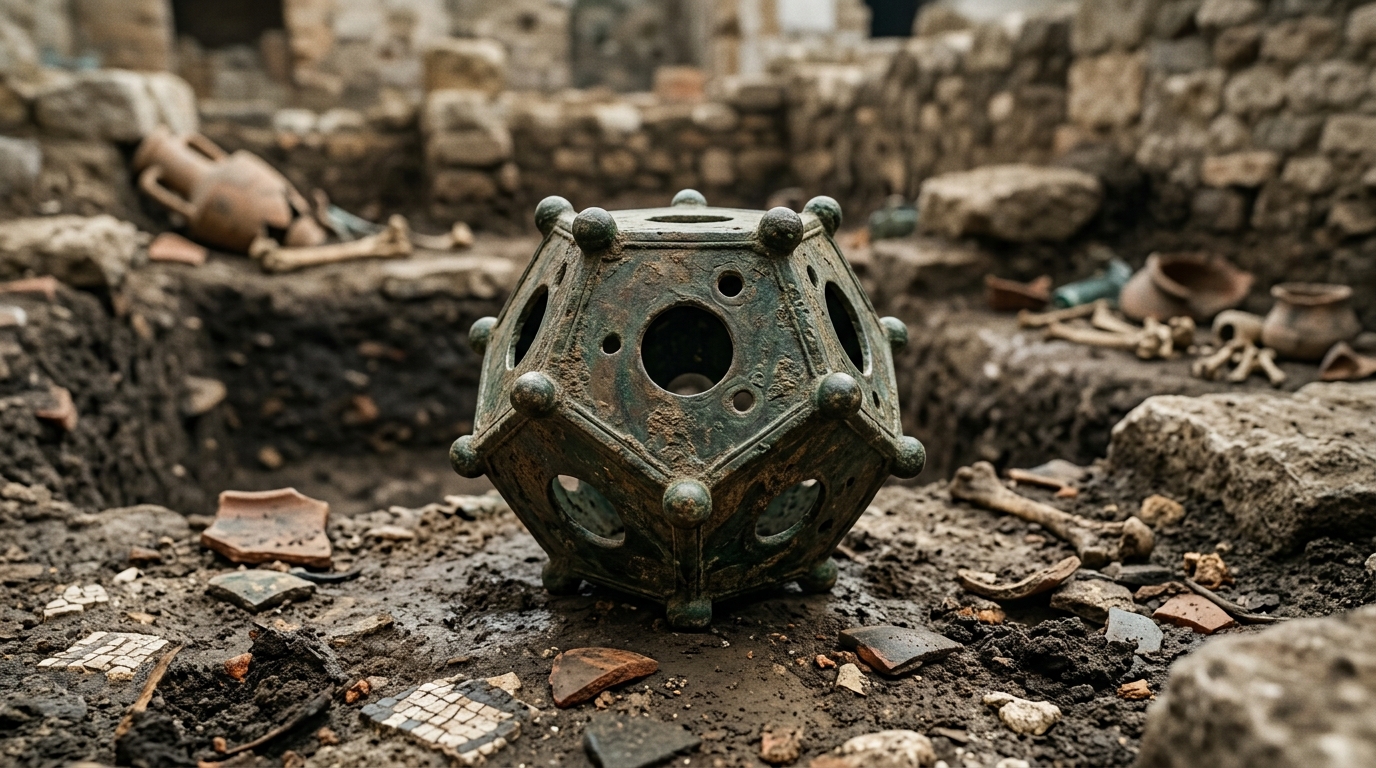
Introduction
More than 1,500 years ago, Roman craftsmen created strange bronze objects known today as the Roman Dodecahedron. These mysterious objects had twelve sides, circular holes, and small knobs at every corner. They were carefully made, expensive-looking, and unlike almost anything else from the Roman world.
Today, these mysterious objects are known as Roman dodecahedrons.
More than a hundred have been discovered across parts of the former Roman Empire, particularly in Britain, France, Belgium, Germany, the Netherlands, Switzerland, Austria, and Hungary. Yet despite centuries of archaeological investigation, nobody knows exactly what they were made for.
The mystery becomes even more fascinating because ancient Roman writers and artists appear to have left no clear description or picture of them.
So what were these strange objects?
What Is a Roman Dodecahedron?
A Roman dodecahedron is a small hollow object usually made from copper alloy or bronze.
It has twelve pentagonal faces, and each face normally contains a circular hole. The holes are different sizes, while small spherical knobs appear at the corners.
Most examples are relatively small, generally measuring only a few centimetres across. Their complicated shape would have required considerable skill to cast and finish, suggesting that they were not cheap everyday objects.
Some are plain, while others have decorative grooves or markings around the holes.
But there is one strange detail.
There are no obvious instructions.
No Roman manual tells us how to use them. No surviving painting clearly shows someone holding one. And no ancient inscription explains what they meant.
That silence is one of the biggest reasons the mystery has survived.
When Were They Made?
Most Roman dodecahedrons date from roughly the 2nd to 4th centuries AD, during the Roman imperial period.
Interestingly, they are not evenly distributed throughout the Roman world.
Most have been found in the northwestern provinces, including Roman Britain, Gaul, and Germania. They are notably absent from places such as Italy and much of the Mediterranean world.
This unusual geographic pattern has led some researchers to believe that the objects may have been connected to local traditions rather than being standard Roman military or household equipment.
But there is still no definitive answer.
The Norton Disney Discovery
One of the most exciting discoveries in recent years happened in Norton Disney, Lincolnshire, England.
During archaeological excavations in 2023, a volunteer discovered a complete Roman dodecahedron at a Roman-era site near a villa and the ancient Fosse Way.
The object was remarkably well preserved.
It was around 8 centimetres tall and weighed about 245 grams. Unlike many other examples that survive only as damaged fragments, the Norton Disney object was almost perfectly intact.
The discovery attracted considerable attention because archaeologists hoped that the object’s archaeological context might provide clues about its purpose.
Instead, it raised even more questions.
Why was such a carefully made object left there?
Who owned it?
And what did they actually do with it?
More Than 50 Theories
The mystery has produced an extraordinary number of explanations.
Researchers and enthusiasts have suggested more than 50 possible uses for Roman dodecahedrons.
Some theories are practical.
Others are surprisingly imaginative.
Here are some of the most discussed possibilities.
A Measuring Instrument
One popular theory is that the dodecahedron was used for measuring distances or estimating the size of distant objects.
The different-sized holes could potentially have helped someone align the object with something in the distance.
Some museum collections have suggested that the proportions between the holes may have allowed users to calculate ratios.
However, there is a major problem.
If the objects were important measuring instruments, archaeologists might expect standardized markings or clearer evidence of mathematical use.
They do not have that evidence.
A Religious or Ritual Object
Another theory is that Roman dodecahedrons had a religious or ritual purpose.
This idea becomes interesting because some examples have been discovered in funerary or unusual contexts.
The Norton Disney example has also encouraged discussion about whether these objects were symbolic rather than practical tools.
The lack of obvious wear on some examples may support the possibility that they were not used regularly for everyday work.
Perhaps they were connected to ceremonies, beliefs, or local religious traditions.
But again, there is no surviving Roman text that confirms this.
A Candle Holder?
Another theory suggests that some dodecahedrons may have been used as candle holders.
One example discovered in Germania reportedly contained traces of wax, which has been used to support the idea.
But this explanation does not necessarily account for every example.
Why would a candle holder need twelve different-sized holes?
And why would such an elaborate object be produced for such a simple purpose?
The mystery remains.
A Knitting Tool?
One of the more unusual theories is that Roman dodecahedrons were used to make gloves or other knitted objects.
The holes could theoretically have been useful for different sizes of thread or yarn.
It is an interesting idea—but there is a serious historical problem.
The earliest known evidence for spool knitting appears much later, making the theory difficult to connect confidently with the Roman period.
A Game or Fortune-Telling Device?
Some researchers have also suggested that the objects might have been connected to games, divination, or fortune-telling.
A related polyhedral object discovered in Geneva had zodiac names engraved on its faces, providing some intriguing evidence that multi-sided objects could have been associated with divination.
Still, ordinary Roman dodecahedrons usually lack the inscriptions or symbols that would make this interpretation certain.
Why Is the Roman Dodecahedron Mystery So Difficult to Solve?
The biggest problem is context.
Archaeologists often learn the purpose of an object by studying what was found around it.
Was it inside a house?
A workshop?
A temple?
A military camp?
A grave?
The answer can reveal how people used it.
But Roman dodecahedrons have been discovered in a wide variety of places, including military sites, settlements, theatres, baths, riverbeds, and funerary contexts.
That makes it difficult to identify one universal purpose.
Perhaps the objects had different uses.
Or perhaps their real purpose was symbolic rather than practical.
A New Theory in 2026
The mystery is still being investigated.
A 2026 experimental-archaeology study proposed that Roman dodecahedrons may have functioned as tools for forming standardized wax objects, such as wax elements used with cords, documents, or identification. The study describes this as a hypothesis rather than a proven solution.
Another 2026 hypothesis has suggested that dodecahedrons could have been connected to craft skill and social recognition—perhaps serving as demonstrations of a craftsman’s technical ability rather than ordinary tools.
These ideas show that the mystery is far from solved.
Every new discovery can change the discussion.
The Object Rome Forgot
Perhaps the most fascinating thing about the Roman dodecahedron is not its shape.
It is the fact that someone once knew exactly what it was for.
A craftsman made it.
Someone paid for it.
Someone carried it.
Someone used it—or perhaps displayed it.
And eventually, it disappeared beneath the ground.
Centuries passed.
The people who understood its meaning vanished.
The language, customs, and traditions surrounding the object changed.
And when archaeologists finally uncovered it, they were left holding a beautifully crafted object without an instruction manual.
Today, more than a hundred Roman dodecahedrons have been identified, yet their original purpose remains unresolved.
Maybe they were measuring instruments.
Maybe they were ritual objects.
Maybe they were connected to craft, games, astronomy, or something we have not even considered.
The truth may still be waiting in the soil.
And that is what makes the Roman Dodecahedron Mystery one of archaeology’s most intriguing unanswered questions.
Conclusion
The Roman Empire left behind roads, temples, coins, weapons, statues, and countless written records.
Yet among all these familiar objects are strange artefacts that seem to have lost their meaning completely.
The Roman dodecahedron is one of them.
It is small, complicated, expensive to make—and apparently impossible to explain with certainty.
For nearly two thousand years, these mysterious objects have survived.
The people who made them are gone.
Their world is gone.
But the question remains:
What were Roman dodecahedrons really made for?
[…] – Roman Dodecahedron […]