
 By admin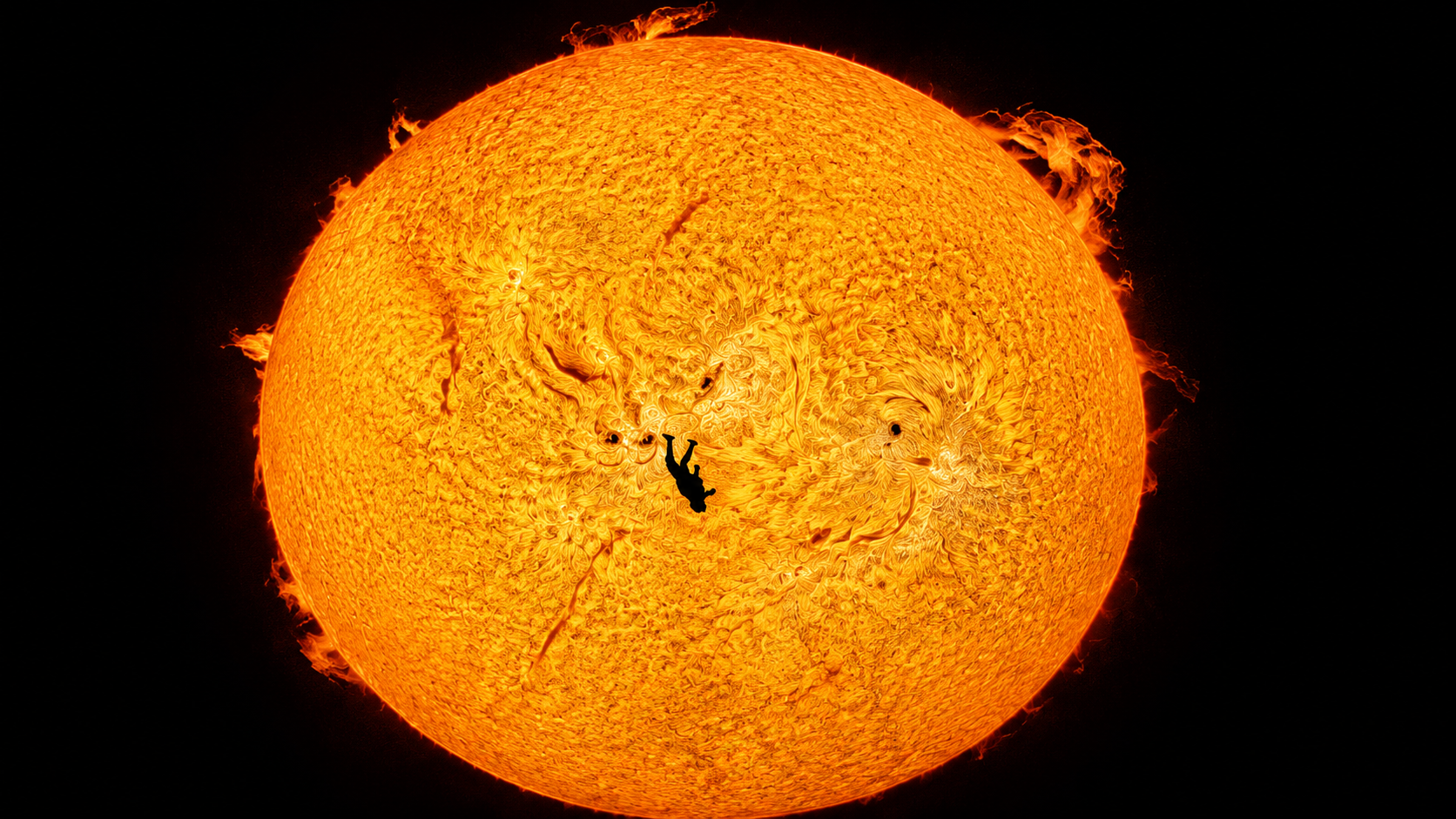
Introduction
When you first see “The Fall of Icarus,” it looks almost impossible. A tiny human figure appears to be falling directly across the blazing surface of the Sun, surrounded by swirling solar activity.
For many people, the first question is simple
Is this real, or is it AI-generated?
Surprisingly, the image is based on a real photograph. It was created by astrophotographer Andrew McCarthy with skydiver Gabriel C. Brown in Arizona in November 2025. The photograph required careful planning, precise timing, aerial coordination, and specialized solar photography.
But the story behind the picture is even more fascinating than the image itself.
What Is “The Fall of Icarus”?
The Fall of Icarus is the name given to an extraordinary photograph showing a skydiver silhouetted against the Sun.
At first glance, the image creates an incredible illusion. The skydiver appears to be falling through the Sun itself, almost as if a person has somehow entered the atmosphere of our star.
Of course, that is not what happened.
The skydiver was actually falling through Earth’s atmosphere, many thousands of feet away from the photographer. The remarkable effect came from carefully aligning the jumper with the Sun from the photographer’s viewpoint.
The photograph was captured by Andrew McCarthy, an astrophotographer known for detailed images of the Sun and other astronomical objects. The skydiver was his friend Gabriel C. Brown, who is also known online as BlackGryph0n.
Is The Fall of Icarus a Real Photo?
Yes. The Fall of Icarus is based on a real photographic capture, not an AI-generated scene.
The actual skydiving moment was photographed on November 8, 2025, in Arizona. Brown jumped from a small aircraft while McCarthy monitored the Sun through specialized equipment from the ground.
However, there is an important detail.
The final artwork was created by combining the high-resolution image of the Sun with the capture of the skydiver. McCarthy photographed the Sun separately in extreme detail and assembled a large mosaic before matching it with the skydiver’s image. So while the scene represents a real event and real photographic captures, the final presentation is a carefully constructed composite rather than one ordinary camera exposure of the entire scene.
That makes the photograph no less impressive. In fact, it shows just how much planning and technical skill went into creating it.
How Was the Skydiver Aligned With the Sun?
This was the hardest part of the entire project.
The Sun is enormous, but from Earth’s surface, the area visible through a highly magnified solar telescope is surprisingly narrow. Even a small error in the aircraft’s position could cause the skydiver to completely miss the desired part of the Sun.
McCarthy and Brown therefore had to carefully consider the location, time, aircraft trajectory, distance, solar position, and the exact moment of the jump.
The aircraft made six passes to achieve the correct alignment.
Finally, when everything was lined up, McCarthy gave Brown the signal to jump.
Brown had only one real opportunity to produce the desired silhouette because another immediate jump would not have been practical. The successful attempt created the extraordinary image that later became known as The Fall of Icarus.
And that is what makes the photograph so remarkable: thousands of tiny details had to come together at almost exactly the right moment.
How Did They Capture the Sun’s Fiery Details?
The Sun in the photograph doesn’t look like an ordinary photograph of the Sun.
You can see dark sunspots, glowing structures, filaments, and turbulent patterns across its surface. These details were captured using hydrogen-alpha solar photography, a specialized technique that allows photographers to reveal features in the Sun’s chromosphere.
The chromosphere is a layer of the Sun’s atmosphere above the visible surface. When photographed using the appropriate equipment, it can reveal structures that are difficult or impossible to see in ordinary white-light photographs.
This specialized technique is one of the reasons the background of The Fall of Icarus looks so dramatic.
Why Is It Called “The Fall of Icarus”?
The name is a reference to one of the most famous stories from Greek mythology.
According to the myth, Icarus escaped from Crete with wings made by his father, Daedalus. He was warned not to fly too close to the Sun because the heat could melt the wax holding his wings together.
Icarus ignored the warning and flew too high.
The wax melted, his wings failed, and he fell into the sea.
The modern photograph obviously has nothing to do with the mythical Icarus. But the visual similarity is striking: a human figure appears to be falling against the enormous Sun.
That is why the title The Fall of Icarus feels almost perfect.
A Photograph That Looks Like Science Fiction
Perhaps the most fascinating thing about this image is how easily it can fool the eye.
The human silhouette is tiny compared with the Sun, yet the composition makes it appear as though the person is somehow falling through a gigantic star.
In reality, the skydiver was much closer to Earth than to the Sun. The incredible appearance comes from perspective, distance, magnification, timing, and precise positioning.
It is a perfect example of how photography can create an image that looks completely impossible while still being rooted in a real event.
The Story Behind the Image
The Fall of Icarus is more than just a beautiful photograph.
It is the result of two very different forms of adventure coming together: astrophotography and skydiving.
One person was falling through the sky while another was trying to capture that tiny moving figure against one of the most difficult objects to photograph—the Sun.
After months of planning and calculations, the idea finally worked.
And the result was a photograph that made thousands of people stop scrolling and ask the same question:
“Wait… is that actually real?”
Yes. It is.
And perhaps that is what makes The Fall of Icarus so fascinating—not that someone fell into the Sun, but that human creativity, mathematics, technology, and perfect timing made something that looked impossible appear in a single breathtaking image.
Image Disclaimer: The feature image used in this article was generated with AI for illustrative purposes. The actual “Fall of Icarus” photograph discussed in this article is based on a real photographic capture.
Explore More Historical Stories
Enjoyed this story about The Fall of Icarus: A Skydiver Crosses the Sun. If you found it interesting, you can explore our other historical stories and discover more fascinating events from the past:
– Urfa Man: The 11,500-Year-Old Statue That Remains a Mystery
Prophet Hud (AS): The Fall of the Nation of ‘Ad
Great Pyramid of Giza: Secrets of Ancient Egypt
Click on any title above to continue exploring history and uncover more fascinating stories from the past.