
 By admin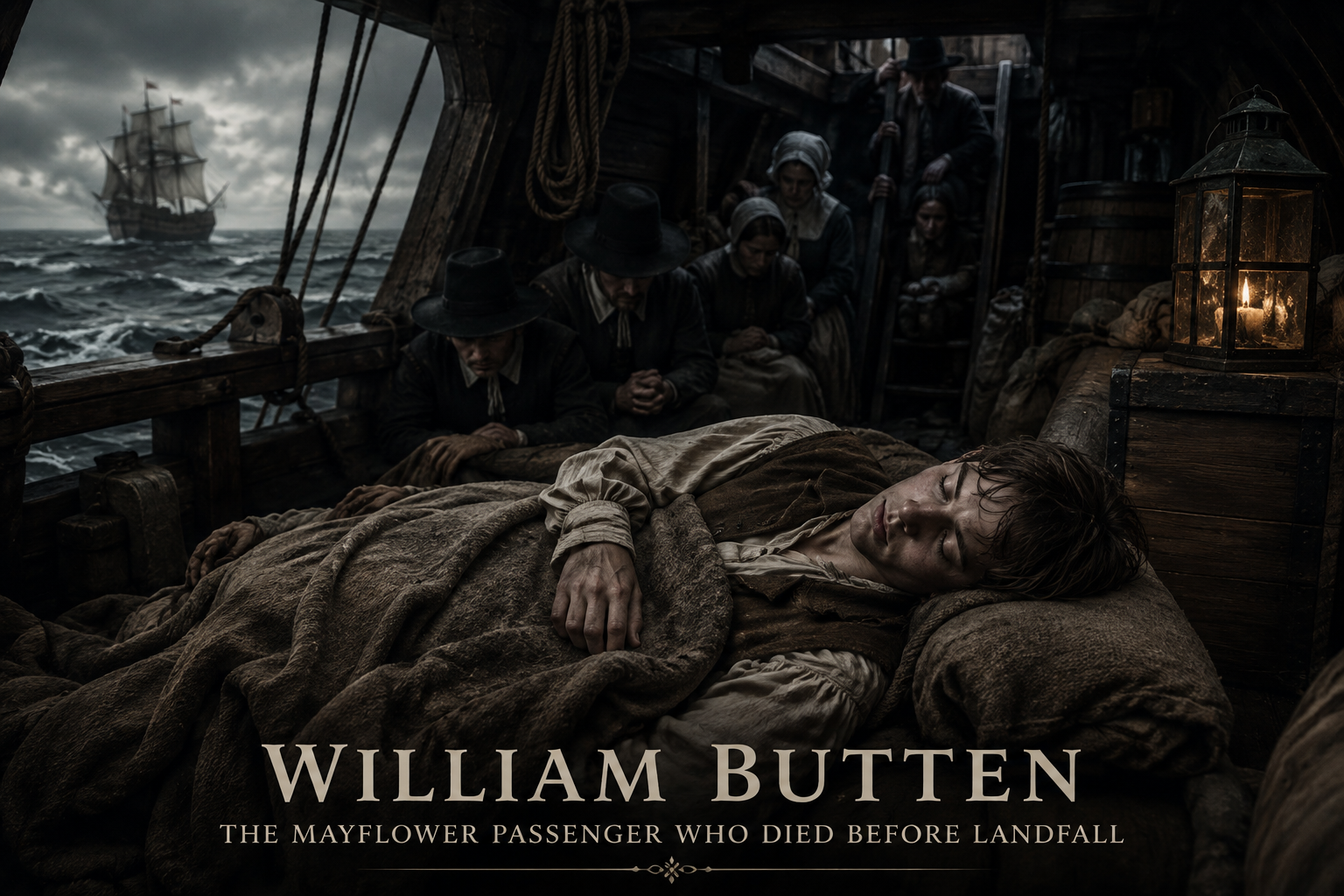
Introduction
William Butten was a young passenger aboard the Mayflower in 1620 who died just days before the ship reached the coast of North America. While the Mayflower is remembered for carrying the Pilgrims across the Atlantic, his story is a quieter and more tragic part of that famous voyage. He became the only passenger to die during the journey itself.
The Mayflower left Plymouth, England, in September 1620, carrying around 102 passengers along with its crew. The voyage was difficult from the beginning. The ship was small, crowded, and exposed to rough Atlantic weather. Passengers lived in cramped conditions, with limited space, poor sanitation, and little comfort.
For someone already suffering from illness, the journey could be especially dangerous.
Who Was William Butten?
Very little is known about Butten’s early life. Historical records describe him simply as a “youth” and as a servant of Dr. Samuel Fuller, a member of the Pilgrim community and the Mayflower’s physician.
His exact age and family background remain uncertain. Historians have suggested possible connections to families in England, but there is no conclusive evidence identifying his parents or birthplace.
This lack of information makes his story unusual. We know the moment when his short life ended, but much of the life that came before the Mayflower remains hidden.
Life Aboard the Mayflower
The Mayflower voyage lasted roughly two months, and conditions aboard the ship were harsh.
The passengers had to endure violent storms, cold weather, damp living quarters, and long periods without the comforts they had known on land. The ship’s movement could make even ordinary activities difficult.
Butten was reportedly sick during much of the voyage. As a servant of Samuel Fuller, he would have travelled alongside the Fuller household and other members of the Pilgrim community.
There was no modern medical care available. Although Samuel Fuller was a physician, the resources available aboard a seventeenth-century sailing ship were extremely limited.
For a young and already ill passenger, the combination of sickness, exhaustion, cold, and an unforgiving Atlantic journey could become fatal.
The Final Days of the Voyage
The Mayflower was approaching the coast of what is now New England when Butten’s condition became fatal.
According to accounts based on William Bradford’s history, Butten died on November 16, 1620, only a few days before land was sighted. He was the first passenger to die during the Mayflower’s voyage.
The timing makes his story particularly heartbreaking.
After weeks at sea, the passengers were finally close to their destination. Land was almost within reach, yet Butten would never see it.
The following day, his body was committed to the sea. Historical accounts describe this as the first burial at sea of a Mayflower passenger during the voyage.
Just Three Days Before Land
Perhaps the most striking detail about Butten’s story is how close he was to reaching America.
The Mayflower sighted Cape Cod on November 19, just three days after his death. The ship had crossed the Atlantic, survived storms, and finally reached the edge of the new continent—but Butten was no longer alive to see it.
The passengers initially hoped to continue south toward their intended destination in the Virginia Colony. Dangerous conditions and difficult waters prevented them from doing so, and the Mayflower eventually anchored at Cape Cod.
For the people who survived, the journey was entering a new chapter. For Butten, it had ended just before that chapter began.
Why His Story Matters
William Butten is not one of the most famous names connected with the Mayflower. He did not sign the Mayflower Compact, lead the colony, or become a prominent figure in Plymouth’s history.
Yet his story gives us a different perspective on the voyage.
The Mayflower story is often presented as a tale of arrival and survival. But the journey was also filled with uncertainty, illness, fear, and loss. Butten’s death reminds us that reaching the New World was not guaranteed simply because the ship was getting close.
He also represents the many young and lesser-known people whose lives became connected with the Mayflower voyage but whose personal stories were poorly recorded.
The First Mayflower Passenger to Die
Butten holds a unique place in Mayflower history. The General Society of Mayflower Descendants identifies him as the only passenger who died at sea during the actual voyage. Other passengers died later, including several after the ship reached Cape Cod.
His death was therefore the first passenger death of the famous Mayflower journey.
It also came before the much larger wave of deaths that followed during the harsh winter of 1620–1621. Nearly half of the Mayflower passengers eventually died during that first winter in New England.
Butten’s death was an early warning of just how dangerous the settlement journey would become.
A Name Almost Lost to History
Today, William Butten is remembered mainly through a few surviving historical references. Even his origins remain uncertain, and there is no complete biography of his short life.
What we do know is enough to tell a remarkable story: a young servant boarded the Mayflower, endured a difficult Atlantic crossing, became seriously ill, and died when the ship was only days away from land.
He never stepped onto the shore of North America.
He never saw the settlement that would become Plymouth.
But his name survived because his death became part of the record of one of the most famous voyages in American history.
William Butten’s story is a reminder that history is not only made by governors, leaders, and famous settlers. Sometimes, the people whose lives were shortest leave behind the most haunting stories.
Conclusion
The Mayflower finally reached Cape Cod just three days after William Butten died. For the passengers who remained, a new life was about to begin. For Butten, the journey had ended within sight of its destination.
He came so close to the land that would define the Mayflower story—yet he never lived to see it.
Explore More Historical Stories
If you enjoyed this story about the William Butten, you can explore our other historical stories and discover more fascinating events from the past:
Theban Tomb 209: Luxor’s Forgotten Ancient Egyptian Tomb
Wari-Bateshwar: The 2,500-Year-Old Lost City of Bangladesh
The Tomb of Qin Shi Huang: Secrets of China’s First Emperor
Click on any title above to continue exploring history and uncover more fascinating stories from the past.
[…] William Butten: The Mayflower Passenger Who Died at Sea […]