
 By admin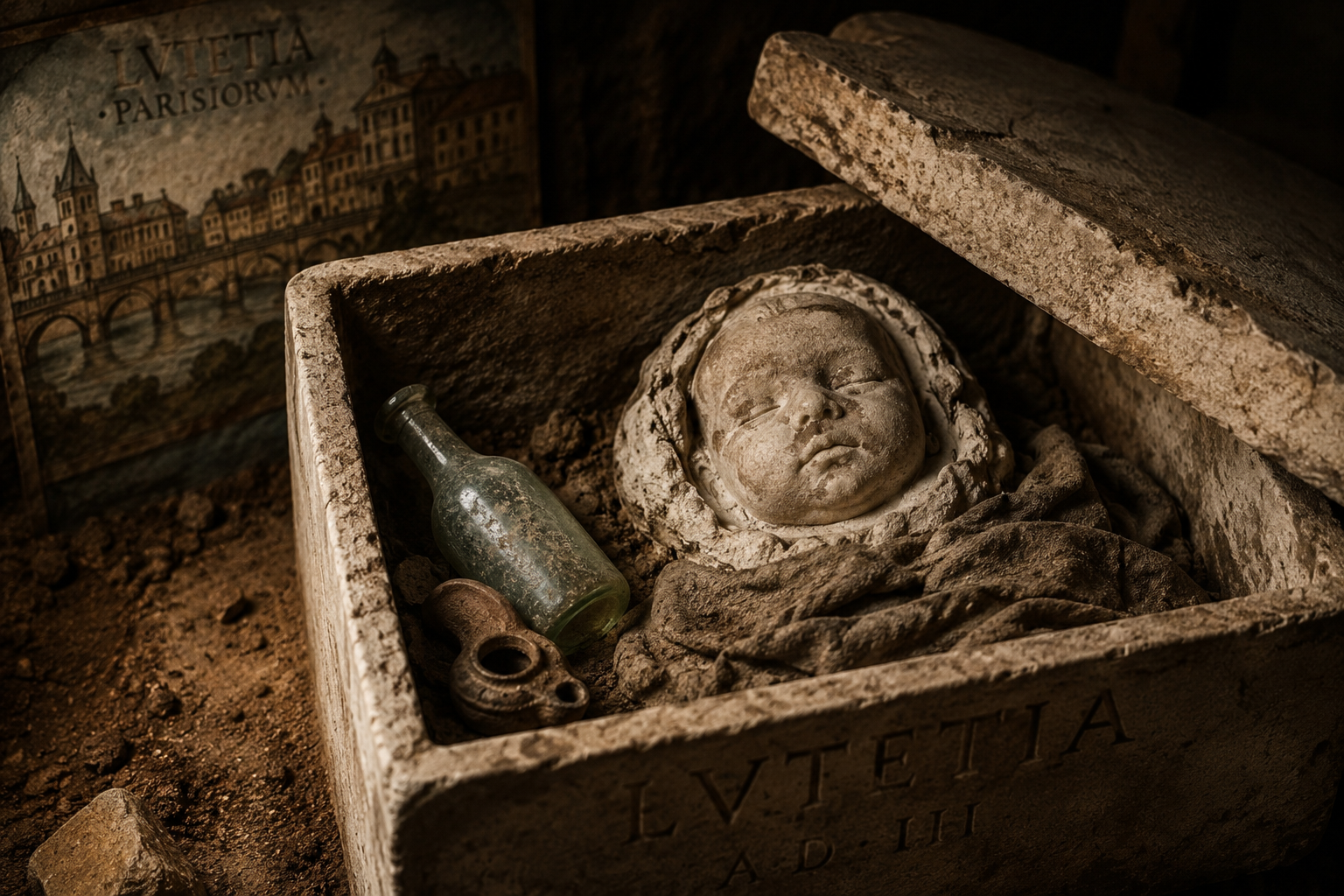
Introduction
Imagine looking at the face of a baby who lived nearly 1,800 years ago. What you’re seeing is not a painting, statue, or artist’s reconstruction, but a Roman baby’s accidental death mask—an actual impression of the child’s face, preserved by an extraordinary accident.
This remarkable object comes from Lutetia, the Gallo-Roman settlement that eventually became modern-day Paris. The tiny face belongs to a Roman infant who was buried in a stone sarcophagus during the Roman period.
What makes the discovery so unusual is the way the child’s face survived. The family did not intentionally create a death mask. Instead, material used to seal the sarcophagus accidentally formed a mould over the infant’s face.
The result is one of the most haunting and personal archaeological traces of ancient Roman life.
A Baby Buried in Roman Lutetia
Around 1,800 years ago, Lutetia was an important Gallo-Roman settlement in what is now Paris. Like other Roman communities, its people had established burial grounds where the dead were placed to rest.
The infant was buried in a stone sarcophagus. According to the Science Museum Group, the child was also buried with a small glass bottle, believed to have been a feeding bottle.
That small object makes the discovery particularly moving. It gives us a glimpse of the child not simply as an archaeological specimen, but as a baby who was cared for during a very short life.
The exact identity of the child has been lost to history, and there is no surviving record explaining the cause of death.
How Was the Roman Baby’s Accidental Death Mask Created?
This is the most fascinating part of the story.
When the sarcophagus was sealed, the material used to close it apparently leaked into the interior. It came into contact with the child’s face and hardened.
Instead of disappearing into the soil, the material captured the contours of the baby’s face.
The hardened substance effectively became a negative mould—an impression showing the shape of the child’s facial features. Centuries later, that mould could be used to create a positive plaster cast.
The Science Museum Group describes the object as a plaster cast made from a mould accidentally created when cement used to seal the sarcophagus leaked inside and covered the child’s face.
In other words, nobody planned to preserve the baby’s face. It happened entirely by chance.
That accident transformed an ordinary burial into an extraordinary archaeological record.
The Discovery in Paris
The burial was discovered in 1878 during archaeological excavations in Paris. The sarcophagus was found in the gardens of a Paris convent, in an area associated with the ancient Roman settlement of Lutetia.
When archaeologists opened the burial, they discovered the remains of the infant and the unusual material covering the face.
The discovery must have been extraordinary. Instead of seeing only ancient bones, the excavators encountered something that seemed almost like a portrait of a child from the Roman world.
The original face impression was preserved, and a plaster cast was later made from it. The Science Museum Group records the cast as dating from between 1878 and 1920.
Today, the plaster cast is part of the Science Museum Group Collection.
Was It Really a Roman Death Mask?
Technically, calling it a “death mask” can be slightly misleading.
A traditional death mask is normally created deliberately after a person’s death, using a mould taken from the face. In this case, however, the facial impression was created accidentally by the material used to seal the child’s burial.
That is why it is often described as an accidental death mask.
The distinction is important because there is no evidence that the child’s family intentionally commissioned this particular mask.
Still, the final result resembles a death mask in one remarkable way: it preserves the physical features of someone who lived almost two millennia ago.
A Face From Ancient Paris
Ancient history often gives us names of emperors, generals, wealthy families and famous philosophers. Ordinary people are much harder to find.
Babies are even harder.
Most people who lived in Roman cities left no written record behind. Their names disappeared, their homes vanished, and their belongings were buried beneath later cities.
But this child’s face survived.
The Roman baby’s accidental death mask gives historians something unusually intimate—a physical connection to an individual who otherwise would have remained completely anonymous.
It does not tell us the baby’s name, personality or dreams. Yet it gives us something rare: a glimpse of the person themselves.
What Was Found With the Baby?
One of the most touching details of the burial is the small glass bottle found with the infant.
The Science Museum Group notes that the child was buried with a perfectly preserved small glass bottle
Such an object provides a tiny window into everyday life in Roman Lutetia.
Archaeologists often learn about ancient societies from grand monuments, coins, temples and military equipment. But sometimes a small personal object can tell a more human story.
A feeding bottle placed beside a baby suggests care and attention at the time of burial, although we cannot know exactly who placed it there or what emotions surrounded the funeral.
What Happened to the Child?
One question naturally comes to mind: How did the baby die?
Unfortunately, we do not have a definite answer.
The surviving museum record specifically states that there is no indication of the cause of death.
That means we should be careful not to invent a dramatic explanation.
The child may have died from an illness, infection, complications of infancy or another cause that cannot now be determined. Without reliable archaeological or historical evidence, the exact cause remains unknown.
What we do know is that the child died during the Roman period and was given a burial that survived for centuries.
Why Is the Discovery So Important?
The significance of this discovery goes beyond the unusual appearance of the plaster face.
It reminds us that ancient history was made up of ordinary human lives.
Behind the enormous Roman Empire were millions of people who lived, loved, worked, raised families and mourned their dead. Most of their individual stories disappeared forever.
This child is different.
Through an accidental chain of events, a moment from the distant past was preserved.
The archaeological record normally gives us fragments—bones, pottery, buildings and inscriptions. Here, those fragments come together to create something much more personal.
For nearly 1,800 years, the child’s face remained hidden underground.
Then, in the nineteenth century, archaeologists opened the burial and revealed a face that had been silently waiting beneath Paris.
A Face That Survived by Accident
The story of the Roman baby’s accidental death mask is both fascinating and deeply sad.
The child lived nearly two thousand years ago, yet the face preserved in the mould still looks remarkably human. There is no famous name attached to it and no great historical event connected to the baby’s life.
And perhaps that is exactly what makes the discovery so powerful.
History is not only about emperors, wars and monuments. Sometimes, the smallest archaeological discoveries can bring us closer to the people who lived in the past.
This Roman baby left behind almost nothing—except a tiny bottle, a burial and, by extraordinary chance, an impression of a face.
Today, that accidental impression allows us to look across nearly two thousand years and briefly meet one of the youngest inhabitants of ancient Lutetia.
Conclusion
The Roman baby’s accidental death mask is a rare reminder of how unpredictable archaeology can be. A mistake during a burial created something no one intended to preserve—and that accident ultimately gave the modern world an extraordinary glimpse of a child from ancient Roman Paris.
The child’s name and story may be lost forever.
But the face survived.
And sometimes, that single face can tell us more about the human side of ancient history than a thousand monuments.
Explore More Historical Stories
If you enjoyed this story about the Roman baby’s accidental death mask, you can explore our other historical stories and discover more fascinating events from the past:
The Suzdal Chamber Grave: A Medieval Mystery
Urfa Man: The 11,500-Year-Old Statue That Remains a Mystery
The Year Without a Summer (1816)
Click on any title above to continue exploring history and uncover more fascinating stories from the past.
[…] The Roman Baby’s Accidental Death Mask […]