
 By admin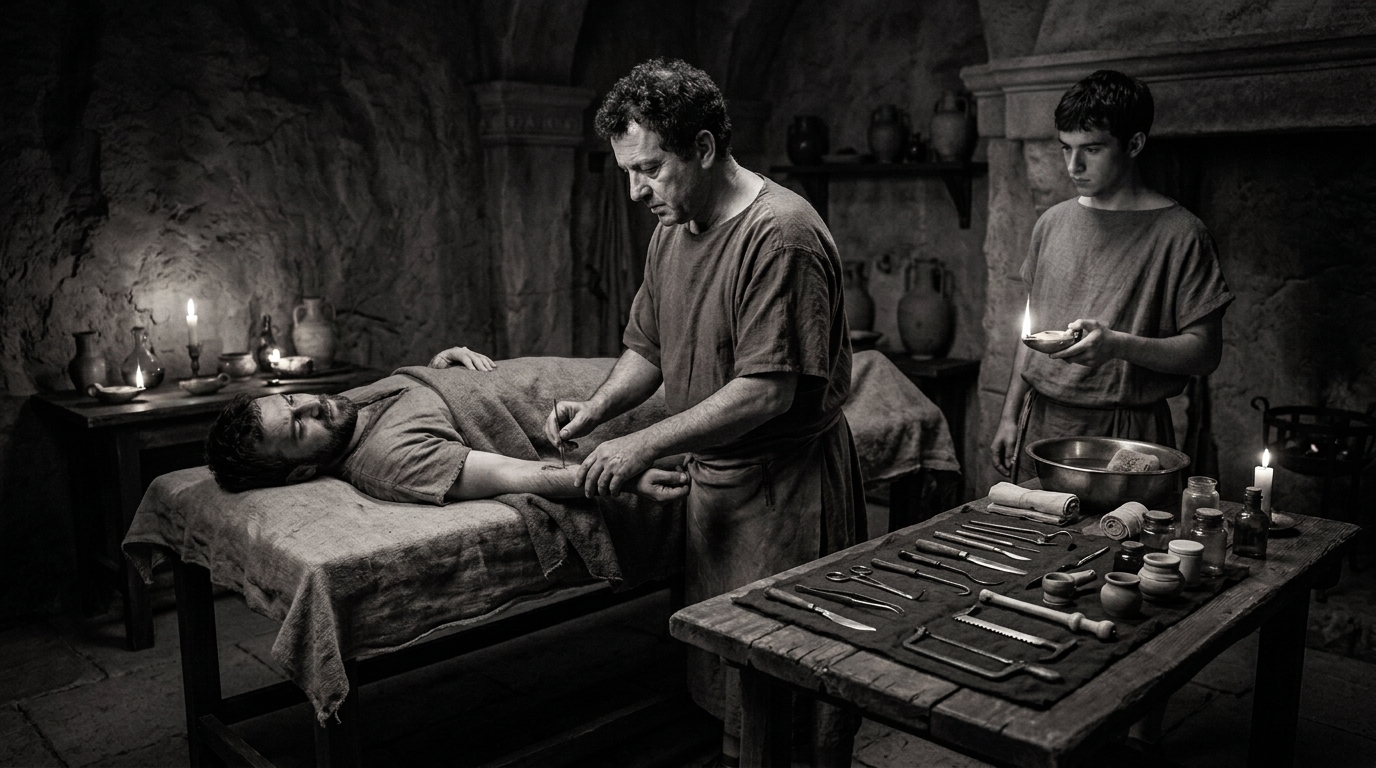
Introduction
Imagine being injured in ancient Rome and needing ancient Roman surgery. There would be no modern hospital, no electric lights, and none of the technology that doctors depend on today. Instead, you might find yourself in the hands of a Roman physician surrounded by bronze instruments, herbs, linen, and simple medical equipment.
It sounds frightening, but the history of ancient Roman surgery is more sophisticated than many people realise.
Roman medicine developed from a mixture of local traditions and Greek medical knowledge. Greek physicians and medical ideas became particularly influential in the Roman world. Archaeological discoveries, ancient writings, and surviving medical instruments give historians a glimpse into how these doctors worked.
Roman Surgeons Had Specialised Instruments
One of the most fascinating things about Roman medicine is the variety of surgical instruments that have survived.
Archaeologists and museums have identified Roman scalpels, forceps, probes, spatulas and other instruments. The Metropolitan Museum of Art, for example, preserves a Roman bronze scalpel dating to the 1st–2nd century CE. The museum describes it as a typical surgical instrument used by Roman doctors and surgeons.
Another surviving Roman instrument is a pair of bronze forceps. Its long arms suggest that it may have been used by a doctor during minor surgical procedures.
These discoveries show that ancient Roman surgery was not simply a collection of improvised treatments. Some Roman medical practitioners worked with purpose-built tools designed for particular tasks.
What Did Roman Surgeons Actually Do?
Roman surgeons dealt with many kinds of injuries and medical problems.
Wounds were particularly important because warfare, accidents, farming, construction, and everyday life could all result in serious injuries. Surgeons could clean and treat wounds, remove damaged tissue or foreign objects, and use instruments to carry out more invasive procedures.
Some instruments were designed for probing wounds or applying medicines. A Roman bronze specillum, for example, is believed to have been used as a probe, although similar instruments could also have had other medical or cosmetic purposes.
Roman doctors also treated conditions that required procedures rather than simple medicines. Historical evidence points to operations involving wounds, abscesses, fractures, and other problems.
However, it is important not to imagine every Roman doctor as a highly trained surgeon. Medical practice in the ancient world varied considerably. There were physicians, surgeons, midwives, drug sellers, and other practitioners, and formal medical qualifications were not organised in the same way as they are today.
The Tools Were Surprisingly Advanced
Perhaps the most striking evidence for ancient Roman surgery comes from the instruments themselves.
Roman scalpels could have removable blades, while other instruments had specialised shapes. One surviving bronze scalpel/dissector from the Roman period combines a scalpel with a leaf-shaped dissector, showing that a single instrument could have more than one function.
Some Roman medical instruments were small and delicate, while others were designed for more demanding procedures.
A Roman physician’s profession could even be represented on funerary art. The Metropolitan Museum’s Sarcophagus with a Greek Physician shows a physician alongside an open case containing surgical tools, providing visual evidence of the medical profession in the Roman world.
Medicine Was a Mixture of Knowledge and Tradition
Roman medicine was not based entirely on what we would now call scientific medicine.
Doctors combined practical experience with theories inherited from Greek medicine, traditional remedies, herbs, and beliefs about the human body. Some treatments were based on observations and experience, while others reflected ideas that modern medicine no longer accepts.
This mixture is one reason Roman medicine is so interesting. It was neither completely primitive nor equivalent to modern medicine. Instead, it was a developing medical tradition built from the knowledge available at the time.
The writings associated with physicians such as Galen, who lived during the Roman imperial period, later became enormously influential in European and Middle Eastern medical history. Archaeological evidence from Roman sites—including medical instruments—also helps researchers understand how medicine was practised.
Surgery Was Still Extremely Dangerous
Despite their impressive tools, Roman surgeons faced enormous limitations.
A serious operation could be dangerous because doctors did not have the modern understanding of infection, sterile surgical environments, antibiotics, or the sophisticated pain control available today.
Even a procedure that seems relatively simple by modern standards could become life-threatening because of bleeding, infection, or complications.
That makes the existence of specialised Roman surgical instruments even more remarkable. The tools reveal that ancient physicians were willing to perform difficult procedures despite having far fewer resources than modern surgeons.
What Ancient Roman Surgery Tells Us
The story of ancient Roman surgery is not simply about shocking operations.
It is a story about people trying to understand the human body and treat injuries with the knowledge available to them.
The surviving scalpels, forceps, probes, and other instruments provide physical evidence of this medical tradition. They show that Roman doctors had developed specialised equipment and practical techniques long before the invention of modern hospitals.
At the same time, these discoveries remind us how different ancient medicine was from medicine today. Roman physicians could be remarkably skilled, but they were working without many of the discoveries and technologies that now make surgery safer.
More than two thousand years later, their instruments still give us a glimpse into a world where medicine was a mixture of experience, experimentation, tradition, and courage.
And perhaps that is what makes ancient Roman surgery so fascinating: behind every bronze instrument was a doctor attempting to solve a medical problem—and a patient trusting that doctor with their life.
Explore More Historical Stories
If you enjoyed this story about the Ancient Roman surgery, you can explore our other historical stories and discover more fascinating events from the past:
The Roman Baby’s Accidental Death Mask
The Golden Age of Rome: When the Roman Empire Reached Its Greatest Glory
The Baghdad Battery: Did Ancient People Really Have Electricity?
Click on any title above to continue exploring history and uncover more fascinating stories from the past.