
 By admin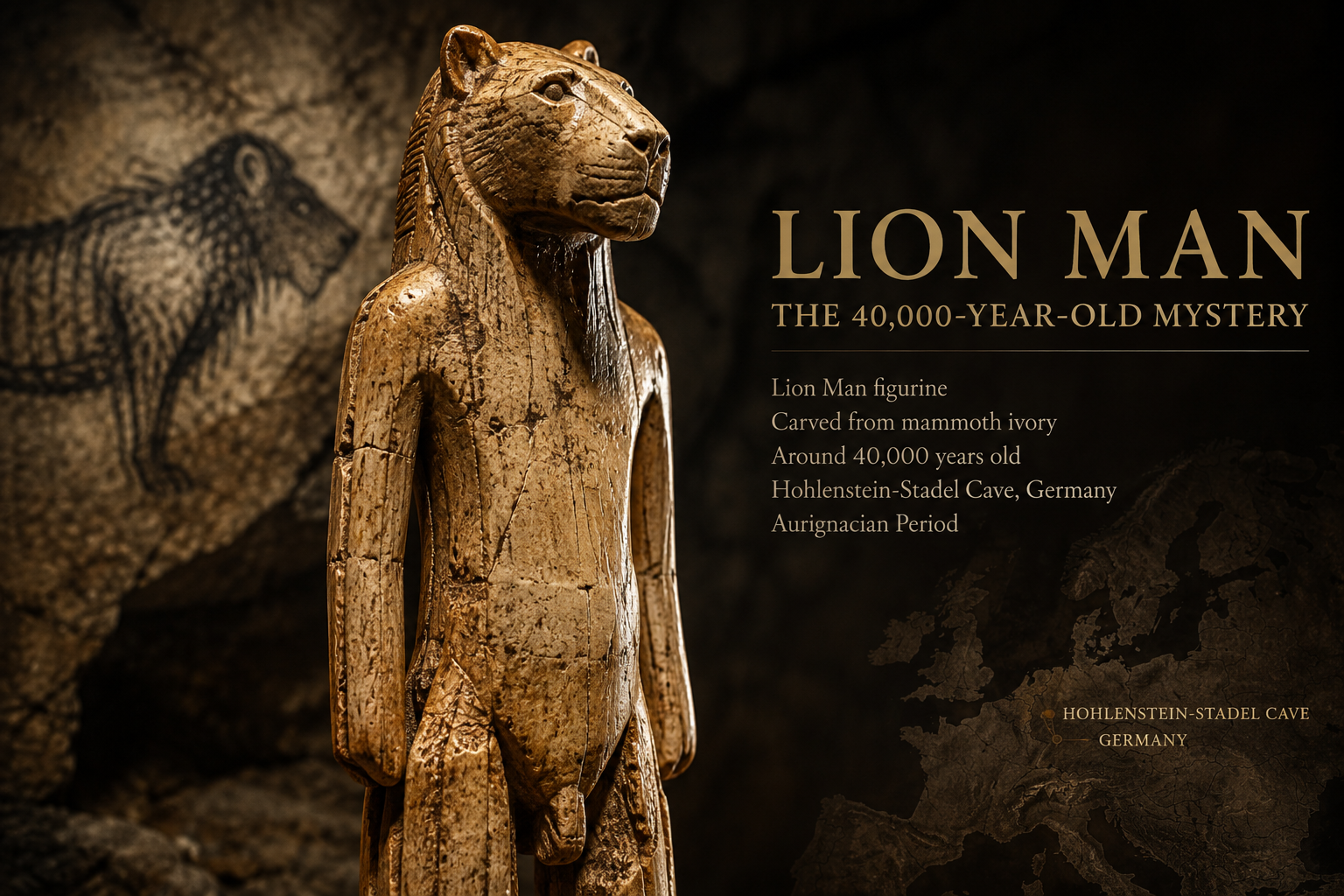
Introduction
Imagine holding a small sculpture that was carved nearly 40,000 years ago, long before written history, cities, and even farming. The Lion Man figurine is one of the most remarkable works of Ice Age art ever discovered—a mysterious figure with a human-like body and the head of a cave lion. Found deep inside Hohlenstein-Stadel Cave in what is now southern Germany, it offers a fascinating glimpse into the imagination of prehistoric humans.
What Is the Lion Man?
The Lion Man is a prehistoric sculpture carved from mammoth ivory. It stands about 31 centimeters tall and combines human and animal features in a way that would have been extraordinary for its time. Its upright body appears human-like, while its head resembles that of a cave lion.
The figure is often called the “Lion Man,” although some researchers have suggested that it may represent a female figure. Because there is no written record from this period, its original identity and meaning remain uncertain.
Where Was the Lion Man Found?
The sculpture was discovered inside Hohlenstein-Stadel Cave in the Swabian Jura region of Germany.
In 1939, archaeologists uncovered hundreds of small fragments of mammoth ivory in the cave. At first, the pieces did not look like a complete statue. Decades later, archaeologist Joachim Hahn began assembling the fragments, gradually revealing the extraordinary human-animal figure.
Later excavations between 2009 and 2013 uncovered additional fragments that belonged to the sculpture. These discoveries helped researchers improve the reconstruction of the Lion Man and understand more about the archaeological setting in which it was found.
How Old Is the Lion Man Figurine?
The Lion Man dates to the Aurignacian period, around 35,000–40,000 years ago. Smithsonian describes it as about 35,000 years old, while Museum Ulm places the sculpture at approximately 40,000 years old. Archaeological dating of the surrounding layers provides a range of roughly 35,000 to 41,000 years.
That age makes the sculpture especially important. It comes from a period when modern humans in Europe were creating some of the earliest known figurative art.
A Creature That Did Not Exist
Perhaps the most fascinating part of the Lion Man is that it does not simply portray an ordinary animal.
Instead, it combines a human body with the head of a cave lion. In other words, the artist created an imaginary being that did not exist in nature.
Creating such a figure required more than the ability to carve ivory. The artist had to imagine a creature by combining characteristics from two different worlds. This is one reason the Lion Man is often discussed as evidence of the sophisticated imagination of Ice Age humans.
Why Was lion Man Figurine Made?
This is where the mystery begins.
Nobody knows exactly why the Lion Man was created.
It may have been connected to storytelling, ritual, spiritual beliefs, or a belief system involving humans and animals. The sculpture was discovered in a dark inner part of the cave rather than in an area that appears to have been used as an ordinary living space. Other objects, including perforated animal teeth, were also found nearby.
Some researchers have suggested that the figure may have represented a supernatural being or played a role in rituals. However, these interpretations remain theories because there is no written evidence explaining what the sculpture meant to its creators.
Did Ice Age People Believe in Spirits?
The Lion Man raises a much bigger question: when did humans begin imagining supernatural beings?
The sculpture does not prove exactly what Ice Age people believed. However, creating a human-animal figure suggests that people living around 40,000 years ago were capable of thinking beyond the world they could directly see.
The British Museum describes the Lion Man as an extraordinary example of an imagined being and connects it with the possibility of early spiritual or ritual ideas.
That makes the sculpture more than just an ancient piece of art. It may provide a rare glimpse into the mental world of people who lived thousands of generations before us.
A Masterpiece of Ice Age Art
Carving mammoth ivory was not an easy task. The artist had to work with a hard material using prehistoric tools, carefully shaping the figure while avoiding damage.
The finished sculpture is surprisingly detailed. Its posture, shoulders, head, and facial features were deliberately shaped to create a powerful impression. The British Museum notes that the figure is about 31 centimeters tall and displays considerable technical skill.
Even after tens of thousands of years, the Lion Man still gives the impression of watching the viewer.
The Mystery Remains
Despite decades of archaeological research, many questions surrounding the Lion Man remain unanswered.
- Who carved it?
- Why was a lion-human figure chosen?
- Was it a mythical creature, a spiritual being, or part of a story?
- And what did the people who gathered around it actually believe?
We may never know the answers.
What we do know is that someone living around 40,000 years ago imagined a creature that combined human and animal characteristics, carefully carved it from mammoth ivory, and left it inside a cave. That simple fact tells us something remarkable about the creativity and imagination of prehistoric humans.
Why the Lion Man Still Matters
The Lion Man reminds us that creativity is far older than written history.
Long before monuments, books, or organized cities, humans were already creating art, imagining beings that did not exist in the natural world, and perhaps using stories and symbols to understand their surroundings.
Today, the Lion Man is one of the most famous pieces of Ice Age art from Europe. Its exact meaning may remain lost to time, but that uncertainty is part of what makes it so fascinating.
A small ivory figure carved tens of thousands of years ago still leaves us with one enormous question:
What was happening inside the mind of the person who created it?
Explore More Ancient History
If you enjoyed discovering the mystery of the Lion Man figurine, you may also enjoy exploring our other fascinating historical stories, including Indigenous Caribbean: The First Peoples Before 1492
Titanic’s Giant Anchor: The Incredible Story of the 15-Ton Monster
1.43-Million-Year-Old Footprints in Kenya
Each story offers a unique glimpse into the mysteries and wonders of the ancient world.
[…] Lion Man Figurine: The 40,000-Year-Old Mystery […]