
 By admin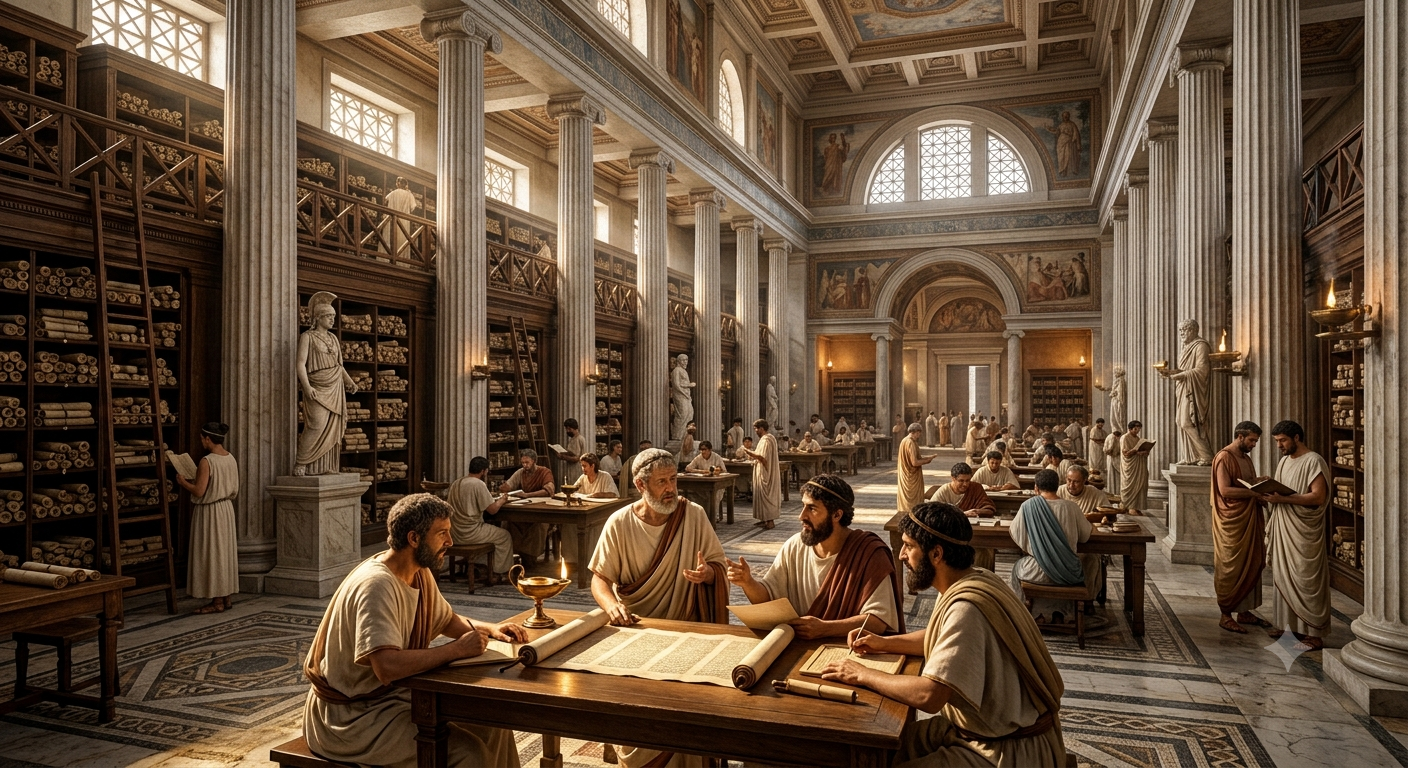
Introduction
Imagine a place where the world’s greatest thinkers gathered under one roof, where thousands of books and priceless manuscripts were carefully preserved, and where knowledge from different civilizations was collected for future generations. This was the Library of Alexandria, one of the most famous and influential libraries in human history.
Built in the ancient Egyptian city of Alexandria during the Ptolemaic Kingdom, the Library of Alexandria was far more than a collection of books. It served as a global center of learning, attracting scholars, scientists, philosophers, and writers from across the ancient world. Many groundbreaking discoveries in mathematics, astronomy, medicine, and geography are believed to have been studied or developed within its walls.
Despite its remarkable importance, the Library of Alexandria became one of history’s greatest mysteries. Historians still debate how many books it contained, what priceless knowledge was lost, and who was responsible for its destruction. Some believe it was destroyed in a single catastrophic event, while others argue that it disappeared gradually over several centuries.
Even today, the Library of Alexandria remains a powerful symbol of knowledge, curiosity, and the importance of preserving human history. Its story continues to inspire researchers, historians, and book lovers around the world, reminding us of how much can be lost when knowledge disappears.
In this article, we’ll explore the history of the Library of Alexandria, discover why it became the greatest library of the ancient world, examine the theories surrounding its destruction, and learn why its legacy still matters today.
Who Built the Library of Alexandria?
The Library of Alexandria was established during the reign of Ptolemy I Soter, one of Alexander the Great’s trusted generals who later became the ruler of Egypt. Although he is believed to have started the project, most historians agree that the library was completed and greatly expanded by his son, Ptolemy II Philadelphus, in the early 3rd century BC.
The vision behind the Library of Alexandria was ambitious. The Ptolemaic rulers wanted to create a place that would collect all the knowledge of the known world. Their goal was not simply to build a library but to establish the greatest center of learning ever seen, where scholars from different cultures could study, teach, and share ideas.
To achieve this dream, the rulers of Alexandria collected books from every possible source. Ships arriving at the city’s busy harbor were carefully searched for manuscripts. Any books found on board were copied by skilled scribes, with the originals often kept in the library while copies were returned to their owners. Envoys were also sent to other kingdoms to purchase or copy valuable texts from across Greece, Egypt, Persia, India, and beyond.
The Library of Alexandria soon became much more than a place for storing books. It was closely connected to the Mouseion, an ancient research institution where scholars lived, conducted research, and exchanged ideas. Many of the ancient world’s greatest mathematicians, astronomers, physicians, and philosophers are believed to have worked there, helping Alexandria earn its reputation as the intellectual capital of the ancient world.
Within a few generations, the Library of Alexandria had become the largest and most respected library of its time. Its extraordinary collection of knowledge attracted brilliant minds from across the Mediterranean, making it one of history’s greatest symbols of learning and discovery.
What Was Inside the Library of Alexandria?
The Library of Alexandria was unlike any other library of its time. Rather than focusing on a single subject, it aimed to collect knowledge from every corner of the known world. Historians believe its shelves may have held hundreds of thousands of scrolls, making it the largest collection of written knowledge in the ancient world. Although the exact number is still debated, there is no doubt that the library was an extraordinary treasure of information.
The collection covered a wide range of subjects, including philosophy, mathematics, astronomy, medicine, geography, history, literature, and science. Many of the manuscripts were written in Greek, but the library also gathered works from Egypt, Persia, India, and other civilizations. Scholars carefully translated important texts into Greek, helping preserve ideas that might otherwise have been lost.
The Library of Alexandria also became home to some of the greatest minds of the ancient world. Famous scholars such as Euclid, the father of geometry, and Eratosthenes, who accurately estimated the Earth’s circumference, are closely connected with Alexandria’s intellectual community. Their discoveries helped shape mathematics, geography, and science for centuries to come.
What truly made the Library of Alexandria special was its role as a center of learning rather than simply a place to store books. Scholars gathered there to study, debate new ideas, conduct research, and share knowledge with one another. This unique environment encouraged innovation and helped Alexandria become the intellectual heart of the ancient world.
For generations, the Library of Alexandria represented humanity’s desire to understand the world. Its priceless collection of manuscripts and its community of brilliant scholars made it one of the greatest achievements in the history of education and learning.
How Was the Library of Alexandria Destroyed?
The destruction of the Library of Alexandria remains one of the greatest mysteries in history. Although the library’s influence on the ancient world is well documented, historians still cannot agree on exactly how or when it disappeared. Over the centuries, several theories have emerged, but none has been proven beyond doubt.
One of the most well-known theories connects the library’s destruction to Julius Caesar. In 48 BC, during a conflict in Alexandria, Caesar reportedly ordered ships in the harbor to be burned. According to some ancient sources, the fire spread into parts of the city and may have damaged sections of the Library of Alexandria. However, many historians believe the library survived this event, at least in part, and continued to operate afterward.
Another theory suggests that the Library of Alexandria was not destroyed in a single disaster but slowly declined over several centuries. Political instability, wars, economic difficulties, and the gradual loss of royal support may have reduced its importance over time. Instead of one dramatic event, the library may have disappeared piece by piece as fewer resources were available to preserve its priceless collection.
Some historical accounts also mention later conflicts during the Roman and Byzantine periods, while other stories claim the library was destroyed after the Arab conquest of Egypt. However, many modern historians question these accounts because there is little reliable evidence to support them. As a result, the true fate of the Library of Alexandria remains uncertain.
What is certain, however, is that the world lost an extraordinary collection of knowledge. Countless manuscripts covering science, philosophy, medicine, mathematics, literature, and history may have disappeared forever. Many scholars believe that if the Library of Alexandria had survived, our understanding of the ancient world could be far richer than it is today.
The mystery surrounding its destruction continues to fascinate historians and researchers. More than two thousand years later, the Library of Alexandria remains a powerful reminder of how fragile human knowledge can be—and why preserving it is so important.
The Legacy of the Library of Alexandria
Although the Library of Alexandria disappeared centuries ago, its influence has never truly faded. It remains a powerful symbol of humanity’s pursuit of knowledge, reminding us that learning and curiosity have always played a vital role in shaping civilization. Even today, historians, researchers, and book lovers continue to admire the library for its extraordinary vision.
The story of the Library of Alexandria has also inspired modern institutions around the world. In 2002, Egypt opened the Bibliotheca Alexandrina, a modern library built near the site of the ancient one. While it is not the original library, it honors the same mission—to preserve knowledge, encourage research, and bring people from different cultures together through education.
More importantly, the legacy of the Library of Alexandria reminds us of the importance of protecting history. Every ancient manuscript, historical document, and scientific discovery carries a piece of our shared past. Once that knowledge is lost, it can never be fully recovered. The library’s story continues to encourage museums, libraries, and researchers to preserve valuable records for future generations.
Conclusion
The Library of Alexandria was far more than a building filled with books. It was the heart of learning in the ancient world, where scholars gathered to exchange ideas, make discoveries, and preserve knowledge from different civilizations. Its remarkable collection of manuscripts made it one of the greatest intellectual centers in history.
Although the exact story of its destruction remains uncertain, the Library of Alexandria continues to inspire people around the world. Its legacy reminds us that knowledge is one of humanity’s greatest treasures and that preserving it is essential for future generations. Even after more than two thousand years, the Library of Alexandria remains a timeless symbol of wisdom, curiosity, and the endless human desire to understand the world.
Interested in another fascinating historical mystery? Read The Voynich Manuscript: The Book Nobody Can Read and discover why one of the world’s most mysterious books has remained undeciphered for centuries.
[…] in another ancient mystery? Explore our article on The Library of Alexandria and discover the story of the world’s most famous lost […]