
 By admin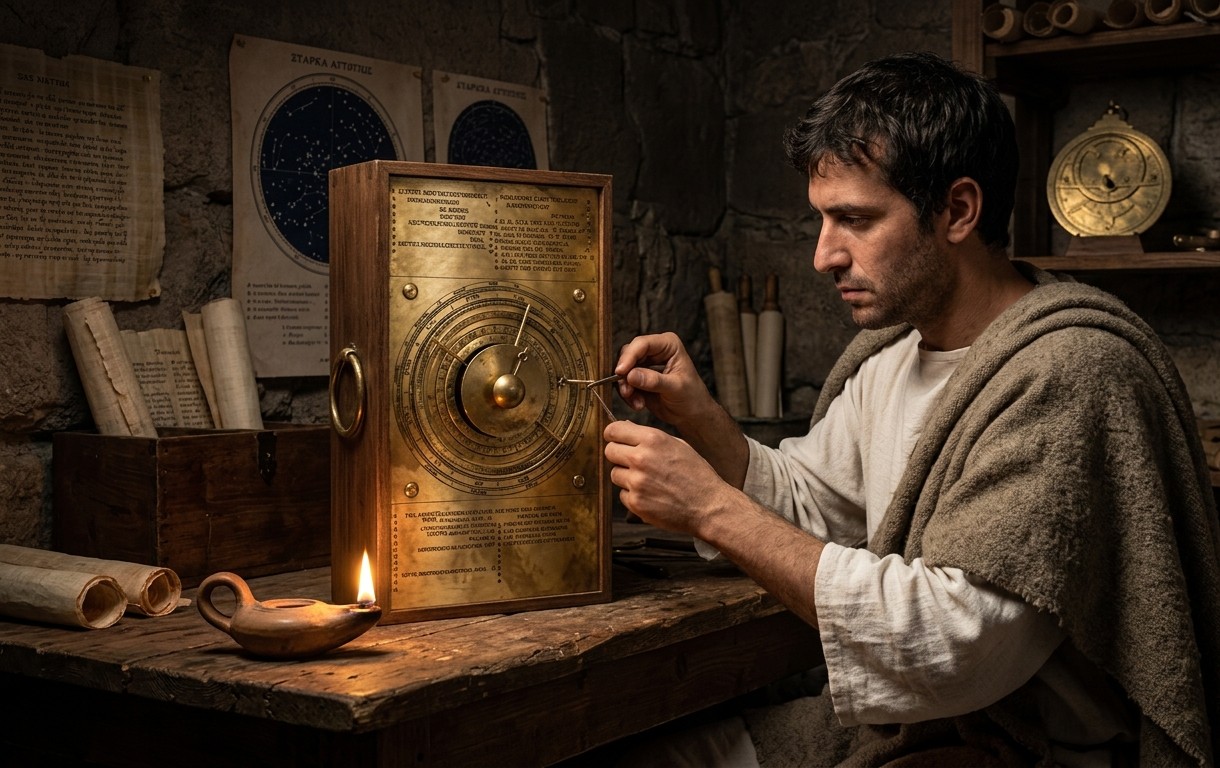
The Mysterious Discovery That Changed History
For over 100 years, the Antikythera Mechanism has puzzled experts and stood out as one of ancient history’s biggest enigmas. People often call it “the world’s first computer,” and for good reason — it completely flipped what we thought we knew about how advanced ancient technology really was.
It was found in a shipwreck that had been sitting on the Mediterranean seafloor for centuries. When divers first pulled it up, it just looked like a lump of rusted bronze pieces. Nothing special at first glance.
But once scientists started cleaning it and looking closer, they realized this was no ordinary artifact. Inside was a surprisingly complex system of bronze gears — basically an ancient machine. And it was way more sophisticated than anyone expected people back then to build.
The discovery forced historians to rethink the Greeks. For a long time, most scholars assumed that this level of mechanical engineering didn’t show up until over a thousand years later. The Antikythera Mechanism proved that wrong. It showed that ancient civilizations understood science and engineering at a level we seriously underestimated.
The Discovery of the Antikythera Mechanism
It all started in 1901. Some Greek sponge divers were diving near a tiny island called Antikythera — right between Crete and mainland Greece. Down there they ran into the wreck of an ancient Roman ship.
The ship had gone down around the 1st century BCE, and it was loaded. Bronze statues, marble sculptures, jewelry, coins… basically a treasure chest. While they were pulling all that stuff up, the divers also spotted a few weird lumps. Just corroded chunks of bronze and wood. Compared to the statues, they looked like trash. So nobody paid them much attention.
Fast forward a few months. Archaeologists started looking at those “junk” pieces. And that’s when things got wild. Buried under all the corrosion were tiny bronze gears.
That was unheard of. Nothing like that had ever turned up from the ancient world. It was clear this wasn’t random scrap — it had been part of a real machine. A seriously advanced one.
As they cleaned it piece by piece, it hit them: they’d found something totally unique. Later we’d call it the Antikythera Mechanism. And it still blows people’s minds today — historians, engineers, scientists, everyone.
It was so complex that at first a lot of scholars just refused to believe it. “No way this was built 2,000 years ago,” they said. Some even thought it must’ve been a later gadget that somehow fell into the wreck.
But after decades of research, the truth came out. It really was made in the ancient Greek world. Today the Antikythera Mechanism is still one of the craziest archaeological finds ever. It gives us this rare peek into just how smart and advanced that ancient civilization actually was.
How Did the Antikythera Mechanism Work?
The deeper scientists dug into the Antikythera Mechanism, the crazier it got. It wasn’t just some simple gadget.
Inside those corroded chunks was something wild — over 30 bronze gears. And not rough gears either. These were tiny, perfectly cut, and all fit together. Basically like the gears inside a modern clock… except this thing was made more than 2,000 years ago.
From what researchers can tell, you’d turn a little hand crank on the side. As you cranked it, all the gears would spin at different speeds. And that’s how it did complex astronomy math.
The craftsmanship is what really shocked engineers. To make gears that precise, you’d need serious skill and serious math. Not something we thought people back then had.
The front had a round dial with moving pointers. It showed where the Sun and Moon were, and what month it was in the Greek calendar. It could even track the Moon’s phases — and it was surprisingly accurate.
Flip it over and the back was even cooler. It had these spiral dials for tracking long-term sky cycles. One dial followed the Metonic Cycle — that’s a 19-year loop that lines up the lunar and solar calendars. Another tracked the Saros Cycle — an 18-year cycle used to predict solar and lunar eclipses.
Because it could calculate stuff and show the results with interlocking gears, historians call it the world’s first analog computer. It was 100% mechanical, but it processed information the same way modern computers solve problems.
The Antikythera Mechanism shows just how much the ancient Greeks understood about astronomy, math, and engineering. For a lot of historians, it’s the best proof we have that Greek science was way, way ahead of what we used to think.
Who Built the Antikythera Mechanism?
Here’s the biggest question nobody can answer yet: Who actually made the Antikythera Mechanism?
Even after 100+ years of research, we still don’t know who designed and built this thing.
But we do have some really interesting theories.
Most scholars think it was made somewhere between 150 BCE and 100 BCE. That was peak time for Greek science. Greek mathematicians, astronomers, and engineers were figuring out the universe in ways that still impress us today.
The most popular guess? Archimedes. Yeah, that Archimedes. The math and physics genius who built machines way ahead of his time. There’s no proof he personally made the Mechanism. But a lot of historians think his ideas probably inspired it. The design just feels like something he would’ve come up with.
Another theory points to Rhodes. Back then, Rhodes was basically the Silicon Valley of ancient astronomy and engineering. It was full of top scholars who spent their lives tracking the Sun, Moon, and planets. A lot of researchers think the kind of brainpower needed to build something this complex probably came from that community.
Modern tech has helped too. With X-rays and 3D scans, scientists found tiny Greek writing hidden inside the Mechanism. It was like an instruction manual. Those inscriptions confirmed it was built to calculate astronomical events, predict eclipses, and track calendar cycles.
But here’s the catch: we still don’t know the inventor’s name. No ancient text mentions it. No record explains how people back then got so good at engineering.
And that’s why the mystery isn’t going away. The Antikythera Mechanism is still one of history’s greatest puzzles. More than 2,000 years later, it’s still making us question everything we thought we knew about ancient science and tech.
Why Did the Antikythera Mechanism Disappear from History?
The mystery isn’t just who built the Antikythera Mechanism. It’s also: why did this kind of tech just vanish for over a thousand years?
Think about it. If the ancient Greeks could build something this advanced, why didn’t we see anything like it again until the Middle Ages?
Most historians think it comes down to what happened to the Hellenistic world. Wars broke out. Politics got messy. Then the Roman Empire expanded and reshaped the whole Mediterranean. A lot of the big science centers were destroyed or just abandoned.
Slowly, that knowledge slipped away. The skills to build crazy complex machines like this? Gone. Forgotten.
And the Mechanism itself? It stayed underwater for centuries. Hidden in that shipwreck near Antikythera, perfectly preserved by the sea.
We only started to really understand it once modern tech showed up. Using X-ray CT scans and 3D imaging, scientists could look inside the fragile pieces without touching them. That’s when the real secrets came out. Dozens of hidden bronze gears. Hundreds of tiny Greek words that had been invisible for almost 2,000 years.
Those inscriptions were like a manual. They told us what the device actually did: Predict solar and lunar eclipses. Track the Sun and Moon. Follow the big astronomical cycles the Greeks used for their calendar.
It proved one thing: the Antikythera Mechanism was one of the most advanced scientific tools ever made in the ancient world.
Today people call it one of the greatest archaeological finds ever. Because it completely changed how we see Greek science. It proved that engineers and astronomers 2,000+ years ago knew things we thought were impossible for that time.
And even now, after decades of studying it, the Mechanism still inspires people — historians, engineers, scientists. Every new scan, every new discovery gets us a little closer to figuring it out. And at the same time, it reminds us of something humbling: how much ancient knowledge we’ve just… lost.
Lessons from the Antikythera Mechanism
The Antikythera Mechanism isn’t just some old artifact in a museum. It’s a reminder that history is still hiding secrets from us.
For the longest time, everyone thought advanced machines didn’t show up until the Middle Ages. Then this one device came along and flipped that whole idea.
The biggest lesson? Ancient people were way smarter than we give them credit for. The Greeks mixed astronomy, math, engineering, and pure craftsmanship to build a machine that could do complex calculations — and do them with crazy accuracy.
It also teaches us something about knowledge itself. A lot of ancient science got wiped out. Wars, disasters, civilizations falling apart… all of it erased skills and ideas. Historians think if more devices like the Antikythera had survived, we’d see ancient tech in a totally different light today.
And here’s the other thing: archaeology is still changing history. Because of modern tools like CT scans and 3D imaging, we’re finding details that were hidden for over 2,000 years. The Antikythera proves that one single discovery can rewrite everything we thought we knew about the past.
Conclusion
The Antikythera Mechanism is still one of the most mind-blowing inventions we’ve ever found from the ancient world.
Made over 2,000 years ago, it showed a level of science and engineering that historians honestly didn’t think was possible back then. That’s why people call it “the world’s first computer.”
It could predict eclipses. Track the Sun, Moon, and planets. Calculate huge astronomical cycles. All of that, using nothing but a maze of tiny bronze gears.
And it still amazes scientists, engineers, and historians today.
Sure, we have a lot of unanswered questions. Who actually built it? How did they get so good at this? We might never know. But one thing is clear: the Mechanism completely changed how we see ancient civilizations.
It’s proof that history is still full of secrets we haven’t dug up yet.
Now it’s more than just an archaeological treasure. It’s a symbol of curiosity, creativity, and human ingenuity. More than 2,000 years later, it’s still inspiring researchers all over the world. And it’s a reminder that some of history’s biggest discoveries are probably still out there… hidden, waiting for us to find them.
Interested in another ancient mystery? Explore our article on The Library of Alexandria and discover the story of the world’s most famous lost library.
[…] admin Aug 3, 2026 […]
[…] a lost goat made an unexpected discovery inside a cave near the Dead Sea. Hidden in clay jars were hundreds of ancient manuscripts that had remained untouched for nearly 2,000 […]