 By admin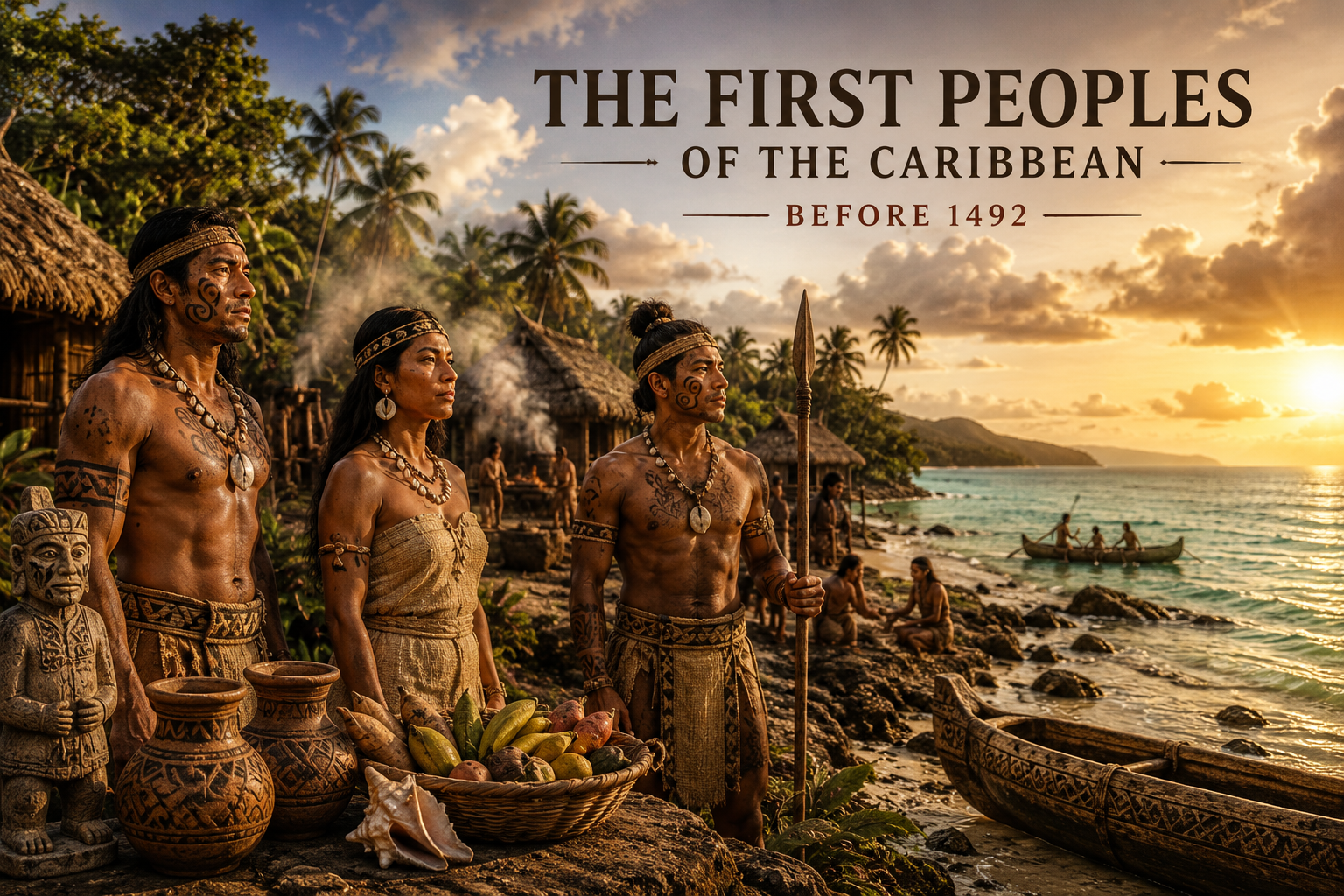
Introduction
Imagine sailing across the Caribbean hundreds of years before European ships appeared on the horizon. The islands were already home to thriving communities with their own languages, traditions, beliefs, farming practices, trading networks, and political systems.
These were the Indigenous Caribbean peoples—the communities who shaped the islands long before Christopher Columbus arrived in 1492.
When people talk about Caribbean history, the story often begins with Columbus. But the Caribbean had a much older history. Among the most well-known Indigenous peoples were the Taíno, the Lucayans of the Bahamas and Turks and Caicos, and the Kalinago of the Lesser Antilles.
Their stories were different, but they were connected through centuries of migration, trade, cultural exchange, and life across the Caribbean Sea.
Who Lived in the Caribbean Before 1492?
The Caribbean was not occupied by one single Indigenous group. Different communities lived on different islands, and their identities and cultures could vary considerably.
The Taíno are among the best-known Indigenous peoples of the region. Their ancestors came through waves of migration from areas connected to northern South America, eventually spreading across much of the Greater Antilles and the Bahamas. By the time Columbus arrived, Taíno communities were established in places including Hispaniola, Puerto Rico, Jamaica, eastern Cuba, and the Bahamas.
The term Taíno, however, needs some care. Modern scholars often use it as a broad label for several related Arawak-speaking Indigenous peoples. It may not have functioned as a single political or ethnic identity for everyone living in the Caribbean before European colonization.
That distinction matters because the pre-Columbian Caribbean was far more diverse than older history books sometimes suggest.
The Taíno Way of Life
Taíno communities developed organized villages and agricultural systems suited to the tropical environment.
They cultivated crops such as cassava, sweet potatoes, maize, and peppers. Fishing and hunting also provided important sources of food. Cotton was particularly valuable and was used to make items such as hammocks.
Many villages were organized under leaders known as caciques. These leaders held political authority and played important roles in their communities. Taíno society also included religious specialists, farmers, craftspeople, fishermen, and other members with different responsibilities.
Their culture was also expressed through art. Archaeologists have discovered carved objects, pottery, stone artifacts, ceremonial objects, and rock art that provide clues about their beliefs and everyday lives.
One especially important object was the duho, a carved ceremonial stool associated with Indigenous Caribbean leadership and ritual life. A Lucayan duho in the British Museum, for example, has been radiocarbon dated to approximately 1186–1273 CE.
The Lucayans of the Bahamas
Farther north, the Bahamas and Turks and Caicos were home to the Lucayans.
The Lucayans were closely connected to the wider Taíno cultural world. Archaeological evidence shows that they had settled in the region by around 700 CE and developed a lifestyle strongly connected to the sea.
Their villages contained round houses known as bohios. They grew crops while also depending heavily on marine resources such as fish, turtles, and conch.
The sea was more than a source of food. It connected communities across islands and allowed people to travel, exchange goods, and maintain relationships over considerable distances.
Archaeologists have also discovered remarkable Lucayan ceremonial objects in caves, including wooden duhos and objects associated with ritual practices. These discoveries show that their society was much more complex than the simplistic descriptions sometimes found in early European accounts.
The Kalinago of the Lesser Antilles
The Kalinago were another important Indigenous people of the Caribbean, particularly associated with the Lesser Antilles.
European accounts often portrayed Caribbean Indigenous societies through a colonial lens, so historians have to treat those descriptions carefully. Archaeology, oral traditions, linguistic evidence, and later historical records help researchers build a more balanced picture.
The Kalinago developed strong maritime traditions and were also known for their military skills. Historical accounts describe the use of bows, arrows, spears, and decorated wooden clubs in warfare.
Their history also demonstrates why it is misleading to imagine the Indigenous Caribbean as a single culture. Different island communities had their own political relationships, traditions, rivalries, and connections.
What Happened After Columbus Arrived?
Everything changed after 1492.
When Christopher Columbus reached the Caribbean, he encountered Indigenous communities almost immediately. The first encounters were followed by Spanish colonization, forced labor, violence, enslavement, and the spread of diseases to which Indigenous populations had little resistance.
The population collapse was devastating.
On Hispaniola, for example, Indigenous communities suffered enormous losses during the early decades of Spanish colonization. Disease, forced labor, warfare, displacement, and social disruption all contributed to the decline.
The Lucayans experienced an especially rapid demographic collapse. Spanish colonizers enslaved many Lucayans and transported them to other parts of the Spanish Caribbean. By the early 16th century, their communities had been devastated.
But this does not mean that every Indigenous person simply disappeared.
Did the Taíno Become Extinct?
This is one of the most interesting questions in Indigenous Caribbean history.
For a long time, the common story was that the Taíno became completely extinct soon after European colonization. Modern research has made that picture much more complicated.
Indigenous people survived through different forms of resistance, migration, intermarriage, adaptation, and integration into colonial society. Archaeological, historical, genetic, and family-history evidence continues to reveal Indigenous ancestry and cultural traditions in parts of the Caribbean.
There is also a modern Taíno cultural revival. People in places such as Puerto Rico, Cuba, and the Dominican Republic continue to explore and reclaim Indigenous ancestry and traditions.
So, rather than saying simply that the Taíno “vanished,” it is more accurate to say that colonization caused catastrophic demographic and cultural disruption while Indigenous ancestry, memory, practices, and identities continued in different forms.
A Caribbean History Older Than 1492
The Caribbean was never an empty landscape waiting for European explorers.
Long before 1492, Indigenous communities had already learned how to navigate its waters, cultivate its land, build villages, create art, conduct ceremonies, and maintain relationships across islands.
The Taíno, Lucayans, Kalinago, and other Indigenous communities left behind far more than archaeological objects. They left languages, place names, food traditions, technologies, artistic traditions, and cultural memories that remain part of the Caribbean today.
Their history also reminds us of something important: 1492 was not the beginning of Caribbean history. It was the beginning of a new and deeply disruptive chapter in a history that was already centuries old.
Understanding the Indigenous Caribbean means looking beyond Columbus and recognizing the people who were already there—their achievements, their cultures, their struggles, and the legacy they continue to leave behind.
Explore More Historical Stories
If you enjoyed this story about the Indigenous Caribbean: The First Peoples Before 1492 , explore our other historical stories and discover more fascinating events, mysteries, and people from the past.
William Butten: The Mayflower Passenger Who Died at Sea
The Black Death: The Deadliest Pandemic in Human History
Prophet Salih (AS) and the People of Thamud
Click on any title above to continue exploring history and uncover more fascinating stories.
[…] Man figurine, you may also enjoy exploring our other fascinating historical stories, including Indigenous Caribbean: The First Peoples Before 1492 Titanic’s Giant Anchor: The Incredible Story of the 15-Ton Monster 1.43-Million-Year-Old […]