
 By admin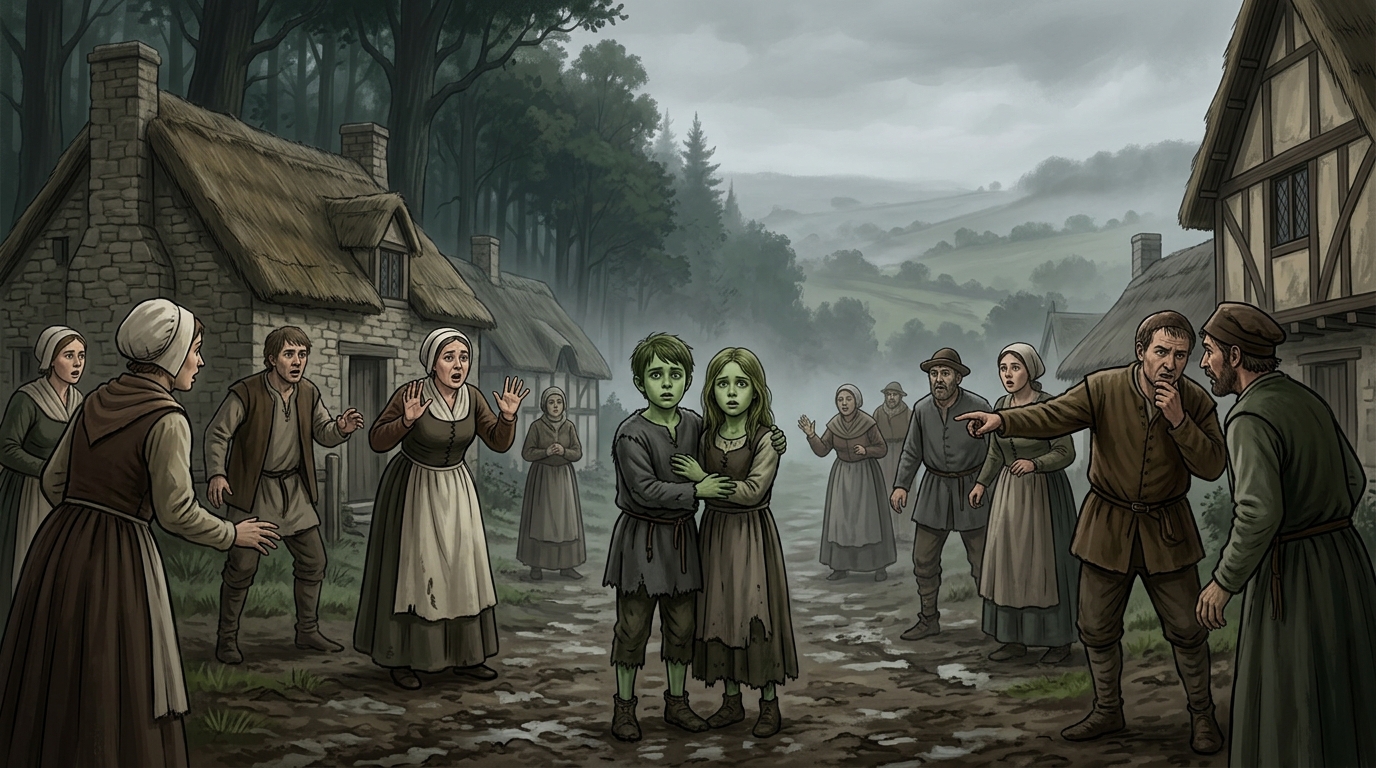
Introduction
Imagine working in the fields of medieval England when two frightened children suddenly appear, speaking a language no one understands and with an unusual green tint to their skin. This strange encounter is at the heart of the Green Children of Woolpit, one of the most mysterious legends recorded in medieval England.
The story reportedly took place in the 12th century in Woolpit, a village in Suffolk. What makes the tale especially fascinating is that it was not simply passed down as a modern ghost story. Two medieval writers, William of Newburgh and Ralph of Coggeshall, recorded versions of the strange event. Their accounts differ in some details, but both describe two children who appeared mysteriously and struggled to communicate with the local people.
The Green Children of Woolpit: A Mysterious Arrival
According to the medieval accounts, the children—a brother and sister—were discovered near the fields of Woolpit during harvest time. Their appearance was unusual, especially their green-colored skin and unfamiliar clothing.
The villagers could not understand the language the children spoke. Even more strangely, the children initially refused the food they were offered.
Eventually, they encountered broad beans. The children eagerly ate them, and this became an important turning point in the story. As they gradually became accustomed to other foods, their unusual green coloring reportedly faded.
What Happened to the Green Boy?
The two children did not have the same fate.
The younger boy was described as weak and sickly. After the children were taken into the care of Richard de Calne, the boy’s condition continued to deteriorate.
He eventually died, while his sister survived and gradually adapted to life in the English community.
The surviving girl eventually learned to speak English. Once she could communicate, she reportedly gave a remarkable explanation about where she and her brother had come from.
A Land of Eternal Twilight
The girl claimed that she and her brother came from a strange place where the sun did not shine brightly. Instead, the land was described as being in a kind of permanent twilight.
In some versions of the story, the place was associated with Saint Martin’s Land. The children supposedly entered the unfamiliar world after following a passage or coming through an underground route.
This is one of the details that transformed the story from a strange encounter into something much more mysterious. Was the girl describing a real place she remembered, or was the story shaped by medieval ideas about an Otherworld?
Was Their Skin Really Green?
This is perhaps the biggest question.
There is no way to independently verify the children’s appearance today. The original accounts were written decades after the supposed event, and the story was preserved through medieval storytelling and written chronicles.
One possible explanation is illness or malnutrition. The Woolpit Parish Council notes that severe iron deficiency can cause anemia and a pale or greenish appearance, and suggests this as one possible explanation if the children really existed.
However, this remains only a possibility—not a proven explanation.
Could They Have Been Lost Children?
Another interpretation is much more ordinary.
Some researchers have suggested that the story could be based on real children who were outsiders, possibly displaced or unable to communicate with the local population. One modern theory connects the story with Flemish immigrants living in eastern England during a period of political and military unrest.
This interpretation attempts to explain the children’s unfamiliar language, clothing, and behavior without requiring an underground world. But there is no definitive evidence proving that the children were Flemish refugees.
A Medieval Legend or Something More?
Over the centuries, people have offered many explanations for the Green Children of Woolpit.
Some see the story as folklore—a medieval tale about people entering an Otherworld. Others believe it may preserve memories of a real historical event that became distorted through storytelling.
Later writers even connected the children with supernatural or extraterrestrial ideas. But these interpretations go far beyond what the medieval sources actually establish.
The safest historical conclusion is that we cannot prove exactly what happened.
What we can say with confidence is that the story was recorded in medieval sources and has remained part of Woolpit’s local identity for centuries. The village itself still recognizes the Green Children as an important part of its history and folklore.
Why the Green Children of woolpit Still Fascinates Us
The Green Children of Woolpit remain fascinating because the story sits between history and legend.
Two children apparently appeared in a medieval English village. They spoke an unfamiliar language, behaved differently from the local people, and were described as having green-tinted skin. One child died, while the other eventually adapted to her new surroundings.
Whether the original event was a misunderstood historical incident, a medical condition, a story about displaced children, or a piece of medieval folklore, we may never know.
And perhaps that uncertainty is exactly why the Green Children of Woolpit have survived in our imagination for more than eight centuries.
Explore More Ancient History
If you enjoyed discovering the mystery of The Green Children of Woolpit , you may also enjoy exploring our other fascinating historical stories, including the:-
Lion Man Figurine: The 40,000-Year-Old Mystery
79 Shackled Men: The Ancient Mystery of Phaleron
Indigenous Caribbean: The First Peoples Before 1492
Each story offers a unique glimpse into the mysteries and wonders of the ancient world.
[…] The Green Children of Woolpit: A Medieval Mystery […]