
 By admin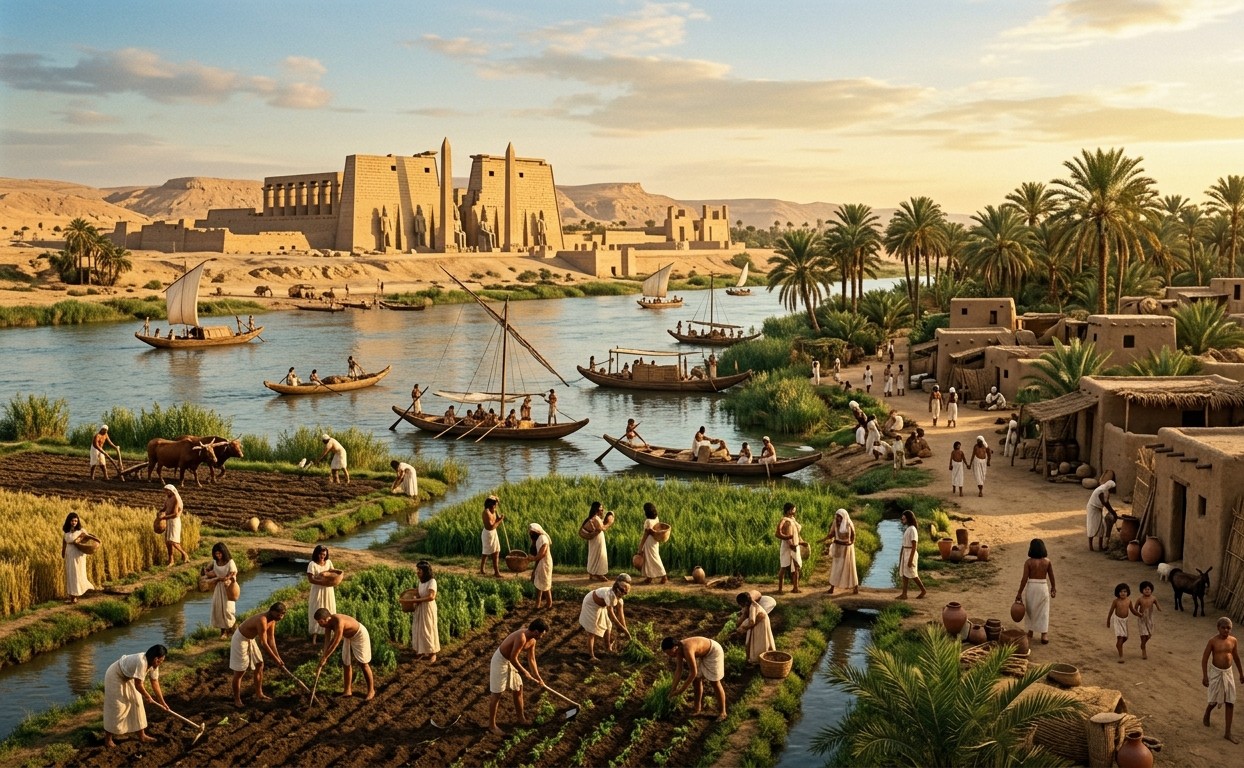
Life Along the Nile
Imagine discovering Ancient Egyptian Culture thousands of years ago, when people lived beside a great river that provided water, food, transportation, and fertile land.
For the people of ancient Egypt, the Nile River was at the center of everyday life. Almost every part of Egyptian society was connected to it.
The Nile flooded its banks each year, leaving behind rich, fertile soil where farmers could grow crops such as wheat, barley, vegetables, and flax. This predictable cycle helped agriculture become the foundation of Egyptian civilization.
Villages and cities developed along the river, while the surrounding desert provided a natural barrier against many outside threats. Boats traveling along the Nile also made it easier to transport people and goods between different parts of Egypt.
Daily life depended greatly on a person’s social position. Pharaohs and wealthy families lived very differently from farmers, craftsmen, and laborers. However, ordinary Egyptians also had families, jobs, homes, celebrations, and religious traditions that shaped their lives.
Food was another important part of daily life. Bread and beer were common foods, while wealthy Egyptians had greater access to meat, fruits, and other luxuries.
Clothing was generally made from linen, which was well suited to Egypt’s hot climate. People also used jewelry, cosmetics, and perfumes, both for appearance and cultural reasons.
But Ancient Egyptian Culture was about much more than daily survival.
Religion influenced almost every part of Egyptian life—from how people understood nature and death to how they celebrated important events.
And at the heart of their beliefs was a powerful idea: life did not simply end with death.
Gods, Religion, and the Egyptian View of Life
Religion was at the heart of Ancient Egyptian Culture. Egyptians believed that the world was controlled by powerful gods and goddesses who influenced nature, health, fertility, the Nile, and the fate of individuals.
They worshipped many deities, each associated with different aspects of life. Ra, the sun god, was one of the most important. Osiris was connected with the afterlife, while Isis was associated with motherhood, magic, and protection. Horus, often represented as a falcon or a man with a falcon’s head, was connected with kingship and protection.
Egyptians believed that maintaining maat—a concept associated with truth, balance, order, and justice—was essential for keeping the world in harmony.
Religion was not limited to temples. It was part of everyday life. People prayed to gods, made offerings, wore protective amulets, and participated in religious festivals.
Death was also deeply connected to their beliefs. Egyptians believed that a person’s existence continued after death, but reaching the afterlife required proper preparation.
They believed the deceased would face judgment, where the heart was symbolically weighed against the feather of Ma’at. A worthy person could enter a peaceful afterlife, while an unworthy soul faced destruction.
These beliefs strongly influenced Egyptian burial customs, including mummification, tomb construction, funerary objects, and prayers intended to help the dead in the next world.
But religion was not the only thing that shaped Egyptian society.
Family, marriage, and children were also extremely important parts of everyday Egyptian life.
Family, Marriage, and Daily Life in Ancient Egypt
Family was an important part of Ancient Egyptian Culture. For many Egyptians, daily life centered around their household, work, children, and community.
Marriage was generally considered an important social institution, although it was not always organized through elaborate religious ceremonies. Couples typically established households together, and family life played an important role in society.
Women in ancient Egypt had some legal and economic rights that were unusual compared with many other ancient societies. They could own property, inherit wealth, enter contracts, and in some circumstances seek divorce. Men and women both contributed to the household, although their responsibilities often differed depending on their social position.
Children were also an important part of family life. Wealthier families could provide formal education for their children, particularly boys who were expected to enter administrative or professional careers. Other children learned practical skills from their parents and relatives.
Homes varied greatly depending on wealth. Ordinary families often lived in relatively simple houses made from mud brick, while wealthy Egyptians could live in larger homes with courtyards, gardens, storage rooms, and decorated interiors.
Daily work depended on a person’s occupation. Farmers worked the fertile land around the Nile, craftsmen produced pottery, jewelry, furniture, and tools, while scribes handled writing and administration.
Food, clothing, music, and entertainment also formed part of everyday life. Egyptians enjoyed bread, beer, vegetables, fruits, fish, and, for wealthier families, different types of meat. Linen clothing was common because it was comfortable in Egypt’s hot climate.
Music and dancing were especially important during celebrations and religious festivals. People also played board games and other forms of entertainment during their free time.
Life was not equally comfortable for everyone, however. Farmers and laborers often performed physically demanding work, while servants and enslaved people occupied lower positions in society.
Still, across different social classes, family and community remained important parts of Egyptian life.
Food, Clothing, Music, and Entertainment in Ancient Egypt
Everyday life in ancient Egypt was filled with traditions that reflected the country’s environment, social structure, and beliefs. Food, clothing, music, and entertainment were all important parts of Ancient Egyptian Culture.
Bread and beer were among the most common foods. Wheat and barley were widely cultivated along the Nile, making them essential parts of the Egyptian diet. People also ate vegetables, dates, figs, onions, fish, and other locally available foods. Wealthier families could enjoy more meat, including beef, poultry, and other delicacies.
Clothing was usually made from linen, produced from the flax plant. Linen was lightweight and suitable for Egypt’s hot climate. Wealthier Egyptians often wore finer fabrics and decorated themselves with jewelry made from gold, colorful stones, and other materials.
Cosmetics were also popular. Both men and women used eye makeup, particularly dark kohl, which was used for appearance and may also have offered some protection from the harsh sunlight and dust.
Music played an important role in celebrations and religious events. Egyptians used instruments such as harps, flutes, drums, and rattles. Musicians and dancers performed at festivals, banquets, ceremonies, and other gatherings.
Entertainment was not limited to music and dancing. Egyptians also enjoyed games, including the famous board game Senet. Paintings found in tombs show people hunting, fishing, dancing, playing games, and enjoying social gatherings.
These activities reveal that ancient Egyptians were not focused only on work, religion, and death. They also valued family, celebration, creativity, and leisure.
Their everyday customs give us a glimpse into what ordinary life may have looked like thousands of years ago.
Education, Writing, and the Importance of Scribes
Education in ancient Egypt was closely connected to social status and occupation. While many children learned practical skills from their parents, formal education was particularly important for families who hoped their children would become scribes, administrators, priests, or other professionals.
Scribes were among the most respected educated people in Egyptian society. They could read and write, record taxes, manage official documents, keep accounts, and help administer temples and government offices.
The Egyptians used hieroglyphs, a writing system made up of symbols representing sounds, words, and ideas. For everyday administration, they also developed simpler forms of writing that were faster to produce.
Students learning to become scribes practiced writing repeatedly on pieces of pottery, wooden boards, or other available materials. Their education required patience and memorization because accurate writing was essential for administrative work.
Writing was also closely connected to religion. Egyptians recorded prayers, offerings, funerary texts, and religious stories. Some of these writings were placed inside tombs to help the deceased navigate the afterlife.
The ability to read and write gave scribes opportunities that were unavailable to most ordinary workers. Their skills allowed them to work for the government, temples, wealthy households, and other institutions.
This importance of writing reveals something significant about Ancient Egyptian Culture: knowledge and record-keeping were essential to maintaining such a large and organized civilization.
But Egyptian culture was not preserved only through writing. Their beliefs and traditions were also expressed through temples, art, festivals, and elaborate burial customs.
Temples, Festivals, and Religious Traditions
Temples were among the most important places in ancient Egyptian society. They were not simply buildings for prayer; they were also centers of religious ceremonies, administration, education, and economic activity.
Egyptians believed that temples were sacred spaces where humans could communicate with the gods. Priests performed daily rituals, presented food and other offerings, and cared for sacred statues representing different deities.
Festivals were another important part of Ancient Egyptian Culture. Throughout the year, communities celebrated religious occasions dedicated to different gods and goddesses. These events could include processions, music, dancing, food, and public gatherings.
One famous celebration was the Opet Festival, associated with the god Amun and held at Thebes. During the festival, sacred statues were carried in ceremonial processions, connecting religious beliefs with public celebration.
People also used amulets for protection. These small objects were shaped like gods, animals, or symbolic objects and were believed to provide protection, health, or good fortune.
Religious traditions were deeply connected to the natural world. The annual flooding of the Nile, the movement of the sun, agricultural cycles, and the changing seasons all influenced Egyptian beliefs and ceremonies.
Through temples, festivals, prayers, offerings, and protective symbols, Egyptians expressed their understanding of the world around them.
But perhaps nowhere was their religious worldview more visible than in the way they treated the dead.
Mummification and the Journey to the Afterlife
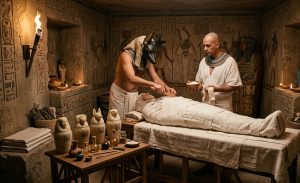
Death was not considered the end of existence in ancient Egypt. Egyptians believed that a person’s spirit could continue living in the afterlife, but the body needed to be preserved so the deceased could continue their journey.
This belief led to the development of mummification, one of the most famous practices of Ancient Egyptian Culture.
During the mummification process, the body was carefully treated to slow decomposition. The internal organs were removed and preserved separately, while the body was dried using a natural salt called natron. After the drying process, the body was wrapped in layers of linen.
Amulets were often placed among the wrappings because they were believed to provide protection in the afterlife. The mummy was then placed inside one or more coffins and taken to a tomb.
The quality of burial depended heavily on a person’s wealth and social position. Pharaohs and wealthy individuals could have elaborate tombs, coffins, funerary objects, and rituals, while ordinary Egyptians generally had much simpler burials.
Egyptians also believed that the deceased would face judgment in the afterlife. According to their beliefs, the person’s heart was weighed against the feather of Ma’at, representing truth and justice.
A person who was judged worthy could enter a peaceful afterlife. This belief encouraged Egyptians to live according to principles of order, justice, and morality.
Their elaborate burial traditions reveal how deeply Egyptians connected life, death, religion, and morality.
But their beliefs were only one part of their cultural legacy. Their art and architecture also preserved remarkable details about how they understood the world.
Art, Architecture, and the Egyptian Sense of Beauty
Art and architecture were deeply connected to Ancient Egyptian Culture. From enormous temples and tombs to small pieces of jewelry, Egyptian creations often reflected their religious beliefs, social values, and ideas about life and death.
Egyptian artists decorated temples and tombs with colorful paintings showing gods, pharaohs, family members, farmers, musicians, animals, and scenes from everyday life. These images were not created only for decoration. Egyptians believed that images and inscriptions could help preserve a person’s identity and provide support in the afterlife.
Egyptian art followed distinctive rules. Important figures, such as pharaohs and gods, were often shown larger than ordinary people to emphasize their importance. Human figures were also commonly represented using a combination of different viewpoints, creating the recognizable style seen in Egyptian paintings.
Architecture was equally impressive. The Egyptians built enormous temples, tombs, statues, and monuments using stone that could survive for thousands of years. Structures such as the temples of Karnak and Luxor demonstrate their advanced understanding of construction and design.
Columns, statues, reliefs, and hieroglyphic inscriptions covered many religious buildings. Their designs often included images of gods, sacred animals, plants, and symbols connected to Egyptian beliefs.
Jewelry was another important form of artistic expression. Gold, colored stones, beads, and amulets were used by wealthy Egyptians for decoration and religious purposes.
Through their art and architecture, the Egyptians left behind a visual record of their civilization.
Even today, these creations allow historians to learn about their religion, clothing, occupations, celebrations, beliefs, and everyday life.
How Ancient Egyptian Culture Influenced the World
The legacy of Ancient Egyptian Culture extends far beyond the monuments that remain along the Nile. Many aspects of Egyptian civilization influenced later societies and continue to fascinate people around the world.
Egyptian achievements in writing, mathematics, medicine, architecture, and astronomy contributed to the development of knowledge in the ancient world. Their ability to organize large construction projects also demonstrated sophisticated planning, engineering, and administration.
Egyptian religious ideas influenced neighboring cultures, while their art, jewelry, architecture, and symbolic designs continued to inspire later civilizations.
Their calendar was closely connected to the yearly cycle of the Nile and agriculture. Egyptians also developed detailed observations of the stars and used astronomical knowledge for practical and religious purposes.
Perhaps the most visible part of their legacy is their architecture. The pyramids, temples, statues, and tombs have survived for thousands of years and provide valuable evidence about Egyptian society.
Even their everyday customs continue to attract interest. Their clothing, cosmetics, food, games, music, family life, and festivals give us a glimpse into how ordinary people lived thousands of years ago.
Much of what we know about ancient Egypt comes from the objects, paintings, inscriptions, and buildings they left behind. These discoveries allow historians and archaeologists to reconstruct parts of a civilization that existed for thousands of years.
Although ancient Egyptian civilization eventually changed and disappeared as a political power, its cultural influence remains visible today.
The Lasting Legacy of Ancient Egyptian Culture
The civilization of ancient Egypt may belong to the distant past, but its influence continues to capture the imagination of the modern world.
The pyramids, temples, statues, hieroglyphs, mummies, and ancient artworks provide a remarkable record of a society that existed for thousands of years. They allow historians to understand not only Egypt’s powerful rulers, but also the lives, beliefs, and traditions of ordinary people.
The Egyptians left important contributions to writing, mathematics, medicine, architecture, engineering, and astronomy. Their religious beliefs and artistic traditions also shaped the way they understood nature, society, death, and the afterlife.
Perhaps what makes Ancient Egyptian Culture especially fascinating is the connection between everyday life and the spiritual world. Food, clothing, family, festivals, art, burial customs, and religious practices were all connected to their understanding of order and existence.
Although ancient Egyptian civilization changed over time and eventually became part of larger empires, many of its traditions and achievements survived through the monuments and objects left behind.
Today, archaeologists continue to uncover new discoveries, while researchers study ancient texts, tombs, artifacts, and human remains to learn more about this remarkable civilization.
Conclusion
Ancient Egypt was much more than pyramids and pharaohs. It was a complex society with its own culture, traditions, beliefs, family life, art, music, food, and customs.
From the banks of the Nile to the great temples and tombs, the legacy of Egypt continues to connect the modern world with one of humanity’s most fascinating civilizations.
[…] admin Aug 11, 2026 […]