
 By admin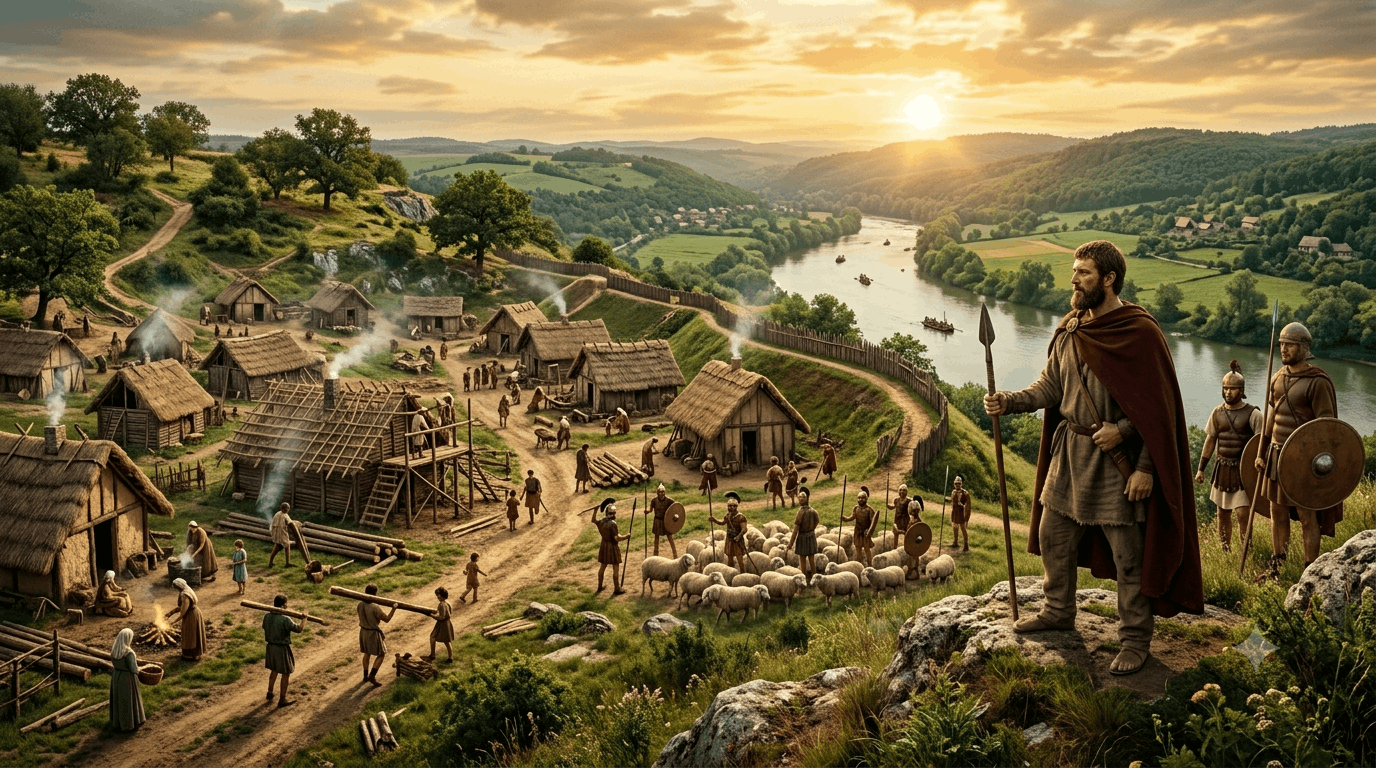
Introduction
The Rise of the Roman Empire is one of the most fascinating stories in world history. From a small settlement on the banks of the Tiber River, Rome grew into one of the greatest civilizations the world has ever known.
When we think about the greatest civilizations in history, the Roman Empire is always among the first to come to mind. At its height, Rome ruled millions of people across Europe, North Africa, and the Middle East. Its influence shaped law, government, architecture, engineering, military strategy, and even the languages we speak today.
What makes Rome truly fascinating is that it did not begin as a powerful empire. It started as a small settlement beside the Tiber River in central Italy. Through determination, military strength, political reforms, and visionary leadership, this small community grew into one of the largest empires the world has ever known.
According to Roman tradition, Rome was founded on 21 April 753 BC by Romulus. While historians believe that parts of this story are legendary, archaeological evidence shows that people were living in this area during the eighth century BC.
In this article, we’ll follow Rome’s incredible journey—from its legendary beginnings and the Roman Kingdom to the Republic, the Punic Wars, Julius Caesar, Augustus, and the beginning of the Pax Romana.
The Legend of Romulus and Remus
Every great civilization has a story about its beginnings, and Rome’s is one of the most famous.
Roman mythology tells us that the twin brothers Romulus and Remus were born to Rhea Silvia, a Vestal Virgin, and Mars, the Roman god of war. Their birth worried King Amulius, who feared they would one day take his throne. To remove the threat, he ordered the babies to be thrown into the Tiber River.
Instead of dying, the twins survived. According to legend, a she-wolf discovered them and cared for them until a shepherd named Faustulus found them. He and his wife raised the brothers as their own children.
As they grew older, Romulus and Remus discovered the truth about their family. They defeated King Amulius and decided to establish a new city. However, they disagreed about where it should be built. Romulus wanted to build it on the Palatine Hill, while Remus preferred the Aventine Hill.
The disagreement turned into a violent conflict. According to the legend, Romulus killed his brother and became the sole founder of the new city.
On 21 April 753 BC, Romulus founded the city on the Palatine Hill and named it Rome. Although historians cannot confirm every detail of this story, it remains one of the most important legends in Roman history.
The Rise of the Roman Empire:The Roman Kingdom
After its foundation, Rome entered a period known as the Roman Kingdom. According to tradition, seven kings ruled Rome before the monarchy came to an end.
During this period, Rome changed from a small village into an organized city-state. Roads, temples, markets, defensive walls, and religious institutions were built, creating a strong foundation for future growth.
One of Romulus’s most important decisions was to welcome newcomers. Refugees, exiles, escaped slaves, and people seeking a new beginning were allowed to settle in Rome. This policy quickly increased the city’s population.
However, there was one serious problem. Most of the new settlers were men, while women were very few. Without families, Rome’s future looked uncertain.
The Story of the Sabine Women
To solve this problem, Romulus asked neighboring communities to allow their daughters to marry Roman men. His request was rejected.
Romulus then organized a grand festival and invited nearby tribes, including the Sabines. During the celebration, Roman men captured many Sabine women and brought them back to Rome.
The Sabines were furious and prepared for war. Months later, they marched toward Rome to rescue their daughters.
By that time, many of the Sabine women had already started new lives in Rome. Some had married Roman men, while others had become mothers.
When the two armies finally faced each other, the women stepped between them carrying their children. They begged their fathers and husbands to stop fighting, explaining that war would only destroy both families.
Their emotional appeal brought peace between the two sides. Instead of continuing the battle, the Romans and the Sabines united, making Rome stronger than before.
Although historians debate whether this event actually happened, the story symbolizes reconciliation and unity, two values that became important in Roman tradition.
The End of the Roman Kingdom
For more than two centuries, Rome was ruled by kings. However, the final ruler, Lucius Tarquinius Superbus, became increasingly unpopular because of his harsh and authoritarian rule.
In 509 BC, the Roman people revolted and removed him from power. Rather than choosing another king, they established a completely new form of government known as the Roman Republic.
This decision marked one of the most important turning points in Roman history and laid the foundation for Rome’s future expansion.
The Rise of the Roman Empire: The Roman Republic
The establishment of the Roman Republic in 509 BC marked a new chapter in Rome’s history. Instead of being ruled by a king, Rome introduced a system in which elected officials shared power. This change was designed to prevent one person from gaining complete control over the state.
At the heart of the Republic was the Roman Senate, a powerful council made up of experienced leaders who advised the government and shaped important policies. Two consuls were elected each year to govern the Republic and command the army. Since their term lasted only one year, this system helped limit the concentration of power.
The Republic also encouraged citizens to participate in public life and introduced laws that strengthened the government. Although the system was not perfect, it gave Rome greater political stability and prepared it for future expansion.
Rome Expands Across Italy
After becoming a republic, Rome focused on strengthening its position in Italy. Over the next few centuries, the Romans fought many battles against neighboring tribes and city-states, including the Etruscans, Samnites, and Gauls.
Unlike many ancient kingdoms, Rome often allowed defeated communities to become allies instead of treating them only as enemies. Some received Roman citizenship, while others were allowed to govern themselves under Roman protection. This policy helped Rome build lasting relationships and reduced the chances of rebellion.
The Roman army also became one of the most disciplined military forces of the ancient world. Strict training, effective leadership, and well-planned strategies allowed Rome to win battle after battle.
By the middle of the third century BC, Rome had gained control of almost the entire Italian Peninsula. This success provided more soldiers, resources, and wealth, preparing Rome for even greater challenges beyond Italy.
The Punic Wars
As Rome expanded, it eventually came into conflict with Carthage, a wealthy and powerful city located in North Africa. Carthage controlled much of the western Mediterranean through its strong navy and profitable trade network.
The rivalry between these two powers led to the Punic Wars, a series of three major wars fought between 264 BC and 146 BC.
The First Punic War was mainly fought at sea. After years of fierce fighting, Rome emerged victorious and gained control of Sicily, its first overseas province.
The Second Punic War introduced one of history’s greatest military commanders—Hannibal Barca. In a bold and unexpected move, Hannibal led his army, including war elephants, across the Alps to invade Italy. His victories shocked the Romans and remain some of the most remarkable achievements in military history.
Despite Hannibal’s success, Rome refused to surrender. Under the leadership of Scipio Africanus, the Romans carried the war into North Africa. In 202 BC, Hannibal was defeated at the Battle of Zama, giving Rome a decisive victory.
The Third Punic War ended in 146 BC when Roman forces completely destroyed Carthage. With its greatest rival defeated, Rome became the dominant power in the Mediterranean world.
Greek Influence on Rome
Military victories brought Rome more than just land—they also introduced the Romans to the rich culture of ancient Greece.
After conquering the Greek kingdoms, Rome absorbed many aspects of Greek civilization. Greek philosophy, literature, art, architecture, medicine, and education became an important part of Roman life.
Wealthy Roman families often hired Greek teachers to educate their children. Roman writers studied Greek literature, while architects used Greek styles when designing temples and public buildings.
Instead of simply copying Greek culture, the Romans adapted it to fit their own traditions. This blend of Roman and Greek ideas helped create one of the most advanced civilizations of the ancient world.
Growing Problems Within the Republic
As Rome became richer and more powerful, new challenges began to appear. Wealth was increasingly concentrated in the hands of a few powerful families, while many ordinary citizens struggled with poverty and unemployment.
Political rivalry also became more intense. Ambitious leaders competed for influence, and disagreements within the Senate often led to conflict.
Reformers such as Tiberius Gracchus and Gaius Gracchus tried to improve the lives of ordinary people through land reforms and other social changes. However, their efforts faced strong opposition, and both brothers were killed during political violence.
These events showed that the Republic was becoming unstable. Although Rome remained powerful, its political system was beginning to weaken, setting the stage for the rise of one of history’s most famous leaders—Julius Caesar.
Julius Caesar and the Fall of the Republic
The Rise of the Roman Empire entered a new phase with the rise of Julius Caes.By the first century BC, the Roman Republic was facing serious political problems. Rival leaders competed for power, corruption increased, and civil wars became more common. In the middle of this uncertainty, Julius Caesar emerged as one of the most influential figures in Roman history.
Caesar first gained fame as a brilliant military commander. His successful campaigns in Gaul (modern-day France) greatly expanded Roman territory and earned him the loyalty of his soldiers. His growing popularity, however, worried many members of the Roman Senate, who feared that he was becoming too powerful.
In 49 BC, the Senate ordered Caesar to give up his command and return to Rome as an ordinary citizen. Instead, he made a decision that changed history forever. He crossed the Rubicon River with his army—an act that was considered a declaration of war against the Senate.
A civil war followed, and Caesar emerged victorious. He became the most powerful man in Rome and introduced several important reforms, including changes to the calendar, government administration, and the rights of Roman citizens.
Despite these achievements, many senators believed that Caesar wanted to make himself king. On 15 March 44 BC, a group of senators assassinated him during a meeting of the Senate. Although they hoped to restore the Republic, his death only pushed Rome into another period of conflict.
Augustus and the Birth of the Roman Empire
Augustus completed the rise of the Roman Empire by establishing a new political system.After Caesar’s assassination, another struggle for power began. His adopted son, Octavian, joined forces with Mark Antony and Lepidus to defeat Caesar’s enemies. However, this alliance did not last long.
Tensions soon grew between Octavian and Mark Antony. The conflict reached its climax in 31 BC at the Battle of Actium, where Octavian defeated Antony and his ally, Cleopatra VII of Egypt.
In 27 BC, the Roman Senate gave Octavian the title Augustus, meaning “the revered one.” This event is widely regarded as the official beginning of the Roman Empire.
Although Augustus claimed to respect the traditions of the Republic, he held supreme authority over the government, the army, and the provinces. His careful leadership brought stability after years of civil war and marked the start of a new era in Roman history.
Pax Romana – Rome’s Golden Age Begins
The Rise of the Roman Empire reached a period of stability known as the Pax Romana.One of Augustus’s greatest achievements was the beginning of the Pax Romana, or “Roman Peace.” This period lasted for nearly 200 years and is remembered as one of the most peaceful and prosperous eras in Roman history.
During the Pax Romana, trade expanded across Europe, North Africa, and Asia. Roman merchants exchanged goods such as silk, spices, wine, olive oil, and grain with distant regions.
The empire also invested heavily in roads, bridges, aqueducts, temples, theaters, and public buildings. These impressive engineering projects improved daily life and connected the vast Roman Empire more effectively than ever before.
Roman law became more organized, cities continued to grow, and education, literature, and architecture flourished. The Roman Empire reached the height of its power, becoming one of the greatest civilizations the ancient world had ever seen.
Conclusion
The rise of the Roman Empire is one of the most extraordinary stories in world history. From a small settlement founded on the banks of the Tiber River, Rome grew into an empire that ruled millions of people across three continents.
Its success was built on strong leadership, military discipline, political innovation, and the ability to adapt to new challenges. Legendary figures such as Romulus, Julius Caesar, and Augustus each played a unique role in shaping Rome’s future.
Even after the fall of the Western Roman Empire centuries later, Rome’s influence continued to shape the modern world. Its legal principles, architectural achievements, and political ideas remain an important part of many societies today.
Understanding the rise of Rome helps us understand how one small city changed the course of history forever.
[…] to explore another great ancient civilization? Read The Rise of the Roman Empire and discover how a small city became one of history’s greatest […]