
 By admin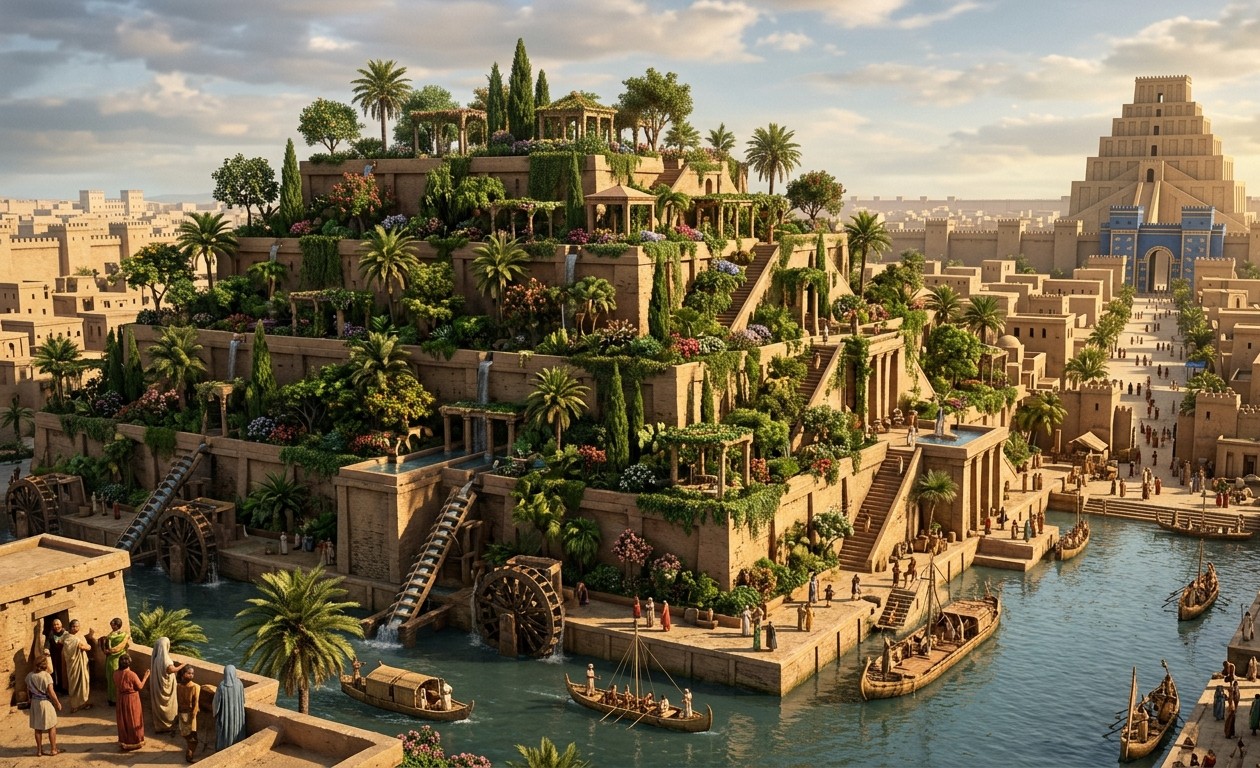
Introduction

Imagine standing in the middle of ancient Babylon and looking up at enormous terraces covered with trees, flowers, and green plants. Water appears to flow from one level to another, creating the illusion of a mountain of greenery rising above one of the greatest cities of the ancient world.
This was the legendary Hanging Gardens of Babylon, one of the Seven Wonders of the Ancient World.
According to ancient accounts, the gardens were built in the great city of Babylon, during the reign of King Nebuchadnezzar II, who ruled the Neo-Babylonian Empire from 605 to 562 BCE. Babylon itself became famous for its massive walls, grand temples, palaces, and impressive architecture.
But there is a fascinating mystery behind the gardens.
Unlike many other famous monuments of the ancient world, no clear archaeological remains of the Hanging Gardens have been found in Babylon. Some historians have even suggested that the gardens may have been located somewhere else, possibly Nineveh, the ancient Assyrian capital.
So, were the Hanging Gardens a real architectural masterpiece, a misunderstood ancient account, or simply a legend that grew over time?
The answer remains one of history’s most intriguing mysteries.
The Rise of Babylon and King Nebuchadnezzar II
To understand the story of the Hanging Gardens, we first need to understand Babylon—one of the most powerful and famous cities of the ancient world.
Located in Mesopotamia, near the Euphrates River, Babylon grew into a major center of politics, trade, religion, and culture. Its strategic location helped the city become wealthy and influential, while its impressive buildings made it famous far beyond Mesopotamia.
Babylon reached its greatest power during the reign of King Nebuchadnezzar II, who ruled from 605 to 562 BCE. He transformed the city with enormous construction projects, including temples, walls, gates, and palaces.
One of the most famous structures associated with his reign was the Ishtar Gate, decorated with brightly colored glazed bricks and images of lions, bulls, and dragons. The city also contained the enormous temple complex dedicated to the Babylonian god Marduk.
Ancient writers later described Babylon as a spectacular city filled with monumental architecture. It was this extraordinary setting that helped create the legend of a magnificent garden rising above the city.
According to the traditional story, Nebuchadnezzar II built the Hanging Gardens for his wife, Amytis, who supposedly missed the green mountains and landscapes of her homeland. The gardens were said to provide her with a reminder of home in the flat and dry landscape of Mesopotamia.
But there is a problem with this story: there is no surviving Babylonian inscription clearly stating that Nebuchadnezzar built the Hanging Gardens.
This missing evidence is one of the reasons the gardens remain such a fascinating historical mystery.
The Legend of the Hanging Gardens
Ancient writers described the Hanging Gardens as an extraordinary creation unlike anything else in the ancient world. They imagined enormous terraces rising one above another, covered with trees, flowers, vines, and other plants.
From a distance, the gardens may have looked like a green mountain rising above the city of Babylon.
According to the traditional descriptions, the gardens were built on a series of large platforms supported by massive stone columns and structures. Different levels were filled with soil deep enough to support trees and other plants. Vines and flowering plants were said to hang down from the terraces, creating the appearance of greenery suspended in the air.
But the most impressive part of the story was not simply the plants—it was the water system.
Babylon stood in a hot and relatively dry region, while the gardens supposedly contained large numbers of trees and plants that required a constant supply of water. Ancient accounts suggest that water was somehow lifted from the Euphrates River and carried to the higher levels of the gardens.
Exactly how this was achieved remains uncertain.
Some historians and engineers have proposed that an ancient chain pump, screw-like lifting system, or series of water-lifting devices could have moved water upward. However, there is no surviving Babylonian description that gives us a definite explanation of the system.
This is what makes the Hanging Gardens so fascinating. The ancient accounts give us a picture of an incredible garden filled with life, but they leave many important questions unanswered.
How high were the terraces?
How did the builders support the enormous weight of soil and trees?
And most importantly—did the gardens actually exist in Babylon?
Those questions would become one of the greatest mysteries surrounding the Seven Wonders of the Ancient World.
How Did the Hanging Gardens Work?
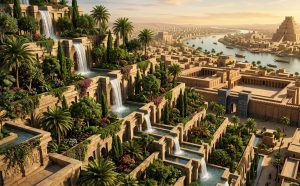
If the Hanging Gardens really existed, building them would have required remarkable engineering. Ancient Babylon was located in a hot, mostly flat region, yet the gardens were supposedly filled with large trees and plants growing high above the ground.
The biggest challenge was water.
Plants on elevated terraces would have needed a continuous supply of water, especially during the hot Mesopotamian summers. According to later descriptions, water was brought upward from the Euphrates River and distributed throughout the different levels of the gardens.
One possibility is that the builders used an ancient water-lifting mechanism. Some modern researchers have suggested devices similar to a chain pump, in which containers attached to a moving chain could continuously carry water upward.
Another possibility is that a system of screw-like water elevators was used. Such technology was capable of moving water from a lower level to a higher one, although we cannot say with certainty that this particular method was used in Babylon.
The terraces themselves would also have needed extremely strong foundations. Large amounts of soil become very heavy, especially when the soil is wet. If the gardens contained mature trees, the supporting structure would have needed to withstand enormous weight.
Ancient descriptions mention stone or brick structures beneath the gardens, possibly creating multiple layers of support and drainage.
However, there is an important limitation: we do not have enough archaeological evidence to reconstruct the actual engineering system with certainty. Much of what we imagine today comes from later Greek and Roman descriptions rather than Babylonian records.
And this leads to an even bigger mystery.
If the gardens were truly one of the greatest achievements of Babylon, why have archaeologists never found clear remains of them?
The Great Mystery: Did the Hanging Gardens Really Exist?
The Hanging Gardens of Babylon are famous around the world, but one surprising fact makes their story even more mysterious: archaeologists have never found clear remains of the gardens in Babylon.
Ancient writers described the gardens in great detail, but no surviving Babylonian inscription has been discovered that clearly says King Nebuchadnezzar II built them. This is unusual because Nebuchadnezzar left many inscriptions describing his other major construction projects.
This has led historians to question whether the gardens actually existed in Babylon.
One important theory suggests that the gardens may have been located not in Babylon, but in Nineveh, the capital of the ancient Assyrian Empire. The Assyrian king Sennacherib described an impressive garden and an advanced water-lifting system at Nineveh. Some researchers believe later writers may have confused Nineveh with Babylon.
However, this theory is not universally accepted. There is still no definitive evidence proving that the famous Hanging Gardens were actually located at Nineveh.
Another possibility is that the gardens did exist in Babylon but were destroyed so completely that little or no trace remains. Babylon itself was repeatedly damaged, rebuilt, and abandoned over the centuries, making archaeological identification extremely difficult.
So, were the Hanging Gardens real?
We simply do not know for certain. Their absence from the archaeological record has turned one of the Seven Wonders into one of history’s greatest mysteries.
And perhaps that uncertainty is part of what makes the story so fascinating.
The Fall of Babylon and the Disappearance of the Gardens
Even if the Hanging Gardens of Babylon truly existed, they could not have survived forever. Babylon went through centuries of political change, wars, and periods of decline that gradually transformed the great city.
After the reign of Nebuchadnezzar II, Babylon remained an important center of the ancient world, but its political power eventually weakened. In 539 BCE, the Persian king Cyrus the Great conquered Babylon. The city continued to exist under later rulers, but its importance gradually declined.
Over the following centuries, Babylon was affected by political changes, warfare, and shifting centers of power. Parts of the city fell into ruin, while other areas were rebuilt or abandoned.
If the Hanging Gardens were located in Babylon, their disappearance may have been caused by a combination of neglect, structural deterioration, changing rulers, and environmental conditions. An enormous elevated garden would have required constant maintenance, particularly because of the weight of soil, trees, and water.
Eventually, the gardens may have disappeared so completely that later generations could no longer identify their remains.
This may help explain why ancient writers remembered the gardens while modern archaeologists have struggled to find them. The city itself survived in ruins, but the exact location and remains of its most mysterious wonder remain unknown.
The disappearance of the gardens did not erase their story, however. Instead, it turned them into a legend that has survived for more than two thousand years.
The Hanging Gardens in Ancient Accounts
Much of what we know about the Hanging Gardens of Babylon comes from ancient Greek and Roman writers. Their descriptions helped turn the gardens into one of the most famous wonders of the ancient world.
Writers such as Diodorus Siculus, Strabo, and Quintus Curtius Rufus described a magnificent garden built on raised terraces. Their accounts mention large trees, flowering plants, and carefully designed structures that made the gardens appear to rise above the ground.
According to these descriptions, the gardens were not simply a collection of plants. They were an enormous architectural achievement in which nature and engineering were combined. Terraces supported layers of soil, while water was supposedly transported upward to keep the vegetation alive.
However, these accounts were written long after the supposed construction of the gardens. This creates an important problem for historians: the writers may have relied on earlier reports, stories passed down over generations, or descriptions that had become exaggerated over time.
Interestingly, Herodotus, one of the most famous ancient historians who wrote about Babylon, did not mention the Hanging Gardens in his surviving description of the city. This absence has contributed to the continuing debate over whether the gardens actually existed.
As a result, ancient accounts provide fascinating clues, but they cannot by themselves prove exactly where the gardens were, how they were built, or whether they existed at all.
The mystery remains—and that uncertainty is what has kept the Hanging Gardens of Babylon alive in the imagination for thousands of years.
Why the Hanging Gardens Still Fascinate Us
The mystery of the Hanging Gardens of Babylon has survived for more than two thousand years because it combines everything that makes ancient history fascinating: a powerful king, an extraordinary city, advanced engineering, and a wonder that may have completely disappeared.
If the gardens really existed, they would have demonstrated an incredible ability to combine architecture, irrigation, and agriculture. Creating a lush garden in the hot landscape of ancient Mesopotamia would have required sophisticated planning and constant maintenance.
But even if the traditional story is partly legendary, it still tells us something important about how people viewed Babylon. Ancient writers saw the city as a place of enormous wealth, ambition, and architectural achievement.
The mystery also encourages historians and archaeologists to keep searching for new evidence. Modern technology, including satellite imagery, digital mapping, and archaeological analysis, may eventually help researchers understand more about ancient Babylon and its lost structures.
Perhaps the gardens were built exactly as the ancient stories describe. Perhaps they were located somewhere else. Or perhaps later writers combined several real gardens and engineering achievements into one legendary wonder.
Until stronger evidence is discovered, the truth remains uncertain.
And that may be the greatest reason the Hanging Gardens of Babylon continue to capture our imagination—they are a lost wonder that history has never completely explained.
Conclusion
The Hanging Gardens of Babylon remain one of the greatest mysteries of the ancient world. For centuries, stories have described a magnificent garden filled with trees, flowers, and plants rising above the city of Babylon.
Yet unlike other famous ancient monuments, no definite archaeological evidence has confirmed their existence in Babylon. Some historians believe the gardens may have been located in Nineveh, while others think they may have existed in Babylon but disappeared without leaving clear remains.
Whether they were a real architectural masterpiece or a legend that grew over time, the story of the Hanging Gardens reveals the extraordinary imagination and engineering ambitions of the ancient world.
Perhaps we may one day discover evidence that finally solves the mystery. Until then, the Hanging Gardens of Babylon will remain what they have been for thousands of years—a lost wonder hidden somewhere between history and legend.
[…] admin Aug 8, 2026 […]
[…] 480 BCE, a small Greek force stood at a narrow mountain pass against one of the largest invading armies of the ancient […]