
 By admin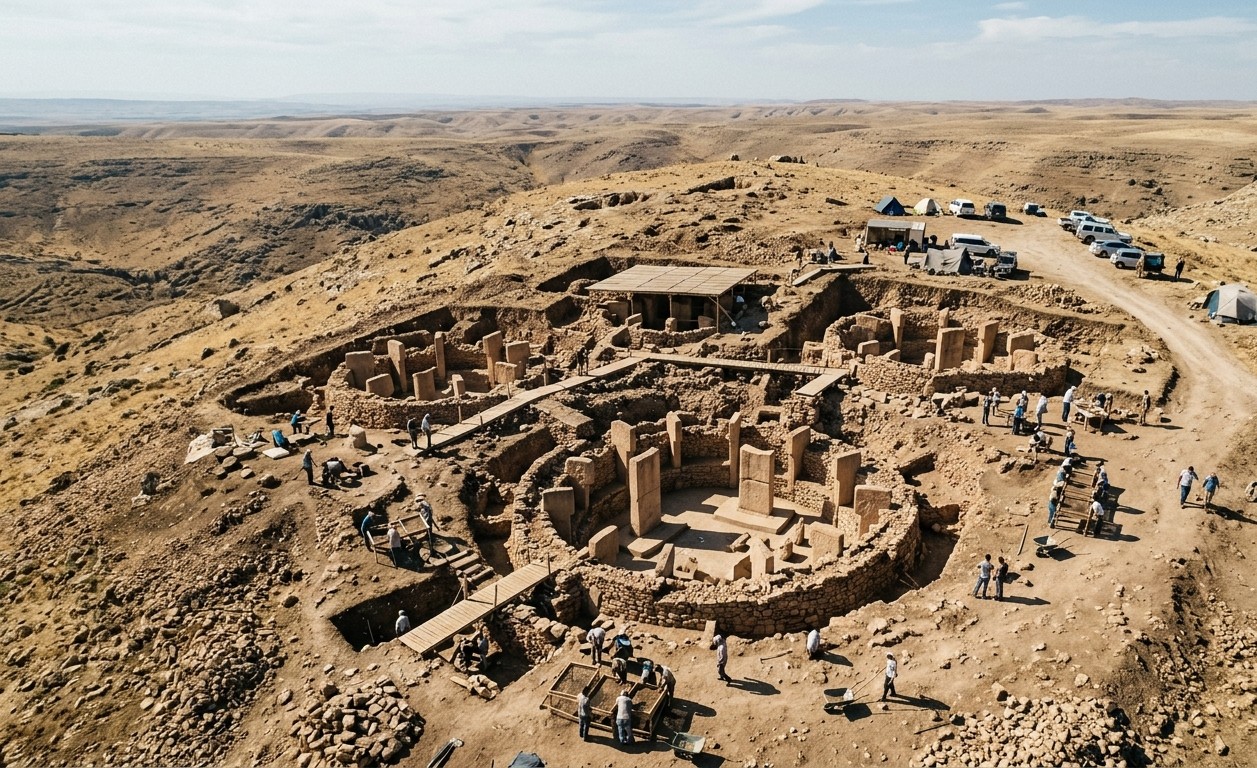
Introduction
Long before the pyramids of Egypt were built, before the first cities appeared in Mesopotamia, and thousands of years before writing was invented, people were already constructing enormous stone monuments.
In southeastern Turkey, archaeologists discovered a mysterious site known as Göbekli Tepe. Dating back roughly 11,000 years, it contains massive T-shaped stone pillars decorated with carvings of animals and other symbols.
What makes Göbekli Tepe extraordinary is its age. The people who built these monumental structures lived during a period when humans were still transitioning from hunter-gatherer lifestyles toward settled communities.
The site has challenged many traditional ideas about how early human societies developed.
Why did people invest so much effort in constructing enormous stone structures before the rise of cities and writing?
What were these mysterious buildings used for?
And why was the site eventually buried?
Göbekli Tepe does not provide easy answers. Instead, it opens a fascinating window into a time when human civilization was only beginning to take shape—and many of its greatest mysteries remain unsolved.
The Discovery of Göbekli Tepe
For centuries, the hills of southeastern Turkey looked like ordinary landscapes. Few people could have imagined that beneath one of them was a site capable of changing our understanding of early human history.
Göbekli Tepe first attracted archaeological attention in the 1960s, when researchers noticed unusual stone features in the area. At the time, however, the site was not recognized for what it truly was.
That changed in the 1990s, when German archaeologist Klaus Schmidt began systematic excavations at the site. His team uncovered enormous T-shaped pillars, circular structures, and carefully carved stone surfaces.
Some of the pillars were several meters tall and weighed many tons. Many were decorated with detailed images of snakes, foxes, birds, wild boars, and other animals.
The discoveries were extraordinary because the structures were much older than the famous pyramids of Egypt and even predated many of the world’s earliest cities.
As excavations continued, archaeologists realized that Göbekli Tepe was not simply an ordinary settlement. It was a monumental complex created by people living thousands of years before written history.
The discovery raised a fascinating question:
How did prehistoric communities organize themselves to build such enormous monuments without cities, writing, or advanced metal tools?
That question would become one of the biggest mysteries surrounding Göbekli Tepe.
The Mysterious Stone Pillars
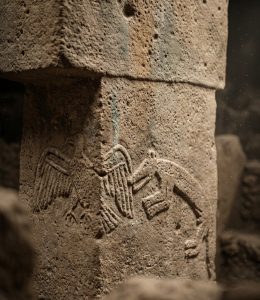
The most remarkable discoveries at Göbekli Tepe are its enormous T-shaped stone pillars. Some of these pillars stand several meters tall and weigh many tons, yet they were shaped and positioned by people living thousands of years before modern machinery existed.
Many of the pillars are decorated with detailed carvings of foxes, snakes, wild boars, birds, insects, and other animals. Some also contain abstract symbols and human-like features, suggesting that the stones may have represented people, supernatural beings, or important figures.
The carvings are particularly fascinating because they were created with impressive skill. The prehistoric builders carefully shaped the limestone and added detailed images to its surface.
Several pillars also appear to have been deliberately arranged around large circular or oval spaces. These structures may have been used for rituals, gatherings, feasts, or other communal activities, although their exact purpose remains uncertain.
The scale of the monuments suggests that building them required cooperation among many people. Workers would have needed to quarry the limestone, shape the massive stones, transport them, and carefully position them.
Yet Göbekli Tepe provides no written explanation of what these structures meant.
The stones therefore remain silent witnesses to a world that existed long before recorded history—and their mysterious carvings continue to raise questions about the beliefs and social organization of our ancient ancestors.
Who Built Göbekli Tepe?
One of the biggest mysteries surrounding Göbekli Tepe is the identity of the people who built it.
The site was constructed thousands of years before written records existed, so we do not know the names of its builders or the exact society they belonged to. Archaeologists believe they were hunter-gatherer communities living in the surrounding region.
Building the massive stone structures would have required considerable cooperation. Groups of people had to quarry the limestone, shape the pillars, transport them, and carefully place them within the monumental enclosures.
This challenges the old idea that only settled farming societies could organize large construction projects. Göbekli Tepe suggests that hunter-gatherer communities were capable of complex cooperation and monumental building much earlier than previously thought.
The builders also appear to have shared symbolic traditions. The repeated animal carvings and similar architectural designs suggest that different groups may have gathered at the site or shared common beliefs and practices.
However, we still cannot say exactly what these people called themselves, what language they spoke, or what their symbols meant.
Their identity remains lost to prehistory—but the monuments they created have survived for thousands of years.
What Was Göbekli Tepe Used For?
The exact purpose of Göbekli Tepe remains uncertain. When the site was first extensively excavated, archaeologists considered the large circular structures to be possible temples or ritual buildings. However, researchers today are more cautious because there is not enough evidence to prove that the site had a single purpose.
The buildings may have been used for ritual activities, communal gatherings, feasting, or ceremonies. The large stone pillars and their animal carvings suggest that symbolism and shared beliefs played an important role.
Evidence of animal bones found at the site has also raised the possibility that people gathered there for large communal meals. Such gatherings may have helped different groups build social connections and cooperate on major construction projects.
Another interesting feature is that the site does not look like a typical residential settlement. Although people clearly used the area, the monumental structures appear to have served purposes beyond ordinary domestic life.
This has led archaeologists to consider Göbekli Tepe as a place where social, symbolic, and possibly ritual activities came together.
But without written records, we cannot know exactly what happened inside these mysterious structures. The true purpose of Göbekli Tepe remains one of its greatest unanswered questions.
Why Was Göbekli Tepe Built?
The exact purpose of Göbekli Tepe remains unknown, but archaeologists believe the site was more than a simple settlement. The large enclosures, carefully carved pillars, and repeated animal imagery suggest that the site had an important social or ritual role.
Some researchers believe people gathered there for ceremonies, feasts, or religious activities. The impressive architecture may have helped bring different hunter-gatherer groups together for special occasions.
The animal carvings may also have had symbolic or spiritual meanings. Images of snakes, foxes, wild boars, birds, and other creatures appear repeatedly throughout the site. However, without written records, we cannot know exactly what these animals represented to the builders.
Another possibility is that Göbekli Tepe served several purposes rather than being a single-purpose temple. It may have been a place where people gathered, celebrated, performed rituals, shared food, and strengthened relationships between different communities.
What makes the site particularly fascinating is that it shows how complex human social and symbolic behavior could be long before the development of cities and writing.
Göbekli Tepe therefore may not give us a simple story about the birth of religion or civilization. Instead, it shows that early human societies were already capable of organizing large communities and creating monumental spaces thousands of years before recorded history.
How Did Ancient People Move the Massive Stones?
One of the most fascinating questions about Göbekli Tepe is how prehistoric people managed to move and position its enormous stone pillars.
Some pillars weigh several tons, yet the builders had no modern cranes, trucks, or metal machinery. The people who created the site relied on simple tools, physical strength, teamwork, and knowledge of the landscape.
The limestone used at Göbekli Tepe was available from nearby areas, which would have made transportation easier. Workers could have shaped the stones using stone tools and then moved them with methods such as wooden rollers, ropes, levers, and large groups of people working together.
Exactly how they transported and raised the largest pillars, however, remains uncertain.
The construction itself tells us something important. Moving such heavy stones would have required planning and cooperation. Different groups may have worked together to quarry, shape, transport, and position the pillars.
This means that the builders were capable of organizing large-scale projects long before the construction of the pyramids or the rise of major cities.
Göbekli Tepe therefore challenges the idea that prehistoric hunter-gatherers lived only in small, simple groups. The monument suggests that early humans could already cooperate on an impressive scale when they had a shared purpose.
Why Was Göbekli Tepe Eventually Abandoned?
Another mystery surrounding Göbekli Tepe is why its monumental structures were eventually abandoned and deliberately buried.
Archaeological evidence suggests that some of the enclosures were filled with soil, stones, animal remains, and other materials. This appears to have happened intentionally rather than simply being the result of natural erosion.
But why would people spend so much effort building enormous stone structures and later cover them?
One possibility is that the site was gradually reorganized or intentionally closed as the communities using it changed. The people may have had cultural or ritual reasons for filling the structures.
Another possibility is that changing lifestyles, environmental conditions, or the development of more settled communities altered the site’s importance. Over time, people may have moved to other locations and stopped using the monumental enclosures.
Importantly, archaeologists do not yet have a definitive answer. The burial of Göbekli Tepe remains an area of active research.
Whatever the reason, the burial helped preserve parts of the site for thousands of years. The structures remained hidden beneath the earth until modern archaeologists began uncovering them.
In a strange way, the decision to bury Göbekli Tepe may have helped protect one of humanity’s most remarkable prehistoric sites until the modern world was ready to discover it.
How Göbekli Tepe Changed Our Understanding of Civilization
The discovery of Göbekli Tepe challenged several traditional ideas about how human civilization developed.
For a long time, historians often described early human history as a gradual progression: people first lived as hunter-gatherers, then developed agriculture, settled permanently, created villages, and eventually built monumental structures and complex societies.
Göbekli Tepe makes this story much more complicated.
The site was built around 11,000 years ago, during a period when people were still living largely as hunter-gatherers. Yet these communities were capable of constructing enormous stone monuments and creating sophisticated artistic carvings.
This suggests that early humans could organize large groups, share traditions, and undertake ambitious construction projects much earlier than previously assumed.
The site has also encouraged researchers to reconsider the relationship between religion, social organization, and settlement. Rather than civilization developing through a simple sequence of events, different aspects of human society may have developed together and influenced one another.
Göbekli Tepe does not prove that religion came before agriculture or that temples directly caused settled life. Instead, it provides evidence that the development of early societies was far more complex than a simple linear story.
That is why this ancient site has become so important. It has not given historians every answer—it has forced them to ask better questions about how human civilization began.
The Legacy of Göbekli Tepe
The discovery of Göbekli Tepe has changed the way historians and archaeologists think about the earliest stages of human civilization.
Its enormous stone pillars and carefully carved animal figures show that prehistoric communities were capable of remarkable cooperation, creativity, and organization. They could plan large construction projects and create places with shared symbolic importance long before the rise of famous ancient civilizations.
The site has also encouraged researchers to look more closely at the relationship between hunter-gatherers, rituals, social gatherings, and the development of settled communities.Rather than being a simple story of progress from primitive groups to cities, human history appears to have developed through many overlapping changes.
Today, Göbekli Tepe is one of the most important archaeological sites for understanding the distant human past. Excavations and research continue to reveal new information about the people who built it and the world they lived in.
Yet many questions remain unanswered. We still do not know exactly what the structures were used for, what the symbols meant, or why the site was eventually buried.
Perhaps that is what makes Göbekli Tepe so fascinating: the stones have survived for thousands of years, but the people who created them left behind no written explanation.
Conclusion
Göbekli Tepe is one of the most remarkable archaeological discoveries of the modern era. Built around 11,000 years ago, its massive stone pillars and mysterious animal carvings reveal that prehistoric communities were capable of far more complex social and construction activities than once believed.
The people who built the site left no written records explaining who they were or what their monuments meant. We can only study the evidence they left behind—the enormous pillars, carved symbols, animal remains, and carefully constructed enclosures.
Göbekli Tepe has therefore become more than an ancient archaeological site. It is a reminder that the story of human civilization is far more complex than we once imagined.
As archaeologists continue to investigate the site, new discoveries may eventually answer some of its biggest questions. Until then, Göbekli Tepe remains a remarkable window into a mysterious world that existed thousands of years before recorded history.
[…] a vast network of underground tunnels. Some are narrow and dark, while others open into enormous chambers filled with the remains of millions of […]
[…] burial complex near present-day Xi’an. At its center lies the mysterious Tomb of Qin Shi Huang, surrounded by thousands of warriors, horses, weapons, and other figures created to accompany the emperor into […]