
 By admin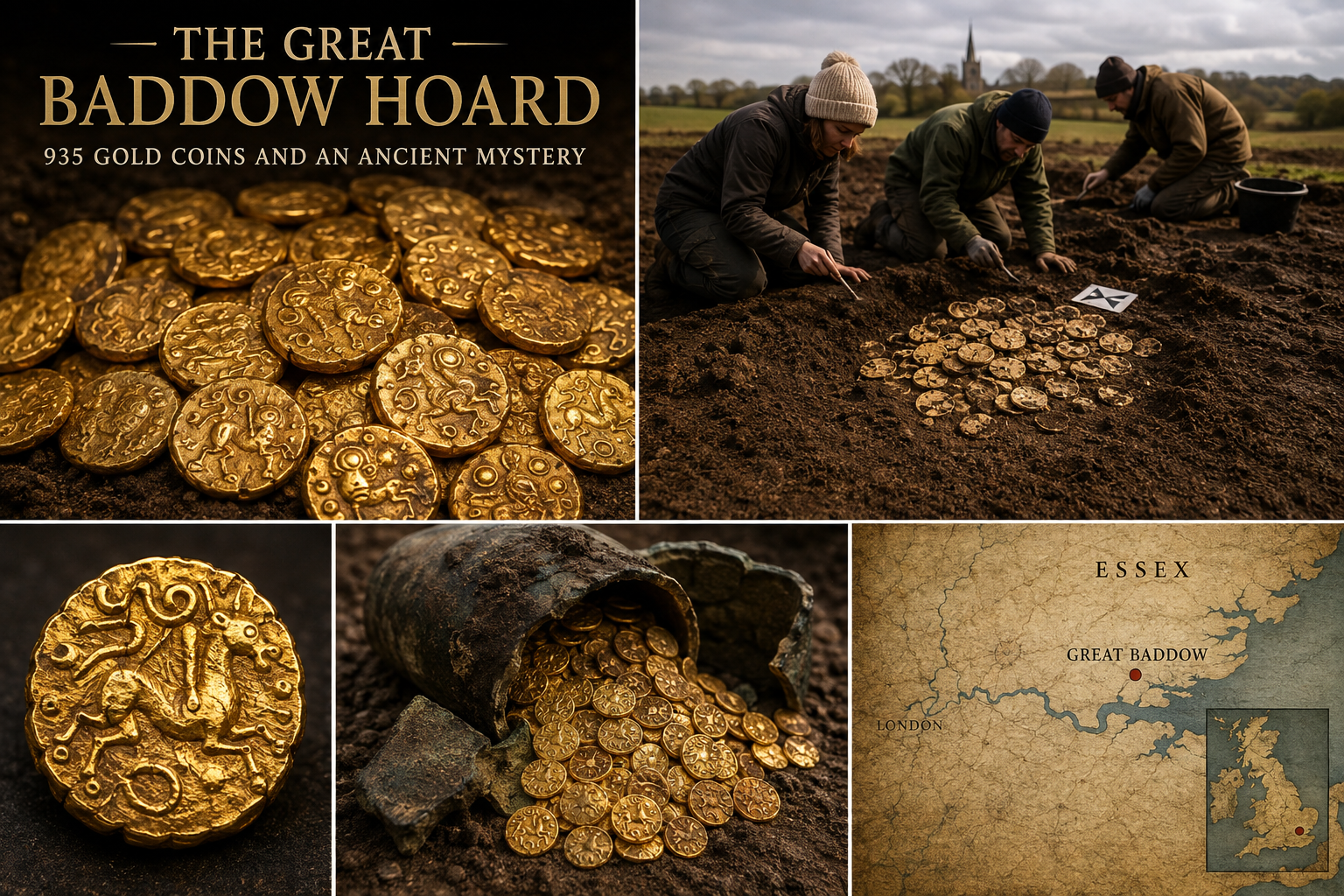
Introduction
More than 2,000 years ago, someone buried an extraordinary fortune beneath the ground in what is now Great Baddow, Essex, England. Hidden there were hundreds of tiny gold coins, carefully gathered together and left untouched for centuries. Today, this remarkable discovery is known as the Great Baddow Hoard, the largest recorded hoard of Iron Age gold coins ever found in Britain. But the greatest mystery surrounding the Great Baddow Hoard is not how much gold was buried. It is why it was buried in the first place—and why nobody ever came back for it.
The Discovery of the Great Baddow Hoard
The story began in 2020, when a remarkable collection of Iron Age gold coins was discovered at Great Baddow near Chelmsford, Essex.
The original discovery contained 933 gold coins, along with fragments that may have belonged to a container or vessel. The coins date from approximately 60 to 20 BC, placing them in one of the most fascinating periods of British Iron Age history.
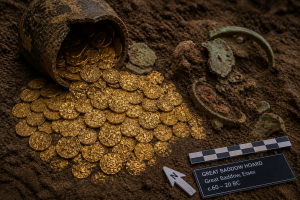
The discovery was extraordinary because of its size. The Great Baddow Hoard became the largest recorded hoard of Iron Age gold coins ever found in Britain.
But the story did not end with the original discovery.
During later archaeological work in the wider area, researchers recovered two additional gold coins associated with the hoard. This brought the total number of coins to 935. All 935 coins were scheduled to be displayed together publicly for the first time in 2026 at the Museum of Chelmsford.
Yet even after thousands of years underground, the hoard still refuses to reveal its biggest secret.
Who buried the gold—and what were they afraid of?
What Were the Great Baddow Coins?
Most of the coins in the hoard are Eastern British gold staters, particularly coins of the “Whaddon Chase” type.
Around 930 of the original 933 coins belonged to this type. They were produced in the North Thames region between roughly 60 and 20 BC. Each coin weighed approximately 5.95 grams, although no two coins were exactly identical. Differences in their size, shape and appearance were partly caused by the way Iron Age coins were struck by hand.
The coins are especially interesting because they were not simply ordinary pieces of currency.
Gold staters were valuable objects in Iron Age Britain and could represent considerable wealth. Finding hundreds together suggests that the person or group who gathered them had access to an extraordinary amount of resources.
And there was something else unusual about the collection.
Alongside the large group of Eastern British staters were three other gold coins of different types. One was an Eastern British quarter stater, another was a Continental Gallo-Belgic E uniface stater dating to around 60–50 BC, and another was an East Anglian gold stater known as the “Norfolk Wolf.”
These different coins provide clues about the movement of people, wealth and objects across Iron Age Britain and continental Europe.
Who Made the Coins?
Most of the coins are believed to have been produced in an area later associated with the Catuvellauni, an influential Iron Age tribal group in southeastern Britain.
But here is where the story becomes much more interesting.
The hoard was discovered in Great Baddow, an area traditionally associated with the Trinovantes.
Why would so many coins connected with the Catuvellauni be found in territory associated with another tribe?
Archaeologists believe the answer could involve the movement—and possibly the conflict—between these neighbouring Iron Age groups. The Museum of Chelmsford notes that the hoard provides important archaeological evidence for understanding activity between the Catuvellauni and Trinovantes during this period.
The coins may therefore have travelled because of trade, political influence, conflict, tribute, or the movement of people.
Whatever brought them there, their final destination was Great Baddow.
And someone decided to hide them.
Was Julius Caesar Connected to the Hoard?
One of the most fascinating theories surrounding the Great Baddow Hoard involves Julius Caesar.
The coins were buried during a period when Rome was becoming increasingly involved with Britain. Julius Caesar launched his first expedition to Britain in 55 BC and returned the following year.
The timing is important because the Great Baddow coins date broadly to the decades surrounding Caesar’s invasions.
Some researchers have suggested that the enormous quantity of gold could have been connected to the political situation created by Rome’s arrival. One theory is that the coins may have been intended as a tribute payment to Julius Caesar following his invasion.
However, there is no evidence proving that Caesar ever received these particular coins.
It is only a theory.
The hoard may have had nothing to do with Caesar at all.
It could instead have belonged to a wealthy individual, an Iron Age leader, or a political group trying to protect its wealth during a period of uncertainty.
That uncertainty is what makes the discovery so fascinating.
Why Was So Much Gold Buried?
People have buried valuable objects throughout history for many different reasons.
Sometimes treasure was hidden because its owner feared war or theft. Sometimes it was buried temporarily for safekeeping. In other cases, precious objects were deliberately deposited as religious offerings.
The Great Baddow Hoard could potentially fit more than one of these explanations.
Perhaps its owner was protecting a fortune from an approaching enemy.
Perhaps the coins were connected to political negotiations.
Perhaps they were being gathered as a tribute.
Or perhaps the gold had a ritual purpose that we no longer understand.
Unfortunately, archaeologists cannot yet give a definite answer.
Fragments of a possible container were found with the coins, including a copper-alloy ring that may have been part of a vessel, fragments of red glass with copper-alloy inlay, copper-alloy sheet fragments, and a piece of organic material that may have been leather.
These remains suggest that the coins may have been placed inside some kind of container before being buried.
But the exact circumstances remain unclear.
The Mystery of the Missing Owner
Perhaps the strangest part of the Great Baddow story is what did not happen.
The person who buried the gold never returned to collect it.
Imagine hiding hundreds of gold coins underground, expecting to retrieve them later.
Something must have happened.
The owner could have died.
They may have been forced to leave the area.
A conflict may have prevented them from returning.
Or the person who knew about the hidden treasure may simply have disappeared from history.
Whatever happened, the location remained hidden for more than two millennia.
Generations came and went.
The Iron Age ended.
Roman Britain emerged and eventually disappeared.
Kingdoms rose and fell.
Yet beneath the Essex soil, the gold remained.
What the Hoard Reveals About Iron Age Britain
The Great Baddow Hoard is more than a collection of ancient coins.
It gives archaeologists a glimpse into a world that existed before Britain became part of the Roman Empire.
The different coin types suggest that objects and wealth were moving across considerable distances. The concentration of coins also tells us that some individuals or groups had access to significant amounts of gold.
The location of the hoard is equally important.
Because many of the coins are normally associated with areas farther west, their discovery in Great Baddow may provide evidence for movement or political expansion involving the Catuvellauni and neighbouring communities.
In other words, these small pieces of gold may preserve evidence of much bigger events.
They can tell us about power.
They can tell us about wealth.
They can tell us about trade.
And perhaps they can even tell us about conflict.
A Discovery Almost Lost
There is another remarkable part of the Great Baddow story.
The original hoard was discovered by a metal detectorist on private land. The finder did not have permission to be detecting there and initially failed to report the discovery under Britain’s Treasure Act 1996. According to the Museum of Chelmsford, this reduced the amount of archaeological information that could be recovered from the original find context.
This is important because archaeological context can be just as valuable as the objects themselves.
Knowing exactly where an object was found, how it was buried and what was around it can help researchers reconstruct what happened thousands of years ago.
Once objects are removed without proper archaeological recording, some of that information can be lost forever.
Fortunately, further archaeological work has helped researchers learn more about the hoard and its significance.
Where Can You See the Great Baddow Hoard?
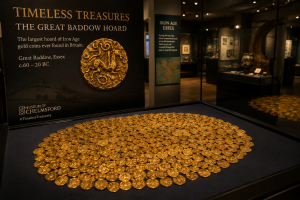
The Great Baddow Hoard was acquired by the Museum of Chelmsford in 2025 with support from the National Lottery Heritage Fund and other organizations.
In July 2026, the museum opened its “Timeless Treasures” exhibition, bringing the extraordinary hoard into public view. The exhibition is scheduled to run from 18 July 2026 to 11 April 2027.
The museum describes the discovery as an exceptional find of national importance because it provides new evidence about Iron Age communities and activity in eastern England.
For anyone interested in ancient Britain, seeing hundreds of real Iron Age gold coins together offers a rare connection to a world that existed more than 2,000 years ago.
The Mystery That Still Remains
The Great Baddow Hoard gives us hundreds of clues—but not the one answer we want most.
We know that someone gathered an enormous amount of gold.
We know that the coins were buried more than 2,000 years ago.
We know that most were produced in the eastern part of Britain and that some of the coins came from different traditions.
We know the burial happened during a period of major political change, when Rome was beginning to exert pressure on Britain.
But we still do not know exactly who buried the 935 coins or why.
Maybe the treasure belonged to a powerful Iron Age leader.
Maybe it was gathered as a political payment.
Maybe it was hidden because war was approaching.
Or perhaps the gold was buried for a reason that has nothing to do with any of these theories.
That is the mystery.
For more than two thousand years, the ground kept the secret.
Now archaeologists have uncovered the gold—but the story behind it is still waiting to be discovered.
And perhaps the most intriguing thought is this:
What if the 935 coins were never meant to be found again?
[…] romance, rivalry, and betrayal. The story of the Boleyn Sisters and Henry VIII is one of the most fascinating chapters in Tudor […]