
 By admin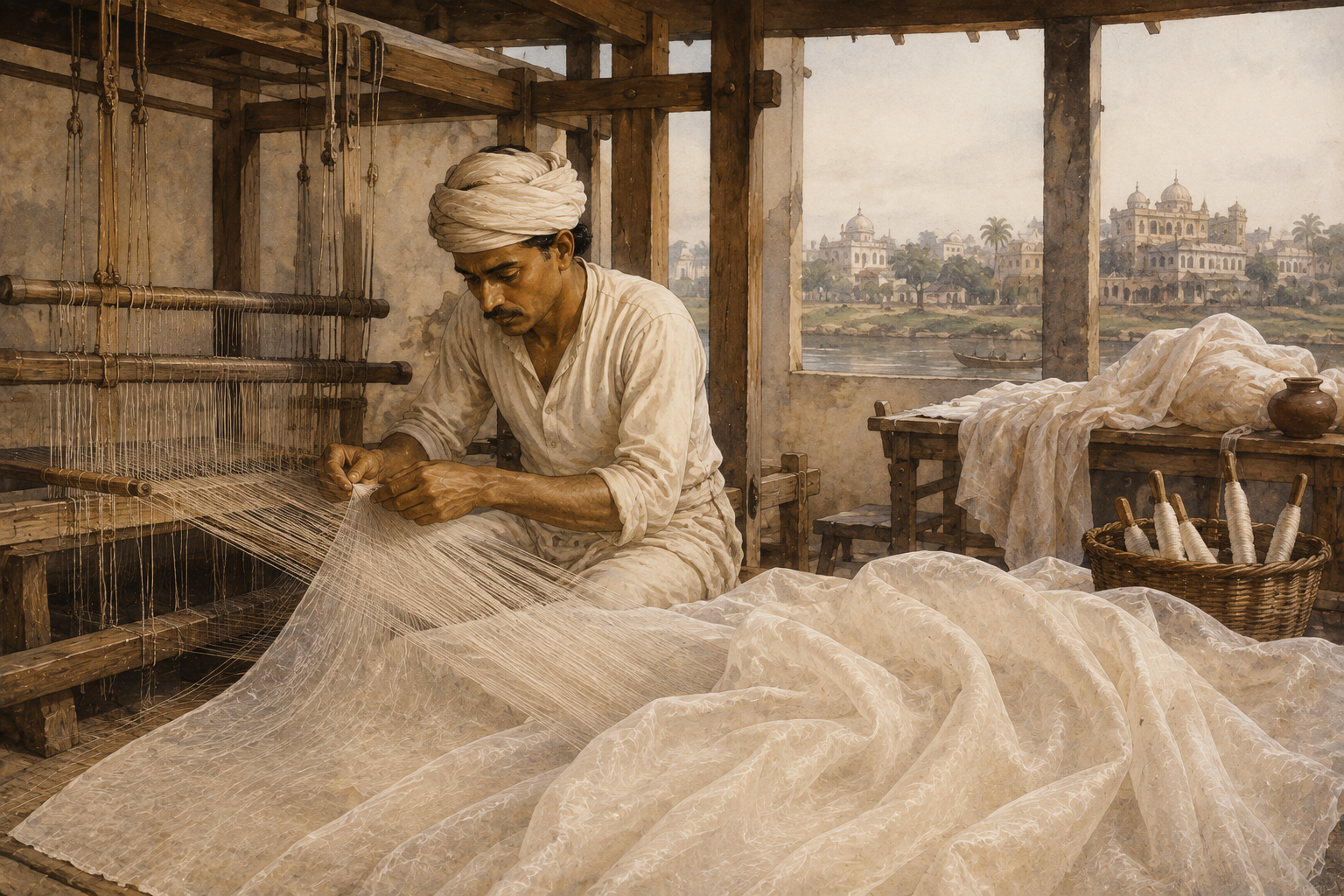
Introduction
For centuries, Dhaka Muslin weavers’ fingers were the skilled instruments behind one of the finest fabrics in the world. Dhaka muslin was more than just a piece of cloth—it was a symbol of extraordinary craftsmanship, so fine and delicate that European travelers, merchants, emperors, and aristocrats prized it as a luxury textile. But behind this legendary fabric lies a dark and controversial story: Did the British really cut off Dhaka Muslin weavers’ fingers?
Woven by highly skilled artisans in and around Dhaka, this legendary cotton fabric became famous across Asia, the Middle East, and Europe. Its extraordinary fineness earned it poetic descriptions such as “woven air.”
But then came one of the darkest stories associated with its disappearance.
According to a widely repeated tale, British colonial authorities deliberately destroyed Dhaka’s muslin industry by cutting off the fingers or thumbs of skilled weavers. The idea was brutally simple: if the weavers could no longer weave, they could no longer produce the exquisite fabric that competed with British textiles.
It is a story that has been repeated for generations.
But did it really happen?
Were the fingers of Dhaka’s muslin weavers actually cut off by the British—or is this one of history’s most powerful myths?
The answer is more complicated than the legend suggests.
The Extraordinary World of Dhaka Muslin
Long before British colonial dominance, Dhaka was famous for its remarkable textile production.
The finest muslin was made from exceptionally delicate cotton and required extraordinary skill. Producing the finest yarn demanded patience, precision, favorable humidity, and highly trained artisans. The process was so delicate that even small changes in conditions could affect the quality of the thread.
Dhaka muslin became particularly important during the Mughal period. The finest varieties were associated with royal courts and wealthy consumers, while merchants carried Bengali textiles to markets far beyond the region.
European traders also developed a strong appetite for Bengali cotton textiles.
By the seventeenth and eighteenth centuries, Dhaka muslin had become an international luxury product.
Its fame was not based simply on appearance. Its production represented generations of specialized knowledge passed from one artisan to another.
And that is what makes the story of its decline so tragic.
When British Power Changed the Textile Trade
The East India Company did not initially enter Bengal simply as a colonial government. It came as a trading company.
But after gaining political and economic power in Bengal, particularly following the Battle of Plassey in 1757, the Company’s influence over trade and production expanded dramatically.
The textile industry became one of the areas where this power was felt.
Company agents and intermediaries exercised significant control over many weavers. Historical accounts describe systems involving advances, contracts, restricted trading opportunities, and pressure on artisans to supply textiles to the Company.
At the same time, Britain’s own textile industry was undergoing a technological revolution.
Mechanized spinning and weaving allowed British manufacturers to produce cotton textiles on a scale that traditional handloom production could not easily match.
This created a devastating imbalance.
Bengali artisans were producing extraordinarily fine handmade fabrics.
British factories were producing increasingly cheaper machine-made textiles.
And colonial trade policies helped determine which products had access to which markets.
The Evidence Behind the Dhaka Muslin Weavers’ Fingers Myth
The decline of Dhaka muslin cannot be explained by a single event.
Researchers have identified several interconnected causes.
British trade policies placed serious disadvantages on Indian textiles entering British markets, while British manufactured goods increasingly entered Indian markets.
The East India Company’s control over textile production also created pressure on weavers.
The devastating Bengal famine of 1770 further weakened the region’s economy and population.
Meanwhile, Britain’s Industrial Revolution transformed the economics of textile production.
Cheap machine-made cotton goods became increasingly competitive.
Dhaka’s traditional muslin industry, which depended on highly specialized manual labor and particular varieties of cotton, struggled to survive this new economic environment.
Historical research therefore points toward economic exploitation, colonial trade policies, industrial competition, loss of royal patronage, and declining demand as major factors in the collapse of the industry.
But what about the fingers?
The Famous Story of the Cut Fingers
The story is one of the most disturbing parts of the history of Dhaka muslin.
According to the legend, British authorities cut off the thumbs—or sometimes the fingers—of highly skilled weavers so they would never be able to reproduce the finest muslin.
The story has survived for generations in Bengal.
It has even appeared in modern books, articles, documentaries, and popular discussions about colonialism.
But historians face a major problem:
There is no solid contemporary evidence proving that British authorities systematically cut off the fingers of Dhaka’s muslin weavers.
A 1925 discussion of the Dhaka muslin industry by Jogesh Chandra Sinha noted that the story was widely believed among people connected with the industry, but he also stated that he could not find specific evidence confirming it. Later historical research has similarly treated the tale with caution.
That does not mean that British officials never committed violence against artisans.
It means something more precise:
The specific claim that the British systematically cut off the fingers or thumbs of Dhaka’s muslin weavers has not been historically established.
So, Was the Story Completely Invented?
Not necessarily.
This is where the history becomes particularly interesting.
The story appears to have circulated in connection with reports of mistreatment of Indian textile workers. William Bolts, an eighteenth-century writer who criticized aspects of East India Company rule, mentioned reports involving the cutting of weavers’ thumbs in his writings.
However, the historical context and location of such reports are important, and later popular retellings appear to have transformed different accounts into the much broader story that the British cut off the thumbs of Dhaka’s finest muslin weavers.
Over time, the story became a powerful symbol of colonial destruction.
So while the literal claim remains unproven, the larger historical reality of exploitation and economic pressure was very real.
The Brutal Truth May Be More Complicated
Perhaps the most important lesson is that an industry does not need to have its artisans physically mutilated to be destroyed.
An entire craft can disappear through economic pressure.
When artisans lose access to markets, when their products become uncompetitive, when monopolistic systems restrict their freedom, when traditional patronage disappears, and when cheaper industrial products flood the market, generations of knowledge can vanish.
That is precisely why the history of Dhaka muslin cannot be reduced to the question of whether someone’s thumb was cut.
The British colonial economic system played a major role in transforming Bengal’s textile economy.
And the consequences were devastating.
The Daily Star’s historical account of the industry identifies multiple causes, including British tariffs, monopolistic control over weavers, the Bengal famine, the Industrial Revolution, and the loss of imperial and aristocratic patronage.
A Legend Born From a Real Tragedy
The image of a British official cutting off a weaver’s thumb is horrifying.
But the destruction of Dhaka’s muslin industry was, in its own way, horrifying without it.
A centuries-old tradition of extraordinary craftsmanship declined.
Specialized knowledge disappeared.
The cultivation of the particular cotton associated with the finest muslin declined.
And the artisans who had once produced one of the world’s most celebrated textiles increasingly lost their economic foundation.
The legend of the severed fingers may therefore have survived because it expresses something emotionally true, even if its literal historical details cannot be proven.
It represents the feeling that colonial rule did not merely take Bengal’s products.
It helped destroy the economic world that had allowed those products to exist.
Myth or Brutal Truth?
So, was the famous story of Dhaka Muslin weavers’ fingers actually true?
There is no reliable historical evidence establishing that the British systematically carried out such a policy.
The famous story should therefore be treated as a legend or unverified historical claim, rather than an established fact.
But dismissing the finger-cutting story should not lead us to dismiss the suffering of Bengal’s textile workers.
The decline of Dhaka muslin was real.
The economic pressure was real.
The Company’s control over aspects of the textile trade was real.
The unequal trade environment was real.
And the transformation brought by Britain’s Industrial Revolution was real.
In the end, Dhaka muslin did not simply disappear because someone cut off a few fingers.
It disappeared through a much larger historical process—one involving colonial power, economic exploitation, changing markets, industrialization, and the destruction of the conditions that had sustained one of the world’s greatest textile traditions.
And perhaps that is the most brutal truth of all.
If you enjoyed this article and want to explore more fascinating stories from history, click on the titles below to read about the Titanic’s Giant Anchor, The Catacombs of Paris, and Sonargaon: The Lost Capital of Bengal.
[…] – Dhaka Muslin: Did the British Cut Off the Weavers’ Fingers? […]