
 By admin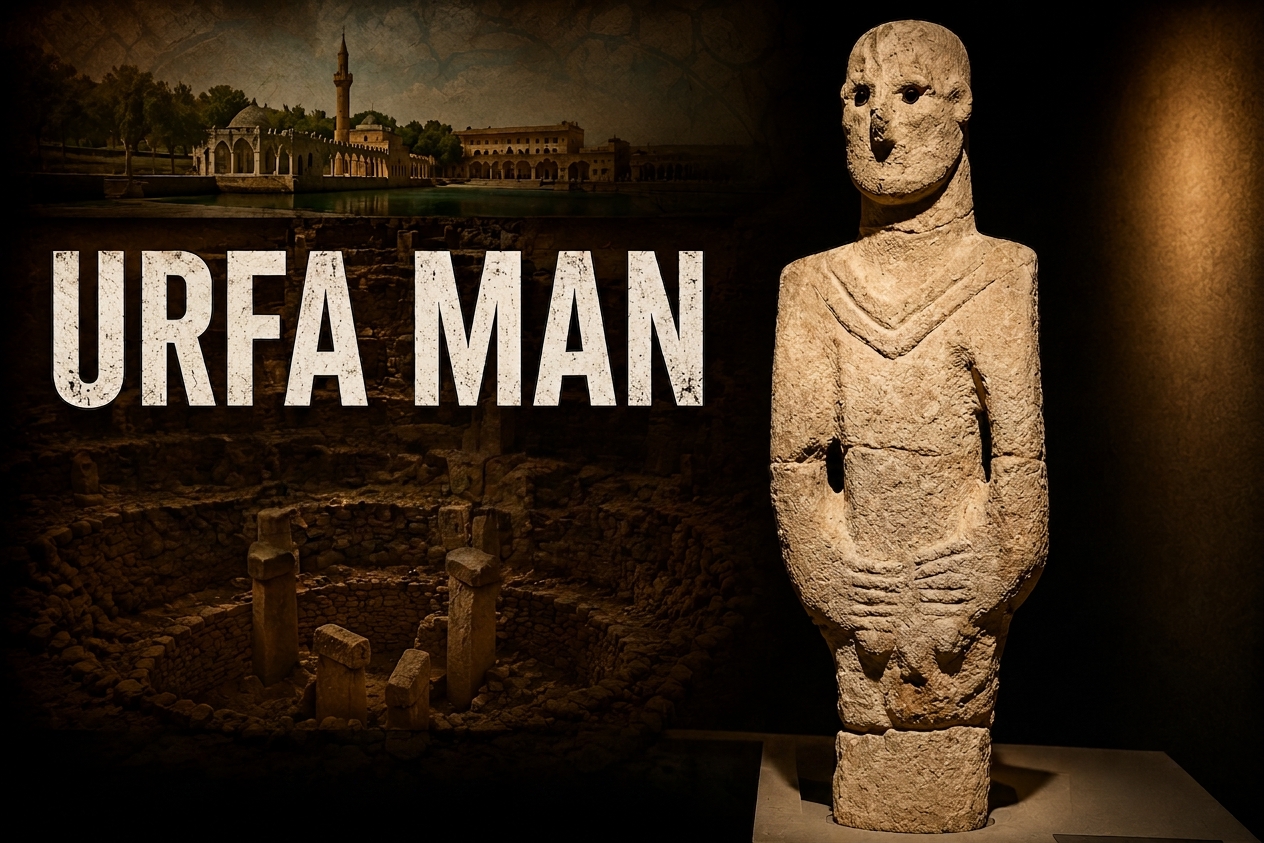
Introduction
Imagine standing in front of the Urfa Man, a human statue carved more than 11,500 years ago—thousands of years before the Egyptian pyramids, before written history, and before most of the civilizations we usually associate with the ancient world.
Its face is strangely human. Its eyes contain pieces of black obsidian. Its hands are held together in front of its body. Yet its mouth is missing, and nobody knows exactly who this mysterious figure was meant to represent.
This is the Urfa Man, also known as the Balıklıgöl Statue, one of the most remarkable surviving sculptures from the Neolithic period.
Today, the statue is displayed at the Şanlıurfa Archaeology Museum in southeastern Türkiye. But despite decades of archaeological research, one major question remains unanswered:
Who was the Urfa Man?
What Is the Urfa Man?
The Urfa Man is a life-size human-shaped statue carved from limestone during the Pre-Pottery Neolithic period.
It stands approximately 1.80 meters (5 feet 11 inches) tall, making it remarkably close to the size of an actual adult human. Turkish Museums describes it as the world’s earliest known life-size human statue.
The statue is particularly fascinating because of how sophisticated it is.
The sculptor carefully created a recognizable human face, ears, nose, body and hands. Deep holes were made for the eyes, and pieces of black obsidian were placed inside them, giving the figure an unusually striking appearance.
There is also a V-shaped design around the neck that may represent a necklace or part of a garment.
But the most mysterious feature may be the face itself.
The statue has no mouth.
Why the sculptor chose to create it this way remains unknown.
When Was the Urfa Man Created?
The statue dates to roughly 9,500 BCE, making it more than 11,500 years old. That places it deep within the Neolithic period.
To understand how ancient that really is, consider this:
The Great Pyramid of Giza was built thousands of years later.
Writing had not yet been invented.
Large urban civilizations such as ancient Egypt and Mesopotamia had not yet emerged in the form we usually imagine.
People in this region were still living through a major transformation—from mobile hunter-gatherer communities toward more settled ways of life.
And yet, someone was already creating a nearly human-sized stone sculpture.
That discovery challenges the old idea that sophisticated artistic expression only appeared after cities and civilizations developed.
Where Was the Urfa Man Found?
The statue was discovered in 1993 in the Balıklıgöl area of Şanlıurfa, in southeastern Türkiye. It was found during construction work near the old city.
Archaeological investigations in the surrounding area later revealed evidence of a much older Neolithic settlement.
Researchers found features including terrazzo floors and stone tools associated with the Pre-Pottery Neolithic period.
The area is also part of a landscape famous for some of humanity’s earliest monumental structures.
Just a short distance away lies Göbekli Tepe, another extraordinary Neolithic site that transformed our understanding of early human societies.
This makes the discovery of the Urfa Man even more significant.
It wasn’t found in isolation.
It belonged to a region where people were already experimenting with monumental architecture, symbolism and complex forms of artistic expression.
The Mysterious Black Obsidian Eyes
Perhaps the first thing people notice about the Urfa Man is its eyes.
The statue has unusually deep eye sockets, and fragments of black obsidian were inserted into them.
Obsidian is a naturally occurring volcanic glass. Its dark, reflective surface can produce a striking visual effect.
Imagine encountering this statue thousands of years ago, perhaps inside a dimly lit structure, with black stones set into its eyes.
The effect must have been extraordinary.
But why were obsidian pieces used?
We don’t know for certain.
They may have been intended simply as artistic details, or they could have had symbolic or ritual significance. Without written records from the period, archaeologists have to rely on the physical evidence to interpret its meaning.
And that uncertainty is one of the reasons the statue remains so fascinating.
What Happened to Its Mouth?
The absence of a mouth gives the statue an especially mysterious appearance.
The face has a nose, ears and eyes, but no clearly carved mouth.
Was this intentional?
Was the mouth deliberately left unfinished?
Or did some part of the sculpture change or become damaged over thousands of years?
There is no definitive answer.
It is tempting to create a dramatic explanation, but archaeology requires caution. We simply don’t have enough evidence to say exactly why the sculptor chose this unusual design.
The mystery itself is part of what makes the Urfa Man so compelling.
Who Was the Urfa Man Supposed to Represent?
This is perhaps the biggest unanswered question.
Was the statue a god?
A powerful leader?
An important ancestor?
A deceased member of the community?
Or perhaps a symbolic representation of something completely different?
Archaeologists have proposed different interpretations, but there is no universally accepted identification.
Turkish Museums itself notes that the identity and purpose of the figure remain unknown.
That means we should be careful with claims that confidently call the statue a particular god or ancient ruler.
There are no inscriptions telling us who the figure was.
No ancient text explains why it was created.
And no surviving record describes the ceremony or place in which it may have been used.
All we have is the statue—and the archaeological world around it.
Why Is the Urfa Man So Important?
The importance of the Urfa Man goes beyond its age.
The statue demonstrates that people living more than 11,000 years ago were capable of producing sophisticated, life-size representations of the human body.
According to Turkish Museums, the discovery is particularly significant because it shows that monumental artistic expression existed during a period when communities were still undergoing the transition toward settled life.
In other words, art didn’t suddenly appear after cities were built.
Human beings were already creating ambitious works of art while their societies were changing dramatically.
The statue therefore offers archaeologists a glimpse into a world that existed long before written history.
The Urfa Man and the World of Göbekli Tepe
The region around Şanlıurfa contains several archaeological sites from the same broad period.
The most famous is Göbekli Tepe, located roughly 10 kilometers from the area associated with the Urfa Man.
Göbekli Tepe is famous for its monumental stone pillars and carvings, and its discoveries have fundamentally changed how researchers think about early societies.
The Urfa Man belongs to this same fascinating cultural landscape.
Together, these discoveries suggest that communities in southeastern Anatolia were developing sophisticated artistic and symbolic traditions much earlier than previously imagined.
Where Can You See the Urfa Man Today?
Today, the statue is displayed at the Şanlıurfa Archaeology Museum in Türkiye.
Visitors can see its limestone body, unusual facial features and the distinctive black obsidian eyes up close. The museum identifies the Balıklıgöl Statue as the oldest known life-size human sculpture in its collection and one of the most important artifacts from the region’s Neolithic past.
After surviving for more than eleven millennia, the statue now sits behind museum walls—but the questions surrounding it remain.
A Mystery From Before Written History
The Urfa Man reminds us how much of human history existed before anyone began writing things down.
We know when the statue was created approximately.
We know what material was used.
We know where it was discovered.
We can examine the tools, settlements and archaeological remains surrounding it.
But we still don’t know the most human question of all:
Who was this person supposed to be?
Perhaps the statue represented an ancestor whose name has been forgotten.
Perhaps it was connected to a ritual or belief that disappeared thousands of years ago.
Or perhaps its true purpose was something we haven’t even considered.
For now, the Urfa Man remains silent—standing nearly two meters tall, with black obsidian eyes staring across more than eleven thousand years of human history.
And perhaps that is what makes this ancient statue so unforgettable.
Explore More Historical Stories
Enjoyed this story about Urfa Man?
If you found it interesting, you can explore our other historical stories and discover more fascinating events from the past:
Dunkleosteus: The Terrifying Fish That Ruled the Ancient Seas
Boleyn Sisters and Henry VIII: The Sister Who Changed England
Chinese Dragon: The Symbol Behind an Ancient Culture
Click on any title above to continue exploring history and uncover more fascinating stories from the past.
[…] – Urfa Man: The 11,500-Year-Old Statue That Remains a Mystery […]