
 By admin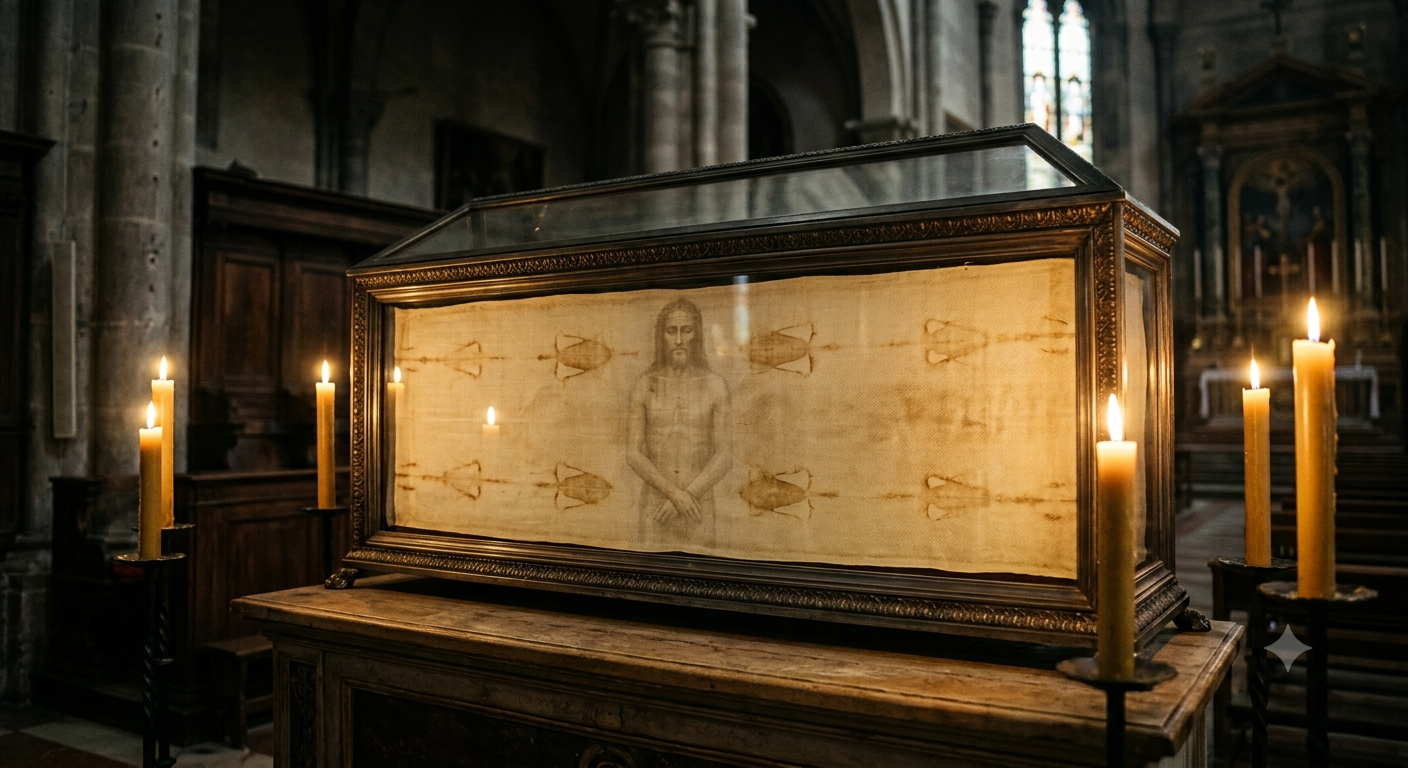
What Is the Shroud of Turin?
Imagine discovering a piece of cloth that many people believe once covered the body of Jesus Christ.
Not a painting. Not a statue. Just an old piece of linen.
At first, it doesn’t seem extraordinary. But as you look closer, something unexpected appears. A faint image of a man is visible on the fabric. His face, hands, and body seem to be marked with wounds that resemble those described in the Bible during the crucifixion of Jesus.
Could this really be the cloth used to wrap Jesus after His death?
Or is it simply one of the greatest hoaxes ever created?
This is the mystery of the Shroud of Turin.
For centuries, the Shroud of Turin has fascinated believers, historians, scientists, and skeptics alike. Some people believe it is one of Christianity’s most important relics. Others argue that it was created during the Middle Ages.
Even after decades of scientific research, no one has been able to give a final answer.
Is the Shroud of Turin truly the burial cloth of Jesus?
Or is its mystery far more complicated than anyone imagined?
Let’s explore the incredible story behind the Shroud of Turin.
The Discovery of the Shroud of Turin
The story of the Shroud of Turin begins in medieval France, not in ancient Jerusalem.
The first well-documented record of the cloth appeared around 1354 in the small village of Lirey, France. A French knight named Geoffroi de Charny displayed the linen cloth in a local church, where thousands of people came to see it.
What made the cloth so unusual was the faint image on its surface.
Instead of colorful paint or detailed artwork, the fabric showed the front and back image of a man. His body appeared to bear wounds on the hands, feet, side, and head—injuries that closely matched the biblical description of Jesus’ crucifixion.
Many visitors believed they were looking at the actual burial cloth of Jesus Christ.
Not everyone agreed.
Some church officials questioned the cloth’s authenticity. They argued that there was no clear historical record linking it directly to the time of Jesus. Others believed it might have been created by a talented medieval artist.
Despite the debate, the cloth continued to attract attention across Europe.
In 1578, the Shroud was moved to Turin, Italy, where it has remained ever since. Today, it is carefully preserved inside the Cathedral of Saint John the Baptist and is only displayed to the public on special occasions.
Over the centuries, millions of pilgrims and visitors have traveled to Turin hoping to see the mysterious cloth with their own eyes.
As technology advanced, scientists also became interested.
Instead of asking whether the image looked real, they began asking a different question:
How was the image on the Shroud of Turin created?
That question would lead to one of the most controversial scientific investigations in history.
Why Is the Shroud of Turin So Mysterious?
At first, the Shroud of Turin looks like an ordinary piece of old linen.
But when scientists examined it more closely, they found something extraordinary.
The image on the cloth doesn’t appear to be painted. No visible brushstrokes have ever been found. In fact, many tests failed to detect the pigments that would normally be used to create a painting.
That immediately raised a question.
If it isn’t painted, then how did the image appear?
The mystery became even more fascinating in 1898.
An Italian photographer named Secondo Pia took the first photographs of the Shroud. When he developed the photographic negatives, he noticed something incredible.
The negative image looked more like a normal photograph than the cloth itself.
In other words, the Shroud seemed to act like a photographic negative—centuries before photography was even invented.
This discovery shocked both scientists and historians.
Some researchers suggested that the image formed through a natural chemical reaction. Others believed it was created by heat, light, or another process that science still doesn’t fully understand.
Many Christians saw the image as evidence supporting the belief that the cloth once covered the body of Jesus after the crucifixion.
Skeptics offered a different explanation.
They argued that the Shroud could simply be an impressive medieval creation, designed to inspire faith during a time when religious relics attracted thousands of pilgrims.
As more studies were carried out, the debate only grew.
Then, in 1988, scientists performed a famous laboratory test that seemed to answer the mystery once and for all.
Or so they thought.
What Did the Carbon Dating Test Reveal?
For centuries, people argued about whether the Shroud of Turin was genuine.
Then, in 1988, scientists decided to test the cloth using one of the most trusted methods for dating ancient objects—radiocarbon dating, also known as the Carbon-14 test.
Small samples were taken from the Shroud and sent to three independent laboratories in Oxford, Zurich, and Arizona.
When the results came back, they all pointed to the same conclusion.
According to the tests, the linen was made sometime between 1260 and 1390 CE.
If those results were correct, the Shroud could not have been the burial cloth of Jesus, who lived in the 1st century.
Many people believed the mystery had finally been solved.
But the story didn’t end there.
Soon after the results were published, several researchers raised new questions.
Some argued that the sample used for testing came from a corner of the cloth that had been repaired after a fire in 1532. If newer threads had been woven into that area, the Carbon-14 test might have measured the age of the repair instead of the original fabric.
Others suggested that smoke, dirt, and years of handling could have affected the results.
However, many scientists disagree with these claims. They believe the 1988 test was carried out correctly and still provides the strongest scientific evidence available.
Because of these different opinions, the debate continues today.
Was the Carbon-14 test completely accurate?
Or was the part that was tested not representative of the entire cloth?
More than three decades later, no one has been able to give a final answer, and the Shroud of Turin remains one of history’s most debated artifacts.
What Do Historians and Scientists Really Think?
After years of research, one thing is clear:
The Shroud of Turin remains one of the most studied religious artifacts in history.
But despite all the scientific tests, historians and researchers still disagree about what it really is.
Most historians believe the Shroud probably dates back to the Middle Ages. They point to the 1988 Carbon-14 test and the fact that there is no confirmed historical record of the cloth before the 14th century.
According to this view, the Shroud is most likely a remarkable medieval artifact rather than the actual burial cloth of Jesus.
However, not everyone agrees.
Some researchers argue that the Carbon-14 test may not have dated the original fabric. They believe the tested sample came from a repaired section of the cloth, which could explain why it appeared younger than expected.
Scientists are also divided over another mystery—the image itself.
Even today, no one has been able to recreate the image exactly as it appears on the Shroud. The faint markings are incredibly detailed, yet they only affect the outermost fibers of the linen.
Some experts think the image may have formed through a natural chemical process over time.
Others believe we still don’t fully understand how it was created.
For many Christians, the scientific debate is not the most important question.
Whether the cloth is authentic or not, they see the Shroud as a powerful symbol of faith and the story of Jesus’ crucifixion.
Today, the Shroud of Turin continues to attract millions of visitors, researchers, and pilgrims from around the world.
Some visit hoping to see a priceless historical artifact.
Others come believing they are standing before one of Christianity’s holiest relics.
And for many people, the mystery itself is what makes the Shroud so fascinating.
Lessons From the Shroud of Turin
The Shroud of Turin is more than just an ancient piece of cloth. It teaches us several important lessons about history, science, and belief.
Lesson 1: History doesn’t always have clear answers.
For hundreds of years, people have tried to discover the true origin of the Shroud. Even with modern technology, no one has been been able to prove beyond doubt whether it is genuine or not. Some mysteries remain unsolved.
Lesson 2: Science and faith can ask different questions.
Science focuses on evidence, testing, and facts. Faith is based on personal belief and spiritual conviction. The Shroud of Turin shows that the same object can be viewed in very different ways depending on a person’s perspective.
Lesson 3: Every discovery leads to new questions.
The Carbon-14 test answered one question but created many others. Researchers continue to study the cloth using new technologies, hoping to learn more about its history and the mysterious image it carries.
Lesson 4: Ancient artifacts connect us to the past.
Whether the Shroud is authentic or not, it has become one of the world’s most important historical and religious artifacts. It reminds us how objects from the past can continue to inspire curiosity, research, and debate centuries later.
Today, the Shroud of Turin remains one of history’s greatest mysteries. It continues to attract scientists, historians, believers, and curious visitors from around the world.
Perhaps the greatest lesson is this:
Sometimes the questions we cannot answer are the ones that teach us the most.
Conclusion
More than 600 years after it first appeared in historical records, the Shroud of Turin continues to fascinate people around the world.
At first glance, it looks like an ordinary piece of linen. But the faint image on the cloth has sparked centuries of debate. Is it the actual burial cloth of Jesus Christ? Or is it one of the greatest medieval creations ever made?
Scientific studies have provided important clues, but they have not ended the discussion. The Carbon-14 dating suggests the cloth was made during the Middle Ages, while other researchers argue that the tested sample may not represent the entire fabric. Even the mysterious image itself has never been fully explained.
For many people, the Shroud is far more than a historical artifact. It is a symbol of faith, hope, and one of history’s most enduring mysteries. For others, it is a fascinating object that shows how science and history continue to challenge what we think we know.
Whether future research proves the Shroud to be authentic or not, its story is far from over. New technology may one day provide answers that have remained hidden for centuries.
Until then, the Shroud of Turin remains one of the world’s most famous unsolved mysteries—a simple piece of cloth that continues to raise extraordinary questions about history, science, and belief.
[…] admin Aug 4, 2026 […]