
 By admin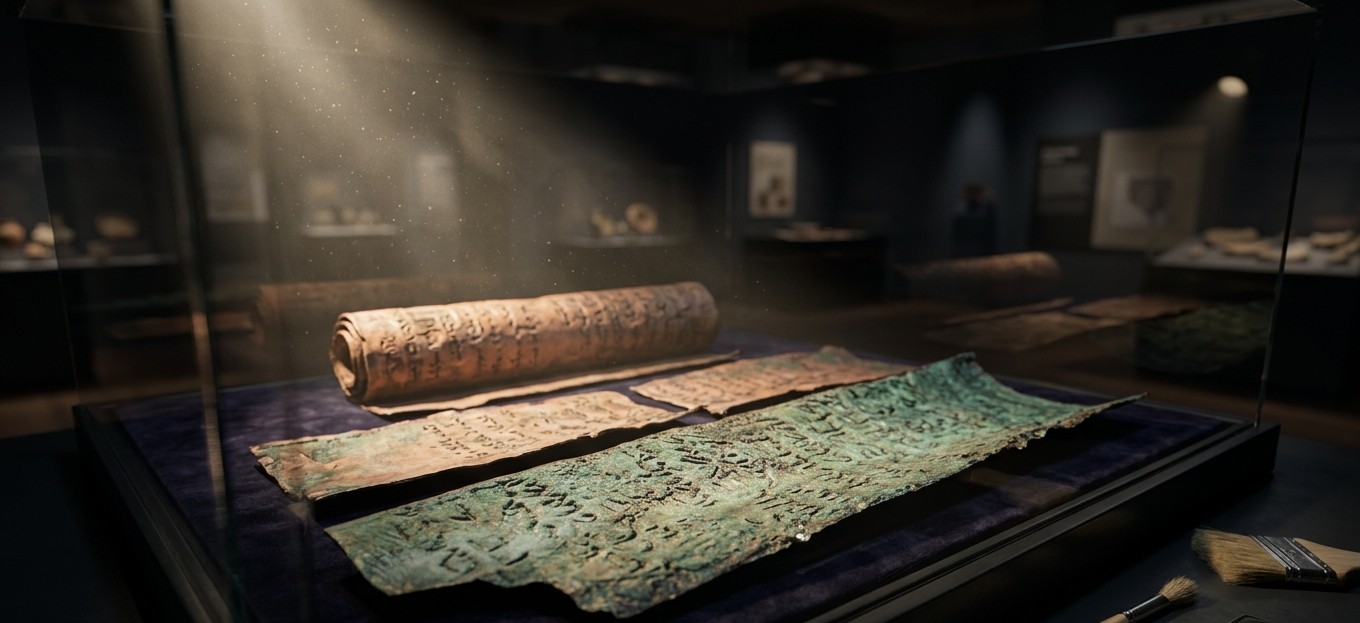
Introduction
Imagine finding an ancient scroll that doesn’t tell stories about kings, wars, or religion. Instead, the Copper Scroll gives detailed directions to hidden treasure buried in secret locations.Not just one treasure, but dozens of places filled with gold, silver, and other valuable objects. It sounds like the beginning of an adventure movie, yet this mystery has puzzled historians and archaeologists for decades.
In 1952, archaeologists exploring caves near the Dead Sea made a discovery unlike anything they had seen before. They found an ancient scroll, but it wasn’t written on parchment like the other Dead Sea Scrolls. It wasn’t made from papyrus either. Instead, this mysterious document was made entirely of copper. After nearly two thousand years underground, the metal had become green with corrosion, making it impossible to open without damaging it.
When experts finally managed to read what was inside, they were stunned. The scroll contained no religious teachings, no historical stories, and no ancient laws. Instead, it listed more than sixty locations where huge amounts of gold, silver, and other valuable objects were supposedly hidden. Some entries even described the exact amount of treasure buried at each place, making it look more like a treasure map than an ancient manuscript.
If everything written on the Copper Scroll is true, the missing treasure could be worth billions of dollars today. Naturally, the discovery attracted historians, archaeologists, and treasure hunters from around the world. Everyone wanted to solve the mystery, but despite decades of research, no one has ever found the treasure.
So what exactly is the Copper Scroll?
Is it the world’s oldest treasure map, a symbolic document, or one of history’s greatest unsolved mysteries?
Let’s uncover the incredible story behind the Copper Scroll.
The Discovery of the Copper Scroll
The story of the Copper Scroll begins in one of the most important archaeological discoveries of the 20th century. During the late 1940s and early 1950s, archaeologists were exploring the caves of Qumran, a desert area near the Dead Sea. These caves had already revealed hundreds of ancient manuscripts, now known as the Dead Sea Scrolls. Most of them contained religious texts, biblical writings, and documents that helped historians understand Jewish life more than two thousand years ago.
In 1952, while searching Cave 3 at Qumran, researchers found something completely unexpected. Unlike the other scrolls, this one wasn’t made from parchment or papyrus. It had been created from thin sheets of copper, carefully rolled into a scroll. After spending nearly two thousand years underground, the metal had become badly corroded. It was so fragile that no one could safely unroll it without destroying the writing inside.
For several years, the mysterious scroll remained unread. Then, in 1955, scientists came up with a creative solution. Instead of trying to open it, they carefully cut the scroll into narrow strips. This allowed them to study the ancient writing while protecting the fragile copper from further damage. It was a slow and delicate process, but it finally revealed the secret hidden inside.
What the researchers discovered surprised everyone.
Instead of prayers, prophecies, or religious teachings, the Copper Scroll contained a long list of hidden treasure locations. It described dozens of places where large amounts of gold, silver, and other valuable objects were supposedly buried. Some entries even recorded the estimated amount of treasure stored at each location, making the document look more like a treasure inventory than an ancient manuscript.
But one important question remained.
Who buried this treasure, and why was it never recovered?
That question has puzzled historians, archaeologists, and treasure hunters ever since, turning the Copper Scroll into one of history’s greatest unsolved mysteries.
What Was Written Inside the Copper Scroll?
When experts finally translated the Copper Scroll, they expected to read another religious text like the other Dead Sea Scrolls. Instead, they found something no one had imagined. The scroll wasn’t filled with prayers, laws, or stories. It was a list—one that appeared to describe hidden treasures scattered across different locations.
Each entry followed a similar pattern. It named a place, gave a short description of where to look, and then listed the amount of treasure supposedly hidden there. Some locations were described as being beneath stairways, while others mentioned underground chambers, ancient wells, or ruins. The directions were surprisingly specific, almost as if they were written for someone who already knew the area.
What made the document even more remarkable was the amount of treasure it claimed to record. According to the scroll, enormous quantities of gold, silver, precious vessels, and valuable artifacts had been hidden in more than sixty different locations. If all of those treasures still existed today, experts estimate they could be worth billions of dollars.
But the scroll leaves out one important detail.
Who buried the treasure?
It never mentions a king, a priest, or a wealthy family. It doesn’t explain why the valuables were hidden or whether anyone was supposed to recover them later. The scroll simply records the locations, as if the writer assumed the reader already knew the rest of the story.
Because of this, historians have developed several theories. Many believe the treasure once belonged to the Second Jewish Temple in Jerusalem. According to this idea, priests may have hidden the valuables before the Romans destroyed the city in 70 CE, hoping to protect them from being stolen. Others believe the treasure came from different communities and was buried during a time of war and uncertainty.
Unfortunately, the Copper Scroll provides no clear answers. It offers clues, but not explanations. That is exactly what makes it so different from every other Dead Sea Scroll ever discovered.
So if the directions seem so detailed, why hasn’t anyone found the treasure?
That question has kept the mystery alive for more than seventy years.
Has Anyone Ever Found the Treasure?
This is the question that has kept the mystery alive for generations.
If the Copper Scroll really describes hidden treasure, why hasn’t anyone found it?
Since the scroll was translated, historians, archaeologists, and treasure hunters have searched for the places mentioned in the text. Some explored the hills around Qumran. Others studied ancient maps, historical records, and old landmarks, hoping to match the descriptions with real locations. Despite decades of research, not a single treasure listed in the Copper Scroll has been confirmed.
One of the biggest challenges is that the world has changed dramatically over the last two thousand years. Ancient villages have disappeared, buildings have collapsed, rivers have changed their course, and many of the place names mentioned in the scroll are no longer used. Even if the directions were accurate when they were written, following them today is incredibly difficult.
Some researchers believe the treasure was recovered long ago. According to this theory, the people who buried it may have returned after the danger had passed and secretly took everything back. Others suggest that the Romans could have discovered the hidden valuables during their conquest of Jerusalem and the surrounding region, leaving nothing behind for future generations to find.
There is another possibility that many historians take seriously. They believe the Copper Scroll may not have been a treasure map in the modern sense. Instead, it could have been an inventory of valuable items belonging to the Jewish Temple, written down for record-keeping rather than to guide someone to buried riches. If that’s true, the treasures may never have been hidden in the places listed—or they may have been lost during the chaos of war.
So does the treasure still exist?
No one knows.
After more than seventy years of searching, the Copper Scroll continues to guard its secret. Whether the treasure is still buried somewhere beneath the desert or disappeared centuries ago, the mystery remains unsolved. And that unanswered question is exactly what continues to attract historians, archaeologists, and treasure hunters from around the world.
What Do Historians Really Think About the Copper Scroll?
After decades of research, historians still cannot agree on what the Copper Scroll really represents. While almost everyone accepts that the scroll is authentic, its purpose remains one of the biggest debates in archaeology.
Was it a real treasure map, or was it something entirely different?
Many historians believe the Copper Scroll was connected to the Second Jewish Temple in Jerusalem. According to this theory, priests may have hidden valuable treasures before the Romans destroyed the Temple in 70 CE. During times of war, it was common to protect religious treasures by moving them to secret locations. If this idea is correct, the Copper Scroll may have been created as a record to help trusted people recover the valuables later.
Not everyone agrees with this explanation.
Some researchers argue that the amount of treasure listed in the scroll seems far too large to be realistic. They believe the document may describe symbolic wealth rather than actual buried treasure. Others think it could simply be an inventory of valuable objects that once belonged to the Temple, without any intention of serving as a treasure map.
There is also another mystery that historians often discuss. Unlike the other Dead Sea Scrolls, the Copper Scroll was written on metal instead of parchment. Copper was much more expensive and far more difficult to work with. Because of this, many experts believe the information written on it must have been considered extremely important. If it had been an ordinary document, there would have been little reason to preserve it in such a durable material.
So why did someone choose copper instead of paper or parchment?
No one knows for certain.
That unanswered question is one of the reasons the Copper Scroll continues to fascinate researchers. Even after decades of study, historians still cannot explain exactly why it was created or whether the treasure it describes was ever real. Until new evidence is discovered, the Copper Scroll will remain one of history’s most intriguing archaeological mysteries.
Lessons From the Copper Scroll
The Copper Scroll is much more than an ancient piece of metal. Whether it really leads to hidden treasure or not, it offers several valuable lessons about history, archaeology, and human curiosity.
One of the biggest lessons is that history still holds many unanswered questions. Even with modern technology, archaeologists cannot explain every discovery they make. The Copper Scroll has been studied for decades, yet no one has been able to prove exactly why it was created or whether the treasure it describes ever existed. Sometimes, the past keeps its secrets no matter how hard we search.
The scroll also reminds us that every archaeological discovery should be approached with both curiosity and caution. It’s easy to jump to exciting conclusions, especially when a document mentions gold and hidden treasure. However, historians rely on evidence rather than assumptions. Until real treasure is discovered, every theory about the Copper Scroll remains just that—a theory.
Another important lesson is that ancient civilizations were far more organized than we often imagine. Whether the Copper Scroll was a treasure map, an inventory, or something else entirely, it shows careful planning and detailed record-keeping. The people who created it clearly believed the information was important enough to preserve on copper, a material that could survive for centuries.
So what is the greatest lesson of all?
Sometimes, the greatest discoveries are not the answers we find, but the questions that continue to challenge us.
More than two thousand years after it was created, the Copper Scroll still inspires historians, archaeologists, and treasure hunters to keep searching. And until new evidence is uncovered, it will remain one of the world’s most fascinating historical mysteries.
Conclusion
More than two thousand years after it was created, the Copper Scroll continues to puzzle historians, archaeologists, and treasure hunters around the world. Unlike the other Dead Sea Scrolls, it doesn’t tell a religious story or preserve ancient laws. Instead, it points to hidden treasure, leaving behind one of history’s most fascinating mysteries.
Some researchers believe the Copper Scroll records real treasures that were hidden to protect them during a time of war. Others argue that it was never meant to be a treasure map at all, but rather an inventory of valuable objects or even a symbolic document. Without physical evidence, neither theory can be proven with complete certainty.
So where is the treasure today?
No one knows.
It may still be buried beneath the ground, waiting to be discovered. It may have been recovered centuries ago. Or perhaps it never existed in the way we imagine. Until new evidence is found, the mystery will remain unsolved.
What makes the Copper Scroll truly remarkable is not just the promise of gold or silver. It reminds us that history is full of unanswered questions, and every new discovery has the power to challenge what we think we know. Sometimes, the greatest mysteries are not about the treasures we find, but about the stories that continue to inspire our curiosity.
For now, the Copper Scroll remains one of the world’s greatest archaeological mysteries—a silent piece of copper that has guarded its secrets for nearly two thousand years.
[…] admin Aug 5, 2026 […]