
 By admin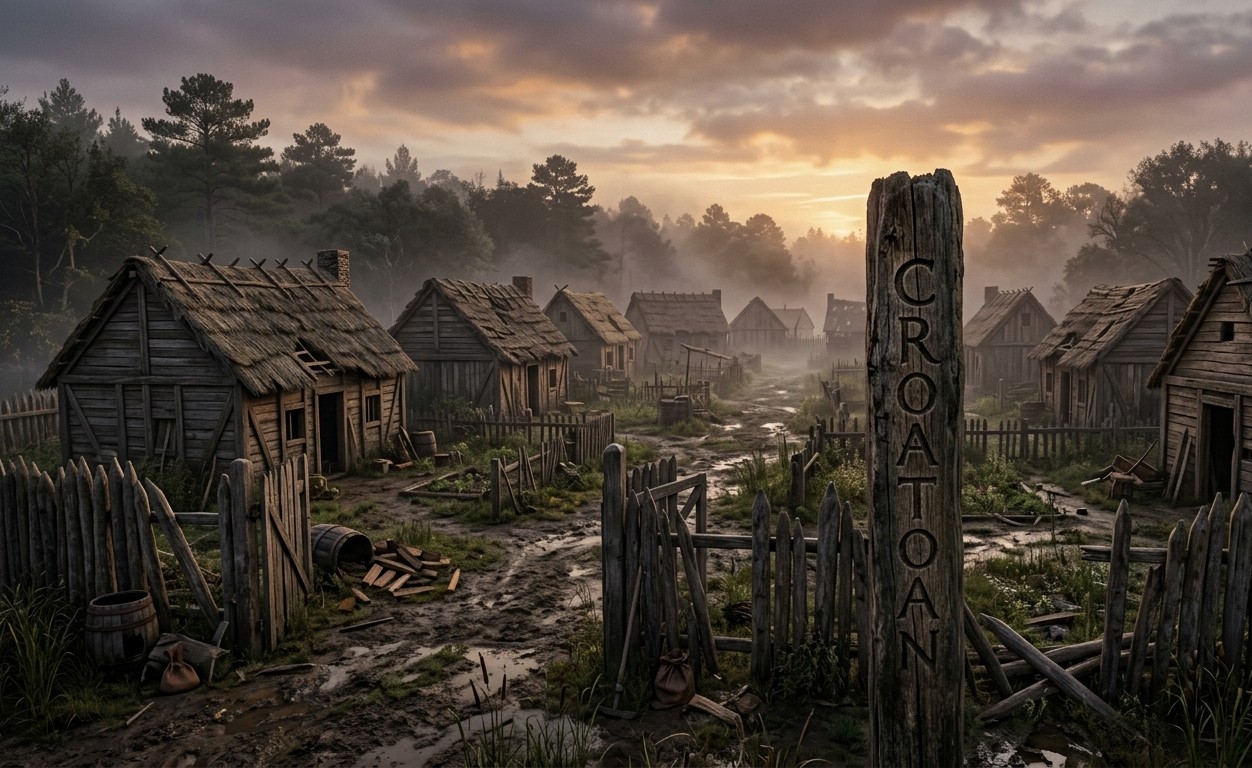
Introduction
Imagine sailing across the Atlantic Ocean in the late 1500s to build a brand-new life in the Roanoke Colony.After months at sea, you finally reach the coast of North America. You build houses, plant crops, and hope to create England’s first permanent colony in the New World.
Then, one day, every single person disappears.
No bodies.
No signs of a battle.
No letters explaining what happened.
Only one mysterious word carved into a wooden post.
“CROATOAN.”
This is the story of the Roanoke Colony, one of the greatest unsolved mysteries in American history. More than 400 years ago, over one hundred men, women, and children vanished without leaving a clear trace behind. Despite centuries of investigations, historians still cannot say with certainty what happened to them.
Some believe the settlers were attacked by Native American tribes. Others think they joined a nearby community to survive. There are even theories suggesting disease, starvation, or secret evacuations. Yet none of these ideas has ever been proven.
So what really happened to the people of the Roanoke Colony?
Did they die, move away, or simply disappear into history?
Let’s uncover the fascinating mystery behind America’s Lost Colony.
The Discovery of the Roanoke Colony
The story of the Roanoke Colony begins during a time when European countries were racing to explore and settle the New World. England wanted to establish its own colonies in North America, hoping to gain wealth, expand its influence, and compete with powerful nations like Spain and Portugal.
In 1587, an English governor named John White led a group of 115 settlers to Roanoke Island, located along the coast of present-day North Carolina. Unlike earlier expeditions, this group included not only soldiers but also families, women, and children. They weren’t coming to explore for a few weeks—they planned to build a permanent home.
At first, everything seemed hopeful. The settlers began building houses, planting crops, and preparing for a new life. Soon after arriving, John White’s daughter gave birth to a baby girl named Virginia Dare, who became the first English child born in North America. It was a proud moment for the young colony and a sign that they believed their future was secure.
But the settlement quickly faced serious problems. Food supplies were running low, and the colonists needed more tools, medicine, and support from England. The settlers asked John White to sail back home and bring back the supplies they desperately needed. Although he didn’t want to leave his family behind, he agreed, believing he would return within a few months.
Things didn’t go as planned.
A war between England and Spain delayed his journey. English ships were needed for the famous battle against the Spanish Armada, making it impossible for White to return to Roanoke as quickly as he had hoped. Instead of a few months, he was forced to stay away for three long years.
When John White finally returned to Roanoke Island in 1590, he expected to see the colony waiting for him.
Instead, he found something no one could explain.
The entire settlement had disappeared.
The Colony That Vanished Without a Trace
When John White finally returned to Roanoke Island in 1590, he expected to reunite with his family and the other settlers. Instead, he was met with complete silence. The houses where people had once lived were empty, and the settlement showed no sign of life. It was as if everyone had simply vanished.
Surprisingly, there were no signs of violence. White didn’t find any bodies, burned buildings, or broken weapons that would suggest the colony had been attacked. Most of the houses had been carefully taken apart rather than destroyed, making it seem as though the settlers had left the island on purpose.
Then he noticed something strange.
The word “CROATOAN” had been carved into a wooden fence surrounding the settlement. Nearby, the letters “CRO” were carved into a tree. Before leaving England, White and the settlers had agreed on a simple plan. If they ever had to leave the colony, they would carve the name of the place where they were going. If they were forced to leave because of danger, they would also carve a Maltese cross beside the message.
There was no cross.
That small detail gave White hope. He believed the settlers had left willingly and had moved to Croatoan Island, now known as Hatteras Island, where a friendly Native American tribe lived. Unfortunately, bad weather and rough seas prevented him from sailing there. With no other choice, he returned to England without finding his family.
But what really happened to the settlers?
Did they safely reach Croatoan Island?
Or was the mysterious message hiding a much darker truth?
For more than 400 years, historians have searched for the answer, but the fate of the Roanoke Colony remains one of history’s greatest unsolved mysteries.
What Really Happened to the Roanoke Colony?
For more than four centuries, historians have tried to answer one simple question:
What happened to the people of the Roanoke Colony?
The truth is, no one knows for certain. Because no clear evidence was left behind, several different theories have been suggested over the years. Some sound very reasonable, while others remain highly controversial.
The most widely accepted theory is that the settlers joined the Croatoan tribe. The Native Americans living on nearby Croatoan Island had friendly relations with the English before John White left. Without enough food and supplies, the colonists may have decided that living with the local tribe was their best chance of survival. Some archaeological discoveries, including English-style tools found on Hatteras Island, have given limited support to this idea, although they do not provide a final answer.
Another theory suggests that the settlers were killed by hostile tribes. Life in the New World was dangerous, and conflicts between European settlers and Native American groups were becoming more common. However, historians point out that no signs of a large battle were found when White returned. There were no burned buildings, scattered weapons, or human remains that would normally be expected after such an attack.
Some researchers believe the colony simply couldn’t survive. Food shortages, disease, harsh weather, and isolation may have forced the settlers to leave Roanoke in search of a safer place. During that journey, they could have died from starvation or illness, leaving little evidence behind after hundreds of years.
There are also more unusual theories. Some people believe the settlers were captured by the Spanish, while others have even suggested supernatural explanations. These ideas often appear in books and television shows, but historians say there is no reliable evidence to support them.
So which theory is correct?
At the moment, none of them can be proven. Every explanation answers some questions while creating new ones. That uncertainty is exactly why the Roanoke Colony remains one of the greatest mysteries in American history.
What Do Historians Really Think Happened?
After more than 400 years of research, historians still cannot say exactly what happened to the Roanoke Colony. However, most experts agree on one thing: the settlers probably did not disappear overnight. Instead, they believe the colony slowly came to an end because of difficult living conditions and a lack of support from England.
Many historians think the strongest theory is that the colonists moved to Croatoan Island and lived alongside the Native American community there. This idea fits with the message carved into the wooden post and explains why there were no signs of violence at the settlement. Some archaeological discoveries, including European-style tools and objects found on Hatteras Island, have added support to this theory. Still, none of these discoveries provide enough evidence to prove it beyond doubt.
Other researchers believe the settlers split into smaller groups after leaving Roanoke. Some may have joined friendly tribes, while others may have tried to travel farther inland in search of food and safer land. If this happened, it would explain why historians have never found one large settlement or burial site connected to the missing colony.
One thing historians are careful about is separating facts from legends. Over the years, countless stories have claimed to solve the mystery, but many of them are based on speculation rather than evidence. Without written records or clear archaeological proof, it is impossible to know exactly which theory is correct.
So will we ever know the truth?
Maybe.
Every year, archaeologists continue to study old documents and search new excavation sites. Modern technology has already helped researchers discover clues that were impossible to find just a few decades ago. While the complete answer remains unknown, many experts believe that future discoveries could finally reveal what happened to the people of the Roanoke Colony.
Lessons From the Roanoke Colony
The mystery of the Roanoke Colony has remained unsolved for more than four centuries, but it still teaches us several important lessons about history and human survival. Even though we may never know exactly what happened, the story continues to remind us that the past is often more complicated than we imagine.
One of the biggest lessons is that history doesn’t always provide clear answers. Not every mystery can be solved with a single discovery. Sometimes important evidence is lost forever, leaving historians to piece together the past using only a few surviving clues. The Roanoke Colony is a perfect example of how one missing piece of evidence can keep a mystery alive for hundreds of years.
The story also shows how difficult life was for the first European settlers in North America. They faced food shortages, unfamiliar weather, disease, and isolation. Without regular supplies from England, simply surviving became a daily challenge. Building a new colony was far more dangerous than many people expected.
Another lesson is the importance of keeping an open mind. Over the years, people have suggested countless explanations for the disappearance of the Roanoke settlers. Some theories are supported by historical evidence, while others are based only on speculation. Good historians examine every possibility carefully but rely on facts before reaching conclusions.
So why does the Roanoke Colony still matter today?
Because it reminds us that some of history’s greatest mysteries are still waiting to be solved. Every new archaeological discovery, historical document, or scientific breakthrough has the potential to bring us one step closer to the truth. Until then, the Roanoke Colony will remain one of the world’s most fascinating unsolved mysteries, continuing to inspire researchers and curious minds alike.
Conclusion
More than 400 years have passed since the settlers of the Roanoke Colony disappeared, yet their fate remains one of history’s greatest unsolved mysteries. What began as England’s first attempt to build a permanent settlement in North America ended with an empty village, abandoned homes, and a single mysterious word carved into wood.
Over the centuries, historians have suggested many explanations. Some believe the settlers joined the Croatoan tribe and started a new life. Others think they died from disease, starvation, or conflict before anyone could rescue them. There are also theories that they moved farther inland in search of safety. While each idea is possible, none has been proven beyond doubt.
So what really happened to the Lost Colony?
The honest answer is that we still don’t know.
Even today, archaeologists continue to search for new clues. Every excavation, historical document, and scientific study brings us a little closer to understanding what happened. Although the complete story may never be uncovered, the search itself has become part of the mystery.
The Roanoke Colony reminds us that history is full of unanswered questions. Sometimes the most fascinating stories are the ones without a clear ending. Until stronger evidence is discovered, the fate of the Lost Colony will continue to inspire historians, researchers, and curious readers around the world.
Perhaps one day, a single discovery will finally reveal the truth.
Until then, the mystery of the Roanoke Colony lives on.
[…] admin Aug 5, 2026 […]