
 By admin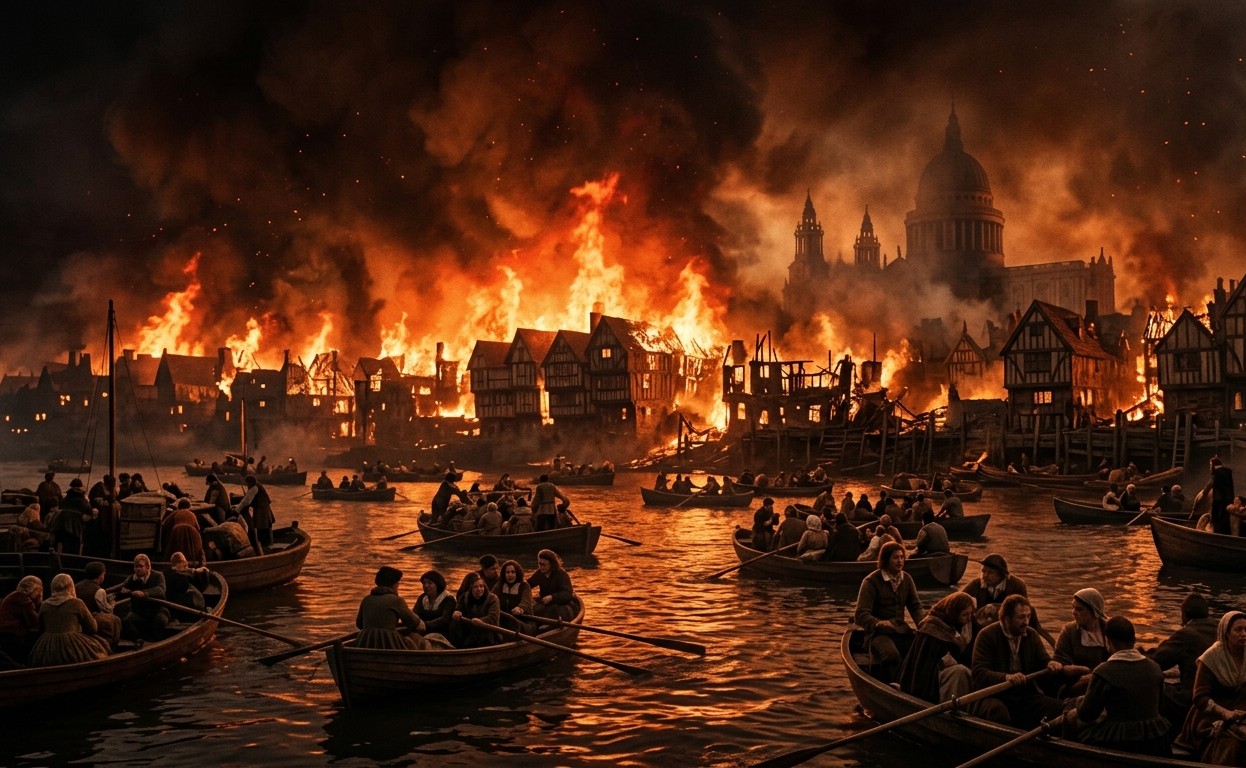
Introduction
Imagine waking up in the middle of the night to the smell of smoke. Within hours, flames spread through narrow streets, wooden houses collapsed, and thousands of people fled with only what they could carry. This nightmare became a reality in London in 1666, when one of the most devastating urban fires in history destroyed the heart of the city.
Known as The Great Fire of London, the disaster lasted for four days, reducing much of medieval London to ashes. More than 13,000 houses, 87 churches, and countless businesses were destroyed. Although the fire caused enormous destruction, it also transformed London forever, leading to safer building methods, wider streets, and a modern city plan.
But how did such a massive fire begin?
Was it an accident, or could it have been prevented?
And how did London rise from the ashes to become one of the world’s greatest cities?
Let’s uncover the remarkable story of The Great Fire of London.
London Before the Great Fire
Before the Great Fire of London, the city was one of the largest and busiest trading centers in Europe. By the 1660s, more than 350,000 people lived within and around London, making it crowded, noisy, and difficult to manage.
Most buildings were made of wood, with roofs covered in straw or wooden shingles. The houses stood very close together, and the streets were narrow and winding. In some places, the upper floors of buildings almost touched each other, making it easy for a fire to spread from one house to the next.
The danger was made even worse by the presence of bakeries, blacksmith shops, candle makers, and warehouses filled with flammable materials such as timber, coal, oil, and cloth. A single spark could quickly grow into a deadly blaze.
Just one year before the disaster, London had already suffered from another tragedy—the Great Plague of 1665, which claimed thousands of lives. Although the city was slowly recovering, its overcrowded streets and unsafe wooden buildings remained a serious risk.
These conditions created the perfect environment for a disaster. All London needed was one small spark—and that spark would soon change the city’s history forever.
How Did the Great Fire of London Begin?
The Great Fire of London began in the early hours of 2 September 1666 in a small bakery on Pudding Lane. The bakery belonged to Thomas Farriner, who supplied bread to the royal household.
According to historical records, a fire was accidentally left burning in one of the bakery’s ovens. During the night, the flames spread to nearby wooden furniture and quickly grew out of control. Within a short time, the entire building was on fire.
Strong easterly winds made the situation much worse. The flames jumped from one wooden house to another, and because the buildings were packed closely together, the fire spread at an incredible speed.
At first, many people believed the fire could be contained. However, city officials hesitated to pull down nearby houses to create firebreaks—a common method used to stop fires from spreading. This delay allowed the flames to grow into a massive disaster.
As the sun rose over London, the fire had already begun racing through the city. Thousands of frightened residents fled their homes, carrying whatever belongings they could save, while the growing inferno threatened to destroy the heart of London.
How Did the Fire Spread So Quickly?
Once the Great Fire of London began, it spread with incredible speed. Several factors combined to turn a small bakery fire into one of the worst disasters in England’s history.
The biggest reason was the city’s construction. Most houses were built from dry timber, and many roofs were covered with highly flammable materials. Since the buildings stood close together, flames easily jumped from one rooftop to another.
The weather also played a major role. A strong easterly wind pushed the fire across the city, carrying burning embers through the air. These embers landed on nearby buildings, starting new fires far ahead of the main blaze.
London’s narrow streets made it difficult for firefighters to reach the burning areas. At that time, there was no professional fire brigade. People relied on simple tools such as buckets of water, hand pumps, and fire hooks, which were far too weak to stop such a powerful fire.
As warehouses filled with oil, coal, wood, wine, and other flammable goods caught fire, the flames became even more intense. Explosions and collapsing buildings forced many people to abandon their homes and flee for safety.
Within just a few days, the Great Fire of London had spread across much of the city, leaving behind destruction on a scale that London had never experienced before.
The Destruction of London
The Great Fire of London continued to burn for four days, leaving a path of destruction across the city. By the time the flames were finally brought under control, much of medieval London had been reduced to ashes.
The fire destroyed more than 13,000 houses, leaving around 70,000 people homeless. Entire neighborhoods disappeared, and families lost their homes, businesses, and belongings in a matter of hours.
Many of London’s most important buildings were also destroyed. Among them was the famous Old St. Paul’s Cathedral, one of the city’s greatest landmarks. The cathedral had stood for centuries, but the intense heat caused its roof to collapse, leaving only ruins behind.
In total, the fire destroyed 87 parish churches, dozens of public buildings, markets, inns, and warehouses. Streets that had once been crowded with people and merchants were transformed into blackened ruins covered in smoke and ash.
Surprisingly, official records reported only a few deaths. However, many historians believe the actual number was likely much higher, as the deaths of poor people were often not recorded, and the intense fire may have completely destroyed many bodies.
Although the destruction was devastating, the disaster also marked the beginning of a new chapter in London’s history. The city would soon be rebuilt stronger, safer, and better planned than ever before.
How Was the Great Fire Finally Stopped?
After four days of destruction, the Great Fire of London was finally brought under control on 6 September 1666. By then, thousands of buildings had already been destroyed, and much of the city lay in ruins.
The turning point came when King Charles II and his brother, James, Duke of York, took direct control of the rescue efforts. They organized workers and soldiers to fight the fire more effectively and encouraged people to act quickly.
The most successful strategy was creating firebreaks. Workers used gunpowder to demolish rows of houses ahead of the advancing flames. By removing buildings in the fire’s path, they created empty spaces that prevented the fire from spreading any farther.
Fortunately, the strong winds that had fueled the disaster also began to weaken. With fewer buildings left to burn and the firebreaks slowing its progress, the flames gradually died out.
Although the city had suffered enormous damage, the fire was finally over.
In the weeks that followed, London faced the difficult challenge of rebuilding. Thousands of people had lost their homes, businesses had been destroyed, and many of the city’s most famous landmarks had disappeared. Yet from these ashes, a new and stronger London would begin to emerge.
How London Was Rebuilt
Although the Great Fire of London caused unimaginable destruction, it also gave the city an opportunity to rebuild in a safer and more modern way.
Soon after the fire ended, King Charles II ordered the reconstruction of London. Architects, engineers, and city officials worked together to create new plans that would reduce the risk of another devastating fire.
One of the biggest changes was the use of brick and stone instead of wood. New laws banned the construction of wooden houses in the city center, making buildings far more resistant to fire.
The streets were also redesigned. Many narrow medieval lanes were widened to improve movement and make it easier to control future fires. Better building regulations were introduced, and houses were constructed with greater spacing between them.
One of the most famous rebuilding projects was St. Paul’s Cathedral. The old cathedral had been completely destroyed during the fire, so a magnificent new cathedral was designed by the renowned architect Sir Christopher Wren. Today, it remains one of London’s most iconic landmarks.
The rebuilding process took many years, but it transformed London into a stronger, safer, and more organized city. In many ways, the Great Fire of London became a turning point that shaped the future of one of the world’s greatest capitals.
Interesting Facts About the Great Fire of London
Even though the Great Fire of London happened more than 350 years ago, it is still remembered as one of the most fascinating events in British history. Here are some surprising facts about the disaster:
- The fire lasted for four days, from 2 September to 6 September 1666, before it was finally brought under control.
- More than 13,000 houses, 87 parish churches, and many important public buildings were destroyed.
- Around 70,000 people lost their homes, leaving thousands of families without shelter.
- The famous Old St. Paul’s Cathedral was completely destroyed. It was later replaced by the magnificent cathedral designed by Sir Christopher Wren, which still stands today.
- Although official records reported only a few deaths, many historians believe the real number was much higher because the deaths of poor people were often not recorded.
- The fire accidentally helped stop the Great Plague, which had devastated London the previous year. By destroying many overcrowded neighborhoods and the rats that carried disease-carrying fleas, the fire may have reduced the spread of the plague.
- Today, a landmark called The Monument to the Great Fire of London stands near the place where the fire began on Pudding Lane. It serves as a reminder of both the tragedy and London’s remarkable recovery.
The Great Fire of London was one of the city’s darkest moments, but it also marked the beginning of a safer and more modern London, proving that even the greatest disasters can lead to lasting change.
Conclusion
The Great Fire of London was one of the most devastating disasters in British history. What began as a small fire in a bakery on Pudding Lane quickly grew into an unstoppable inferno that destroyed much of medieval London.
More than 13,000 homes, 87 churches, and many important buildings were reduced to ashes, leaving thousands of people homeless. Yet, despite the enormous destruction, the tragedy became a turning point in the city’s history.
The disaster led to stronger building regulations, wider streets, and the use of brick and stone instead of wood. These changes made London safer and helped shape the modern city we know today.
More than 350 years later, the Great Fire of London is remembered not only for its destruction but also for the remarkable recovery that followed. It stands as a powerful reminder that even after great disasters, determination and innovation can help rebuild a stronger future.
Today, the story of the Great Fire of London continues to inspire historians and visitors from around the world, proving that some of history’s greatest lessons are born from its greatest tragedies.
[…] of ancient Egypt were covered with mysterious symbols that no one could fully understand. The beautiful Egyptian hieroglyphs had once been used to record the stories, beliefs, and achievements of one of […]