
 By admin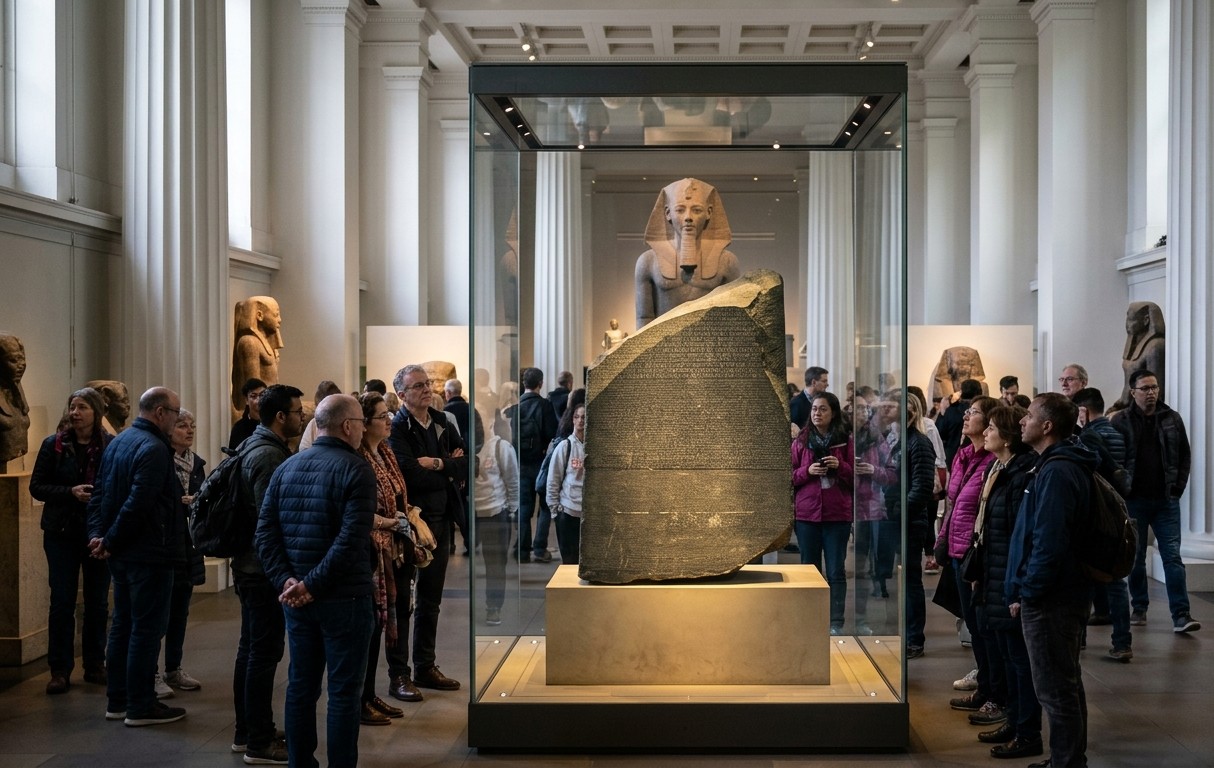
Introduction
For thousands of years, the walls and monuments of ancient Egypt were covered with mysterious symbols that no one could fully understand. The beautiful Egyptian hieroglyphs had once been used to record the stories, beliefs, and achievements of one of the world’s greatest civilizations—but eventually, their meaning was lost.
Then, in 1799, an ordinary-looking stone was discovered near the Egyptian town of Rosetta.
What made this stone extraordinary was not its appearance, but the writing carved into its surface. The same decree appeared in three different scripts: Egyptian hieroglyphs, Demotic, and Ancient Greek.
This discovery gave scholars something they had been missing for centuries—a way to compare a known language with the mysterious Egyptian scripts.
The stone eventually became known as the Rosetta Stone, and its discovery helped unlock the secrets of ancient Egyptian writing. It opened the door to thousands of years of Egyptian history that had been hidden behind undeciphered symbols.
But how was the stone discovered?
Who finally cracked the code?
And how did a single piece of rock change our understanding of ancient Egypt forever?
To answer these questions, we need to go back to the moment when the mysterious stone first appeared.
The Discovery of the Rosetta Stone
The story of the Rosetta Stone began in 1799, during Napoleon Bonaparte’s campaign in Egypt. French soldiers were working near the town of Rosetta (Rashid) when they discovered a large, dark stone buried near an old fort.
The stone did not look particularly impressive. But when the soldiers noticed that its surface was covered with different forms of writing, they realized that they had found something unusual.
The stone contained a decree issued during the reign of King Ptolemy V in 196 BCE. Most importantly, the same decree had been written in three scripts: Egyptian hieroglyphs, Demotic, and Ancient Greek.
This was an extraordinary discovery. Ancient Greek was already understood by scholars, while Egyptian hieroglyphs had remained largely undeciphered for centuries.
Scholars quickly realized that the three sections might contain the same message. If they could compare the known Greek text with the mysterious Egyptian scripts, they might finally discover how to read the language of ancient Egypt.
The discovery therefore became much more than an archaeological find. It was the beginning of a race among scholars to unlock one of history’s greatest linguistic mysteries.
And the person who eventually made the breakthrough would change the study of ancient Egypt forever.
The Three Scripts on the Rosetta Stone
The real importance of the Rosetta Stone came from the three different scripts carved into its surface. Although they looked completely different, they represented the same official decree issued in 196 BCE during the reign of Ptolemy V.
The first section was written in Egyptian hieroglyphs, the formal script traditionally used for religious and important inscriptions. The second used Demotic, a more everyday form of written Egyptian that was widely used for administrative and legal documents. The third was written in Ancient Greek, the language of the ruling elite during the Ptolemaic period.
This combination was incredibly valuable to scholars.
They already understood Ancient Greek, so the Greek section provided a key for comparing words, names, and phrases with the Egyptian scripts. Researchers could examine the same parts of the decree in different languages and look for patterns.
However, deciphering the hieroglyphs was not as simple as translating the Greek text word by word. Egyptian writing was much more complicated than many scholars initially realized. The symbols could represent sounds, individual words, or ideas, depending on how they were used.
The Rosetta Stone therefore became a linguistic puzzle.
For years, scholars studied its inscriptions and searched for clues. Eventually, their work would lead to one of the most important breakthroughs in the history of archaeology—the decipherment of Egyptian hieroglyphs.
The Race to Decipher the Hieroglyphs
After the discovery of the Rosetta Stone, scholars across Europe realized that they might finally have a way to understand ancient Egyptian writing. But turning that hope into reality was far from easy.
The biggest challenge was understanding how hieroglyphs actually worked. For centuries, many European scholars believed that the symbols represented only ideas or objects. Researchers gradually discovered that some hieroglyphs could also represent sounds, making the writing system far more complex than it first appeared.
One important clue came from studying royal names. Scholars noticed that certain groups of hieroglyphs were enclosed in oval-shaped borders known as cartouches. These were believed to contain the names of rulers.
Researchers compared these names with the Greek versions found on the Rosetta Stone and other inscriptions. This allowed them to identify possible sounds and gradually build a better understanding of the ancient Egyptian writing system.
Several scholars contributed to this long process, including Thomas Young, an English scientist who made important progress in understanding the script.
But the final breakthrough would come from a young French scholar named Jean-François Champollion.
By combining evidence from the Rosetta Stone with other Egyptian inscriptions, Champollion finally demonstrated that hieroglyphs could represent both sounds and meanings. His breakthrough in 1822 opened the door to reading thousands of previously mysterious Egyptian inscriptions.
The ancient language that had been silent for centuries was finally beginning to speak again.
Jean-François Champollion Cracks the Code
The breakthrough in deciphering Egyptian hieroglyphs came from Jean-François Champollion, a French scholar who had been fascinated by ancient Egypt from a young age.
Champollion studied the Rosetta Stone alongside other Egyptian inscriptions and carefully compared the different scripts. One of his most important discoveries was that hieroglyphs were not simply pictures representing objects or ideas. Many of them could also represent sounds.
A major clue came from the names of Ptolemy and Cleopatra, which appeared in Egyptian inscriptions and could be compared with their known Greek forms. By identifying the sounds represented by individual hieroglyphs, Champollion was able to make significant progress in understanding the ancient Egyptian writing system.
In 1822, Champollion announced his breakthrough. His work demonstrated that Egyptian hieroglyphic writing combined phonetic signs and symbols representing words or concepts.
This was a turning point in Egyptology.
For the first time in centuries, scholars could begin reading the inscriptions carved into Egyptian temples, tombs, statues, and monuments. Names of pharaohs could be identified, religious texts could be translated, and historical events could be reconstructed from the Egyptians’ own written records.
The Rosetta Stone had not literally contained a secret code. Instead, it had provided the crucial comparison that helped scholars understand a writing system whose meaning had been lost for more than a thousand years.
How the Rosetta Stone Changed Our Understanding of Ancient Egypt
The decipherment of the Rosetta Stone changed the study of ancient Egypt forever. Once scholars began to understand hieroglyphs, thousands of previously mysterious inscriptions could finally be read and interpreted.
Researchers could now study the words written by the ancient Egyptians themselves rather than relying only on later Greek and Roman accounts. Tomb inscriptions revealed information about pharaohs, religious beliefs, funerary traditions, and Egyptian society.
Hieroglyphs found on temples and monuments also helped historians understand important events and identify rulers whose names had been unknown or misunderstood for centuries.
The breakthrough also made it possible to translate ancient Egyptian religious and literary texts. Scholars gained a much deeper understanding of Egyptian mythology, gods, ceremonies, and beliefs about death and the afterlife.
Perhaps most importantly, the Rosetta Stone helped turn Egyptology into a more systematic academic field. Archaeologists and historians could combine physical discoveries with written evidence to reconstruct the lives and history of ancient Egyptians.
A single stone could not tell the entire story of Egypt. But by helping unlock its writing system, it gave historians access to a vast collection of voices that had been silent for centuries.
Where Is the Rosetta Stone Today?
The Rosetta Stone has traveled far from the place where it was discovered in Egypt. After the French were defeated by British and Ottoman forces in Egypt, the stone came into British possession in 1801.
It was transported to Britain and eventually became part of the collection of the British Museum in London. It has been displayed there since 1802, where it became one of the museum’s most famous objects.
Today, millions of people recognize the Rosetta Stone as a symbol of archaeological discovery and the decipherment of ancient languages. Visitors can see the original stone and examine the inscriptions that helped scholars unlock Egyptian hieroglyphs.
The stone itself is not complete. Parts of the original slab are missing, and some of the inscriptions have been damaged. Nevertheless, enough of the three texts survived to make the stone enormously valuable to scholars.
Although the Rosetta Stone is now preserved in London, its story remains deeply connected to Egyptian history and heritage. It continues to represent one of the most important breakthroughs in our understanding of the ancient world.
The Legacy of the Rosetta Stone
The discovery and decipherment of the Rosetta Stone had an impact far beyond the stone itself. It opened the door to a vast collection of ancient Egyptian texts that had remained unread for centuries.
Once scholars could understand hieroglyphs, they were able to read inscriptions on temples, tombs, statues, and monuments across Egypt. These writings revealed details about Egyptian kings, religious beliefs, government, wars, traditions, and everyday life.
The breakthrough also helped historians connect archaeological discoveries with written evidence. Instead of simply looking at ancient buildings and objects, researchers could now understand the words and stories created by the people who had lived among them.
The Rosetta Stone therefore became much more than an ancient artifact. It became a symbol of discovery, language, and the recovery of lost knowledge.
Its story also demonstrates how a relatively small archaeological discovery can transform our understanding of an entire civilization. Without the Rosetta Stone and the scholars who studied it, many secrets of ancient Egypt might have remained hidden for much longer.
Today, the stone continues to represent the moment when the silent writings of ancient Egypt began to speak again.
The Rosetta Stone: A Symbol of Lost Knowledge
The story of the Rosetta Stone is more than the story of an ancient piece of rock. It is the story of how humanity recovered a lost language and gained a deeper connection to one of the world’s oldest civilizations.
Before the stone was deciphered, countless Egyptian inscriptions remained mysterious. Beautiful symbols covered temples, tombs, statues, and monuments, but their meanings were largely inaccessible to scholars.
The work of Jean-François Champollion and other researchers changed that. By understanding the relationship between hieroglyphs and other forms of Egyptian writing, they opened the way for generations of historians and archaeologists to study ancient Egypt in far greater detail.
Today, the Rosetta Stone represents the power of curiosity, persistence, and careful scholarship. Its discovery reminds us that even a seemingly ordinary object can hold the key to an extraordinary historical mystery.
More than two centuries after its discovery, the Rosetta Stone remains one of the world’s most recognizable archaeological artifacts—and a powerful symbol of humanity’s ability to recover knowledge that seemed lost forever.
Conclusion
The Rosetta Stone changed history by helping scholars unlock the mysterious writing system of ancient Egypt. Discovered in 1799, the stone contained the same decree in Egyptian hieroglyphs, Demotic, and Ancient Greek, giving researchers the crucial comparison they needed.
Years of research eventually led Jean-François Champollion to his breakthrough in 1822. His work allowed scholars to begin reading ancient Egyptian inscriptions and uncovering the stories, beliefs, and achievements of a civilization that had remained partly silent for centuries.
Today, the Rosetta Stone stands as a powerful symbol of discovery and lost knowledge recovered. One ancient stone helped open the door to thousands of years of Egyptian history—and changed the way the modern world understands ancient Egypt.
[…] The Rosetta Stone: The Key That Unlocked Ancient Egypt […]